
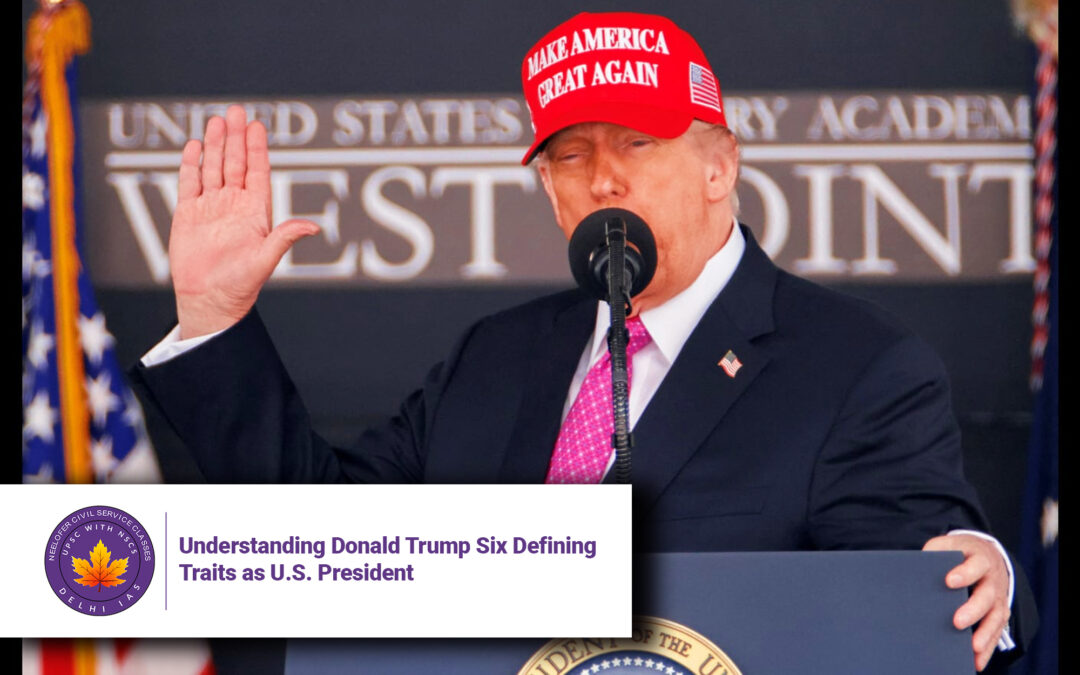
Understanding Donald Trump Six Defining Traits as U.S. President
Why in News?
With Donald Trump preparing for another potential run at the U.S. presidency, political observers and global analysts have revisited the key features that defined his leadership style during his term in office. Political commentator Prashant Jha recently outlined six core traits that characterized Trump’s approach to governance, foreign policy, and public leadership. These traits offer valuable insight into how Trump made decisions and approached both allies and adversaries, including countries like India, China, and Ukraine.
Introduction
Donald Trump’s presidency marked a significant shift in global and domestic politics. Known for his unconventional, aggressive, and sometimes unpredictable methods, Trump established a new model of leadership that deviated from traditional U.S. diplomatic practices. His approach was deeply personal, transactional, and often ideological—reshaping America’s role in the international arena.
The Six Defining Traits of Donald Trump as U.S. President
-
Bilateralism Over Multilateralism
Trump was a strong bilateralist who dismissed the importance of multilateral engagements. He valued each country on its individual merits, rather than as part of broader global coalitions. This attitude shaped his dealings with nations like India, China, and Ukraine—focused on what each nation could offer directly to the U.S. -
Transactional and Extractive Approach
Trump treated international relations as business deals. He prioritized what America could gain materially from any agreement, such as trade advantages, energy security, or arms sales, often demanding significant concessions from partners. -
Ideological Pillars and Nationalism
Trump’s presidency was rooted in a populist, nationalist ideology. He pushed a domestic agenda that was suspicious of immigration, skeptical of foreign influence, and focused on reviving American manufacturing. His policies often involved rolling back protections for minorities, climate action, and international cooperation. -
Pragmatism and Opportunism
While ideologically driven, Trump showed a high level of political flexibility. He often shifted his stance if it served his interests. This trait allowed him to keep opponents off-balance and enabled unexpected alliances or policy decisions. -
Unique Relationship with Money and Power
Trump’s worldview was shaped by his long-standing background in business and wealth. His decisions often involved personal economic calculations—such as lucrative real estate deals, family business involvement, or aligning with emerging tech and crypto firms. -
All-Powerful Presidential Persona
Trump’s final and most prominent trait was his pursuit of absolute authority. Whether through executive orders, challenges to institutions, or attempts to override election outcomes, Trump positioned himself as the singular, dominant force in U.S. politics.
Global Implications
Trump’s traits impacted not just the U.S., but the global order. His treatment of countries like India was based purely on what the U.S. could gain at the moment. His relationship with China was transactional and centered around trade and security. He viewed Ukraine not from a security perspective but in terms of what resources or strategic value it could provide. These approaches signaled a shift in American diplomacy from ideological leadership to transactional supremacy.
Conclusion
Donald Trump’s six leadership traits—bilateralism, extraction, ideology, pragmatism, financial obsession, and a pursuit of absolute power—continue to influence American politics and global relations. As Trump eyes a return to the White House, understanding these traits is crucial for anticipating his future actions and their implications for the world.
Q&A Section
1. What does it mean that Trump is a “bilateralist”?
It means he preferred one-on-one relations with countries, focusing on direct benefits for the U.S., rather than engaging in multilateral or global cooperation frameworks.
2. How did Trump view relationships with countries like India and China?
Trump assessed countries based on what they could offer the U.S. immediately—trade, security deals, or economic investments—without long-term strategic vision.
3. In what ways was Trump ideological?
His ideology was rooted in nationalism, skepticism of immigration, rollback of social protections, and resistance to global institutions or climate agreements.
4. How did Trump mix money with politics?
He often aligned policies with personal or business interests, supported deregulation that favored the rich, and sometimes involved his own family or associates in deals.
5. What makes Trump’s leadership style unique and controversial?
Trump presented himself as the ultimate authority figure, often bypassing traditional institutions, pushing executive orders, and challenging the outcome of democratic processes.

