
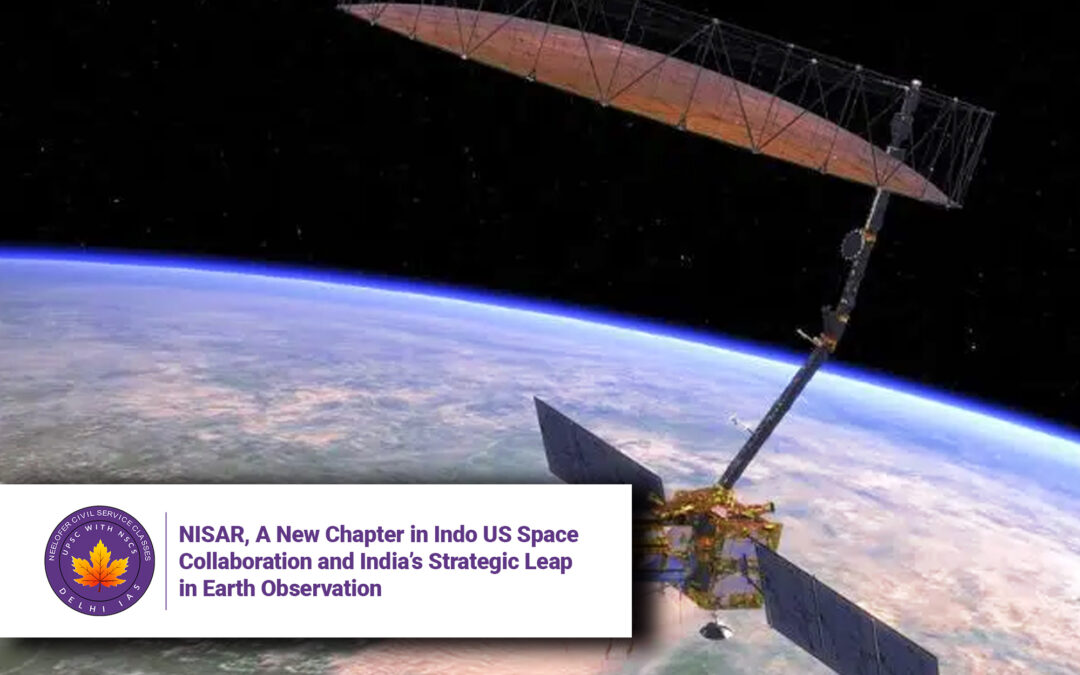
NISAR, A New Chapter in Indo US Space Collaboration and India’s Strategic Leap in Earth Observation
Introduction
India’s journey in space exploration has been marked by frugal innovation, strategic thinking, and international collaboration. One of the most significant milestones in recent years is the collaborative satellite mission between NASA (National Aeronautics and Space Administration) and ISRO (Indian Space Research Organisation) — the NASA-ISRO Synthetic Aperture Radar (NISAR). As it prepares for its launch aboard India’s GSLV-F16 rocket, NISAR stands as a remarkable example of global cooperation in space science, particularly in the realm of Earth observation. 
The satellite is the product of years of coordination between two of the world’s most respected space agencies. Not only will it be the first radar satellite to use dual-frequency radar (L-band and S-band), but it also symbolizes the growing synergy between nations in tackling global environmental challenges. The mission is expected to revolutionize the way we study the Earth, from its ice sheets and land movements to natural disasters and ecosystem changes.
This article delves deep into the NISAR project, its technical and scientific components, geopolitical significance, and how it aligns with India’s strategic focus on near-earth opportunities. It also reflects on the broader trends in international space collaboration, especially against the backdrop of growing competition in outer space.
Wing Commander Shubhanshu Shukla: A Symbolic Return to Global Space Stage
Earlier this month, Wing Commander Shubhanshu Shukla, a distinguished pilot, became only the second Indian to travel to space. He spent 18 days aboard the International Space Station (ISS), piloting the SpaceX Dragon spacecraft as part of the Axiom-4 crew. His journey, although commercial in nature, is symbolically significant for India’s re-entry into the international human spaceflight arena.
Shukla’s mission contributes valuable experience for India’s Gaganyaan program, the country’s first indigenous human spaceflight mission. Having trained at the Yuri Gagarin Cosmonaut Training Centre in Moscow and later at the Johnson Space Center in Houston, Shukla personifies India’s increasing international footprint in space exploration.
Gaganyaan 1 and 2 — unmanned missions — are expected to be launched in 2025 and 2026, followed by the first crewed Gaganyaan 3 mission in 2027. India is steadily laying the groundwork for a sustained human presence in space.
What is NISAR?
NISAR stands for NASA-ISRO Synthetic Aperture Radar. Scheduled to be launched by the end of July 2025, this mission is a bold initiative to scan nearly all of Earth’s land and ice surfaces every 12 days, providing a treasure trove of data on:
-
Climate change
-
Glacier and ice sheet deformation
-
Land subsidence
-
Earthquakes
-
Volcanic activity
-
Natural and man-made ecosystem changes
The dual-band radar system onboard NISAR includes:
-
L-band radar, built by NASA’s Jet Propulsion Laboratory (JPL)
-
S-band radar, developed by ISRO’s Space Applications Centre (SAC) in Ahmedabad
This dual-frequency system is the first of its kind in the world, enabling highly detailed and frequent imaging, making it indispensable for Earth science research, disaster response, and agricultural monitoring.
Satellite Specifications and Launch
Weighing approximately 2400 kilograms, the NISAR satellite has been moved to Sriharikota for final launch preparations. It will be carried into orbit aboard the GSLV-F16, and placed in a 743-km sun-synchronous orbit. This specific orbit allows for consistent lighting conditions for Earth observation, crucial for accurate data capture.
NASA’s contributions to the satellite include:
-
High-rate telecom subsystem for scientific data
-
A solid-state data recorder
-
Payload data subsystem
ISRO is responsible for:
-
The satellite bus
-
Launch vehicle
-
Integration and testing
-
Ground support and data dissemination
Together, these contributions represent a seamless partnership in high-end science and engineering.
Scientific and Environmental Significance
The radar payload on NISAR is capable of detecting deformations in Earth’s crust as small as a few millimeters. This enables it to:
-
Track ice loss in Greenland and Antarctica
-
Observe tectonic plate movements that cause earthquakes
-
Monitor crop productivity and land usage
-
Assess damage post-disaster (floods, landslides)
The satellite’s outputs are expected to benefit:
-
Environmental monitoring agencies
-
Disaster management bodies
-
Agricultural planners
-
Climate researchers
NISAR thus bridges the gap between space technology and real-world applications on Earth.
Geopolitical Relevance and the Artemis Accords
The NISAR mission is not just about scientific collaboration; it also reflects India’s growing alignment with global democratic space partnerships, particularly the Artemis Accords led by the United States. These principles promote peaceful, transparent space exploration.
As of now, over 55 countries have signed the Artemis Accords. This growing coalition is seen as a counterweight to the Chinese and Russian-led International Lunar Research Station (ILRS) and China’s Tiangong space station initiative.
India, while strategically aligning with the Artemis vision, maintains autonomy in its space policy but is clearly leaning toward democratic multilateralism over authoritarian techno-blocs.
India’s Strategic Focus: Near-Earth Wins
India’s space policy has consistently been pragmatic. While ISRO remains ambitious about future interplanetary missions, the focus remains on near-earth applications, where:
-
Returns on investment are high
-
Technological success is achievable
-
Data benefits multiple sectors
NISAR’s role fits perfectly in this model. Unlike deep space missions that demand massive budgets and timelines, Earth observation satellites yield quicker, tangible benefits in:
-
National security
-
Resource management
-
Urban planning
-
Climate risk mitigation
ISRO’s future roadmap includes:
-
Multiple satellites for Earth observation
-
A directional shift toward an Indian Space Station by 2035
-
Expanding the private space sector under the aegis of IN-SPACe
Global Trends in Space Collaboration
While global partnerships like NISAR are inspiring, not all space agencies are collaborative. China’s CNSA, for instance, has built the Tiangong space station with limited international input. Although China proposed ILRS with Russia, most global democratic nations are staying clear.
In contrast, the ISS (International Space Station), despite being nearly 25 years old, remains a beacon of multinational cooperation. Although Russia plans to exit by 2028, it has served as a platform for over 100 nations.
India’s balanced approach—collaborative yet self-reliant—is gaining global appreciation, especially for its cost-effective mission planning, such as:
-
Chandrayaan-3
-
Mangalyaan (Mars Orbiter)
-
Aditya L1 (Solar Mission)
Conclusion
NISAR is a landmark mission that symbolizes scientific excellence, international partnership, and strategic foresight. For India, it represents not only a leap in Earth observation but also a diplomatic statement — a vote of confidence in rules-based, collaborative space exploration.
As India continues to shape its space future, the success of missions like NISAR will serve as a blueprint for high-impact, low-cost, and globally relevant space science.
In the words of cosmologist Stephen Hawking:
“We are just an advanced breed of monkeys on a minor planet of a very average star. But we can understand the Universe. That makes us something very special.”
With missions like NISAR, India and the world are coming together to understand — and perhaps save — that universe.
5 Q&A Based on the Article
Q1: What is NISAR and what makes it unique?
A1: NISAR (NASA-ISRO Synthetic Aperture Radar) is a joint Earth observation satellite mission by NASA and ISRO. It’s the first radar satellite using dual-band synthetic aperture radar (L-band by NASA and S-band by ISRO), capable of scanning nearly all land and ice surfaces every 12 days with unprecedented detail.
Q2: How does NISAR align with India’s strategic space objectives?
A2: NISAR supports India’s strategic focus on near-earth missions, which provide high returns on investment and serve sectors like agriculture, disaster management, and climate monitoring. It aligns with India’s cost-effective, impactful space policy.
Q3: What is the significance of Wing Commander Shubhanshu Shukla’s mission?
A3: Shubhanshu Shukla’s 18-day mission to the ISS via SpaceX Dragon makes him the second Indian in space and contributes critical experience for India’s upcoming human spaceflight program, Gaganyaan.
Q4: How does NISAR contribute to global environmental and scientific research?
A4: NISAR will track changes in Earth’s crust, ice sheets, glaciers, and ecosystems. It helps in climate change studies, disaster prediction, and land-use planning, offering valuable data for global environmental monitoring.
Q5: What does NISAR represent in terms of global space diplomacy?
A5: NISAR represents a successful Indo-US partnership under peaceful space exploration norms like the Artemis Accords. It contrasts with more insular space programs like China’s Tiangong, showing India’s preference for multilateral collaboration.

