
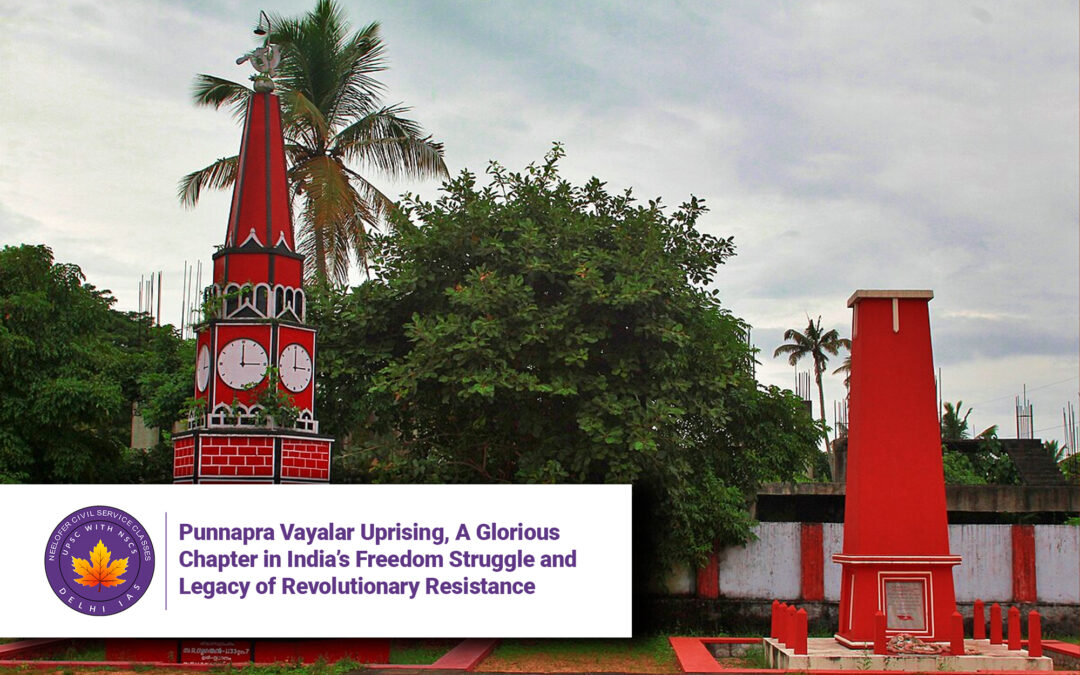
Punnapra Vayalar Uprising, A Glorious Chapter in India’s Freedom Struggle and Legacy of Revolutionary Resistance
Introduction
As India commemorates the life of V.S. Achuthanandan, one of Kerala’s tallest political figures and a product of the Punnapra-Vayalar uprising of 1946, it brings to national attention a forgotten but profoundly significant chapter in India’s freedom struggle. The Punnapra-Vayalar revolt was not just a regional insurrection in the princely state of Travancore but a crucial marker in the resistance against colonialism, feudalism, and capitalism. While mainstream narratives often center around the Indian National Congress and non-violent resistance, the Punnapra-Vayalar uprising stands as a testament to the revolutionary spirit of the working class and the Communist Party of India (CPI). 
This uprising reflected the collective anger and aspirations of a working class betrayed by monarchy and capitalism, crushed by colonial repression, and determined to shape a more just post-Independence India.
Historical Context: The Brewing Storm in Travancore
By 1946, as British colonial rule neared its end, Travancore’s Maharaja secretly prepared to declare independence from India. This move alarmed the Communist Party and the organized working class, who feared a feudal continuation of power and economic subjugation. The princely state of Travancore was one of the most repressive in India at the time. Under the control of autocratic Diwan C.P. Ramaswami Iyer, a political crackdown on trade unions, communists, and peasant activists had intensified.
The CPI, which had formed in Kerala in 1940 with leaders like P. Krishna Pillai, EMS Namboodiripad, and Achuthanandan, began mobilizing working-class resistance. Achuthanandan, who was orphaned young and drawn into trade unionism in 1938, joined the CPI and quickly rose through its ranks due to his unwavering commitment.
The Uprising: Defiance in Punnapra and Vayalar
October 1946 witnessed mass protests in Alleppey and neighboring regions. Communist-led trade unions organized massive demonstrations. The repression was brutal. On October 24, in response to the workers’ general strike and their demand for democratic rights, the Travancore police launched a deadly crackdown.
Villages like Punnapra and Vayalar became battlegrounds. Thousands of workers, peasants, and communists armed with rudimentary weapons confronted a well-equipped army. On October 26, the Travancore army attacked Vayalar with tanks and machine guns. More than 500 workers and peasants were gunned down in what would later be remembered as Kerala’s own Jallianwala Bagh. Those who survived were either tortured or arrested, including a young Achuthanandan who was beaten severely and imprisoned.
Despite being crushed, the uprising echoed across the nation. It symbolized the working class’s resolve to resist authoritarianism and secure democratic rights in an emerging independent India.
Post-Uprising Political Impact and Legacy
Although the rebellion was violently suppressed, its political consequences were far-reaching. The uprising exposed the weaknesses of princely rule and helped generate public pressure for Travancore’s accession to the Indian Union. By 1947, the princely state’s dream of independence had evaporated, and Travancore became part of democratic India.
In the decades that followed, many leaders of the uprising became pillars of democratic politics in Kerala. V.S. Achuthanandan, in particular, emerged as a symbol of integrity and ideological commitment. A lifelong Marxist, he led the Communist movement in Kerala for decades, serving as Chief Minister and becoming one of the most respected political figures in India.
Historiographical Perspective: Communism, Sacrifice, and Resistance
Western historian Jeffrey, who examined British records and Travancore archives, documented the uprising in his work, “India’s Working Class Revolt: Punnapra-Vayalar and the Communist Conspiracy of 1946.” He highlighted the bravery and spontaneity of the workers and peasants, describing the revolt as one of the most dramatic moments in India’s anti-colonial history.
According to Jeffrey, the uprising showed that revolutionary potential in India was not confined to urban centers like Bombay or Calcutta. It was equally strong in “a small provincial town in a remote corner of the south.” His work debunked the myth that Communism in India was merely an elite intellectual exercise and instead emphasized its deep rural roots and mass support.
The CPI had planned to escalate the uprising to a national level. However, due to internal differences and inadequate coordination, the insurrection remained localized. Nonetheless, it proved the potential for an armed working-class revolution and shaped the trajectory of Indian Communism for years.
A Counter-Narrative: Suppression and Demonization
Not surprisingly, official state narratives have often demonized the Punnapra-Vayalar uprising. British and princely state records accused the communists of sedition and terrorism. Inspector General of Police H.E. Keene documented it in his report as a “conspiratorial uprising” and not a democratic movement. Yet, such versions have been challenged by multiple historians and even former government officials, who acknowledged the brutality with which the Travancore state crushed dissent.
The CPI was criticized for arming its cadres, but the party justified this as a response to the Diwan’s violent suppression and unwillingness to allow political freedom.
Role of V.S. Achuthanandan and Other Leaders
Achuthanandan was only 23 during the uprising but left an indelible mark on Kerala’s political history. Arrested and tortured for participating, he never betrayed his comrades nor gave up the struggle. After his release, he continued to fight for workers’ rights, eventually becoming Chief Minister and an icon of clean politics.
Achuthanandan represented the synthesis of revolutionary zeal with democratic engagement. His political journey showed that a revolutionary could transition from street struggles to legislative leadership without compromising ideals.
Other leaders, such as P. Krishna Pillai and EMS Namboodiripad, carried the torch of the uprising into post-Independence politics, helping the Left become a dominant force in Kerala. Their sacrifices and organizational acumen laid the foundation for Kerala’s unique political landscape, where Communism and democracy coexist robustly.
Remembering the Uprising Today
In an era where working-class movements are often sidelined, the Punnapra-Vayalar uprising stands as a powerful reminder of collective action. The uprising was not merely about feudal oppression in Travancore—it was about shaping the future of India itself.
In today’s context, where questions of authoritarianism, labor rights, and economic justice resurface, the uprising offers valuable lessons. It teaches that revolutionary struggle, even when defeated militarily, can win politically by altering the narrative and pressuring regimes to reform.
The resurgence of interest in the uprising, especially in light of Achuthanandan’s passing, presents an opportunity to re-evaluate India’s freedom movement through the lens of class struggle and popular resistance.
Conclusion
The Punnapra-Vayalar uprising is more than just a footnote in Kerala’s political history. It is a shining example of the sacrifices made by ordinary workers and peasants in shaping democratic India. It reaffirms that freedom was not granted but won—by countless acts of courage, often far away from the mainstream limelight.
As India grapples with new challenges, recalling these acts of resistance becomes more important than ever. The story of Punnapra and Vayalar—of blood, struggle, and defiance—should find its rightful place in the national imagination, not merely as history, but as a living legacy.
5 Questions and Answers on the Punnapra-Vayalar Uprising
Q1: What was the Punnapra-Vayalar Uprising and why is it significant?
A1: The Punnapra-Vayalar uprising was a worker-led revolt in Travancore in 1946, organized by the Communist Party of India against the oppressive policies of the princely state. It is significant as it symbolized working-class resistance, influenced Travancore’s merger with India, and left a lasting legacy in Kerala’s political history.
Q2: What triggered the uprising?
A2: The uprising was triggered by growing worker unrest, brutal repression by Diwan C.P. Ramaswami Iyer, and the Maharaja’s plans to declare Travancore independent from India. Workers and communists organized protests, strikes, and eventually armed resistance against the state.
Q3: How was the uprising suppressed?
A3: The Travancore army, with heavy weaponry, brutally suppressed the uprising in October 1946, particularly in Vayalar, where more than 500 workers were killed. Leaders were arrested, tortured, or executed. The repression was widely condemned.
Q4: What was V.S. Achuthanandan’s role in the uprising?
A4: At 23, Achuthanandan was an active participant. He was arrested, tortured, and imprisoned but remained committed to the movement. He later became Kerala’s Chief Minister and a symbol of political integrity and working-class leadership.
Q5: What is the legacy of the Punnapra-Vayalar uprising today?
A5: The uprising remains a symbol of working-class resistance and political courage. It played a key role in shaping Kerala’s leftist political identity and continues to inspire movements for labor rights, justice, and democratic socialism.

