
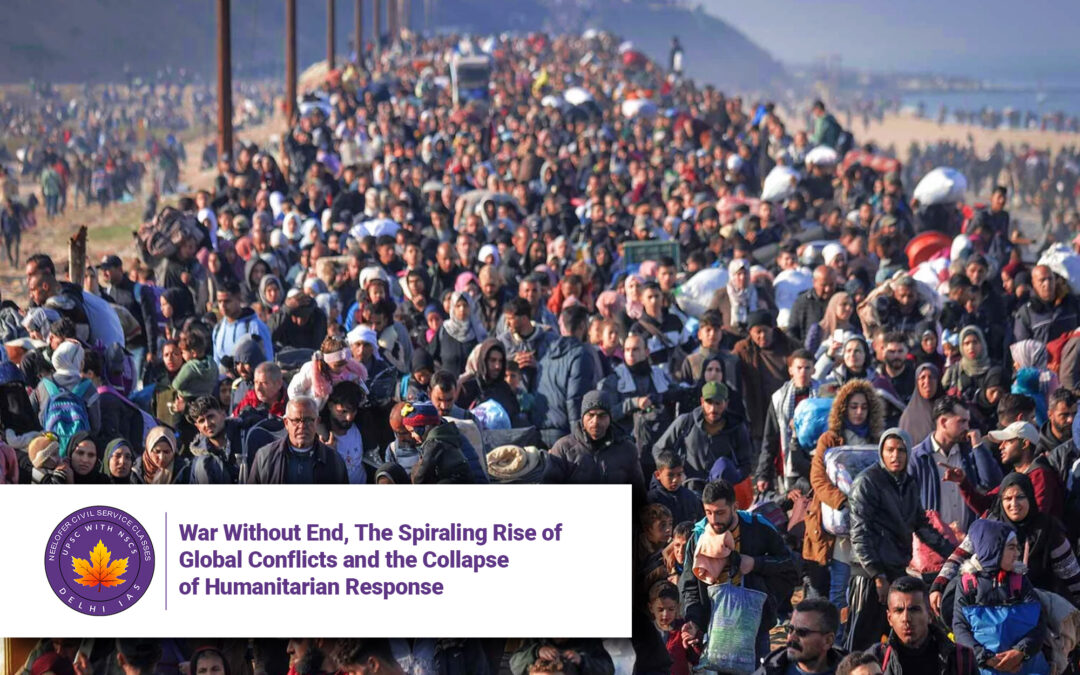
War Without End, The Spiraling Rise of Global Conflicts and the Collapse of Humanitarian Response
Why in News?
In the wake of a 12-day armed confrontation between Iran and Israel — marked by intense military exchanges and deepening US involvement — the fragile ceasefire that followed appears increasingly unsustainable. The confrontation has not only pushed the region toward instability but has also underscored a grim global trend: a significant and sustained rise in violent conflicts and a parallel collapse of humanitarian aid and multilateral peace initiatives. 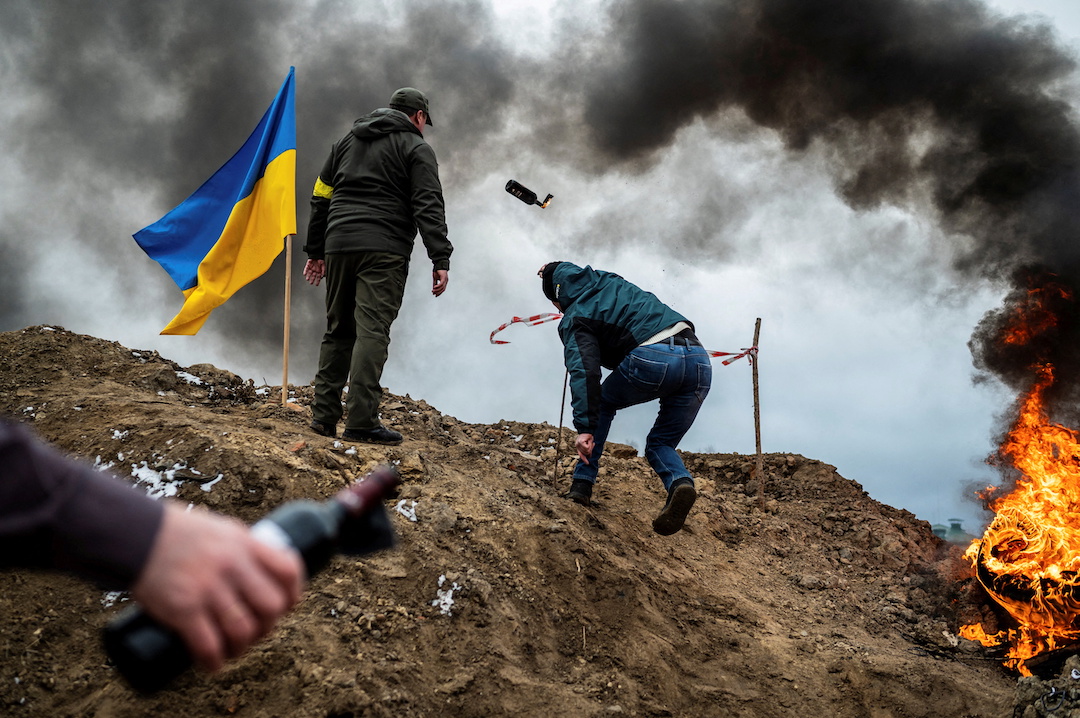
As violence intensifies worldwide, a new wave of militarisation is taking root while the mechanisms for diplomacy, aid, and peaceful resolution are faltering. The situation has triggered one of the gravest security and humanitarian crises since World War II.
The Alarming Rise in Armed Conflicts
According to data from the Peace Research Institute of Oslo, the world witnessed 61 state-based conflicts across 36 countries in 2024 — the highest recorded since World War II. These conflicts affect nearly one-fourth of the global population and represent not just an increase in numbers, but in lethality and scale.
Between July 2023 and June 2024, fatalities from conflicts surged by 37%. Meanwhile, the average number of deaths per violent event rose by 17%, as revealed by the Armed Conflict Survey 2024. Civilian casualties jumped 40%, with one person now being killed every 12 minutes globally due to war-related violence. Humanity & Inclusion UK reported that the annual global death toll from armed violence approached 200,000 — an appalling number in an era where peace mechanisms are theoretically more advanced than ever before.
Humanitarian Aid in Collapse
While war rages on, humanitarian aid efforts are rapidly collapsing. According to the Global Humanitarian Overview (GHO), 186.5 million people across 77 countries required urgent humanitarian assistance in 2024. Yet, of the $49 billion needed globally, only $22.58 billion — less than half — was raised.
This left a gaping $26.42 billion shortfall, further exacerbated by a historic fall in global aid budgets. Humanitarian assistance shrank sharply from $37.5 billion in 2023 to $33.9 billion in 2024. Traditional donor countries like the US, Germany, Canada, Norway, and France slashed their contributions. For instance:
-
Canada cut aid by 40%.
-
Germany reduced its funding by 23%.
This massive drop in funding has left millions vulnerable and essential humanitarian operations severely underfunded.
The Surge in Global Militarisation
As aid dries up, defence budgets are skyrocketing. Global military expenditure in 2024 reached an unprecedented $2.718 trillion, roughly 2.5% of global GDP. More than 100 countries increased their military spending.
The United States remains the biggest spender, investing $997 billion (66% of NATO’s total and 37% of global military expenditure). NATO collectively spent $1.506 trillion, with 18 member states now meeting or exceeding the 2% of GDP threshold for defence — the highest number since 2014. NATO has already announced plans to raise this spending to 5% of GDP by 2035, citing threats from Russia and terrorism.
Critics argue this militarisation push will:
-
Benefit arms manufacturers disproportionately,
-
Heighten geopolitical tensions, and
-
Worsen existing crises like climate change and forced migration.
Country-Wise Military Spending Trends
Israel
-
Increased military spending by 65%, reaching $46.5 billion.
-
Defence now consumes 8.8% of its GDP — second highest globally.
Iran
-
Increased military budget by 10% to $7.9 billion, despite heavy international sanctions.
China
-
Spent $314 billion, up by 7%, accounting for half of Asia and Oceania’s defence budget.
India
-
Modestly raised military spending by 1.6% to $86.1 billion.
Pakistan
-
Allocated $10.2 billion to defence.
Russia
-
Estimated to have spent $149 billion (7.1% of GDP) on defence in 2024.
Ukraine
-
Raised defence spending to $64.7 billion, using 34% of GDP — the highest national income share globally.
What This Lopsided Prioritisation Means
The stark contrast between increasing military budgets and declining humanitarian aid reveals the weakening state of international cooperation. Instead of investing in peace and resilience, many governments are prioritising warfare and national security. This shift has frayed the fabric of multilateral diplomacy and endangered global stability.
The Global Cooperation Barometer 2025, published by the World Economic Forum and McKinsey, described the global security framework as being under “severe pressure.”
Failure of Multilateral Institutions
The credibility and efficacy of global institutions created to ensure peace are rapidly eroding. The Multilateralism Index by the International Peace Institute and the Institute for Economics and Peace showed that international cooperation on peace saw its steepest decline between 2013 and 2023.
The UN Security Council has been particularly ineffective, authorising only one new peacekeeping mission since 2014. Rivalries among major powers like the US, China, and Russia have prevented consensus on even the most pressing global issues.
UN80: A Hopeful Initiative Amidst Gloom
In this deteriorating environment, the UN80 Initiative — launched to mark 80 years of the United Nations Charter — offers a rare glimmer of hope. It seeks to:
-
Reinforce multilateralism,
-
Strengthen the capacities of global institutions, and
-
Recommit nations to the core principles of peace, justice, and humanitarian cooperation.
Despite its imperfections, the UN remains the most inclusive and representative global platform. Its founding ideals — especially those aiming to prevent another world war — are more relevant today than ever before.
Conclusion
The global community stands at a pivotal crossroads. Conflicts are escalating, humanitarian support is collapsing, and multilateral institutions are weakening. We are witnessing a world order where weapons are prioritised over well-being, and war budgets outpace peacekeeping budgets.
The next war might not be an accident. It may be a direct outcome of deliberate choices — of nationalism over cooperation, of militarisation over diplomacy, and of silence over accountability.
If nations do not recommit to peace, diplomacy, and shared humanity — in both word and action — we may soon find ourselves fighting battles we cannot afford to lose.
Q&A Section
1. Why are global conflicts on the rise in 2024?
The rise in global conflicts is due to a combination of geopolitical rivalries, breakdowns in diplomacy, weakened multilateral institutions, and a dramatic increase in military spending by key nations. Tensions in the Middle East, Eastern Europe, and East Asia have all contributed to an unstable global security environment.
2. What is the impact of these conflicts on civilians?
Civilian casualties have skyrocketed, with a 40% increase in 2024 alone. One person is killed every 12 minutes globally due to conflict. Beyond deaths, millions are displaced, infrastructure is destroyed, and essential services like healthcare, education, and food distribution collapse.
3. Why is humanitarian aid faltering?
While needs have risen dramatically — with 186.5 million people requiring assistance — global funding has dropped. Only $22.58 billion of the $49 billion needed was raised in 2024. Donor countries like Canada and Germany have slashed their aid budgets, prioritising national issues and defence.
4. How does military spending compare to humanitarian funding?
In 2024, global military spending hit $2.718 trillion, compared to only $33.9 billion in humanitarian assistance. This means military budgets are over 80 times larger than global humanitarian aid — highlighting a drastic global shift in priorities.
5. What can be done to reverse this dangerous trend?
-
Nations must recommit to multilateralism and diplomacy.
-
Global institutions like the UN must be empowered and reformed.
-
Military spending must be balanced with investments in peacebuilding and humanitarian aid.
-
Initiatives like UN80 offer hope, but they need genuine political backing.
-
Ultimately, global leaders must prioritize human lives over geopolitical power plays.

