
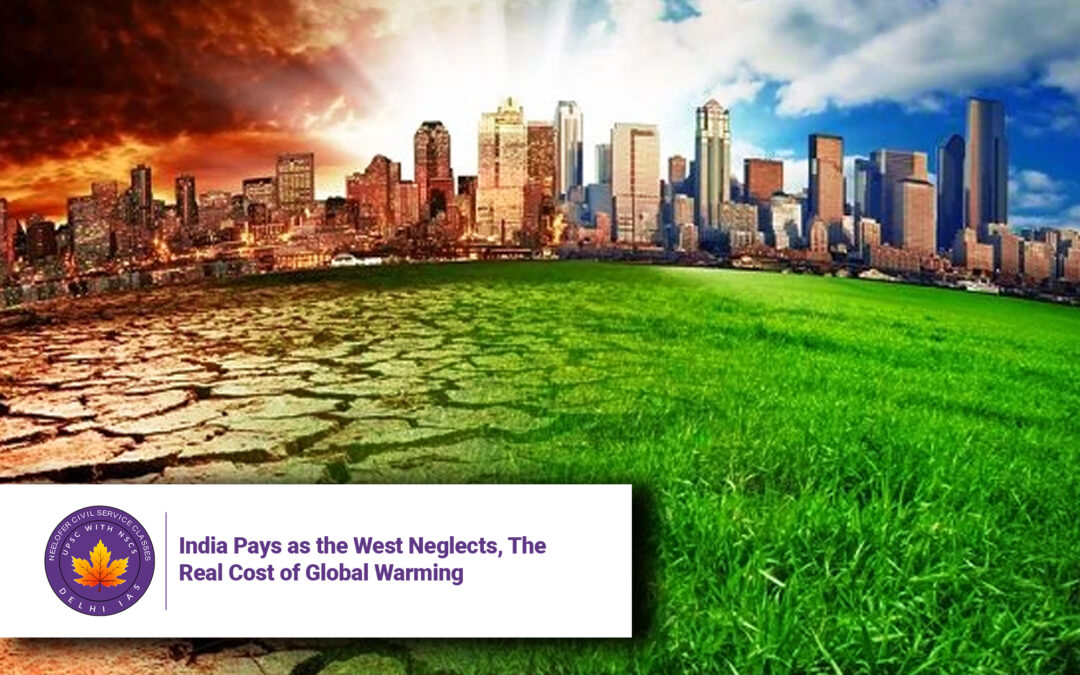
India Pays as the West Neglects, The Real Cost of Global Warming
Why in News?
As wildfires rage across continents, floods sweep away cities, glaciers melt at record speed, and summers scorch the earth for weeks, the signs of climate change have grown too intense to ignore. India, while being one of the lowest per capita emitters of greenhouse gases, continues to suffer disproportionately from the devastating effects of a warming planet. The problem, however, runs deeper than emissions. It lies in the global power imbalance, persistent denial by developed countries, and a collective inner crisis of consumption, ignorance, and avoidance. 
Introduction
Every season, we hear about disasters — burning wildfires in Greece, flash floods in India, cities sinking in the US, and glaciers vanishing in the Arctic. These are no longer isolated or distant events. Climate change has transitioned from being a looming threat to a lived reality. But while science shouts its warnings, the world — especially powerful nations — often choose convenience over conscience.
This climate catastrophe is not just environmental; it is deeply political, economic, and moral. And it brings to light one harsh truth: countries like India are paying the heaviest price for a problem largely created by wealthier, more industrialized nations.
Uneven Burden: Who Pays and Who Pollutes?
Statistically, the inequality is staggering. The United States emits approximately 15 tonnes of CO₂ per person annually. India, with more than four times the population, emits just 2 tonnes per person. Yet India faces extreme heatwaves, prolonged droughts, vanishing rivers, failing monsoons, and flash floods with growing frequency and intensity.
This discrepancy is neither accidental nor new. Industrialized nations, while historically responsible for the bulk of global emissions, continue to prioritize short-term economic gains over collective climate responsibility. Their promises of climate action are often offset by policy backsliding, as seen when the United States withdrew from the Paris Agreement.
Even now, as India and many Global South countries plead for a more equitable climate framework, richer countries largely fail to act with urgency. Their refusal to cut emissions, curb industries, or fund climate adaptation measures in poorer nations reveals a deep moral vacuum.
Nature Is Reacting — Not Breaking
When the ground is parched and the rains fall, the water has nowhere to go — flooding cities and ruining homes. Streets turn into rivers, crops vanish, livelihoods collapse. This isn’t nature breaking down; it’s nature responding to years of human excess. Years of deforestation, concrete expansion, wetland encroachment, and fossil fuel addiction have pushed the planet into revolt.
Extreme weather is now routine. In the past decade, India has experienced 100-year floods almost every year. Rain no longer follows seasonal patterns. Heatwaves persist for weeks, not days. Glaciers are melting, not inching. Entire eco-regions are shifting in months, not decades.
Powerful Nations Refuse to Act
Despite producing the majority of greenhouse gases, many developed countries are still reluctant to change. They cling to high-consumption lifestyles, delay climate policies, and shift responsibility. Fossil fuel subsidies remain in place. Mega-projects that harm ecosystems continue. Climate targets are pushed back — and poorer countries are blamed for lagging behind.
They often hide behind “technological optimism” — promising that innovation will solve everything. But this techno-utopianism is a distraction. It allows them to continue polluting while claiming to be working on the problem.
Worse, global forums often devolve into political theater rather than meaningful climate action. Powerful lobbies block agreements. Vague pledges replace enforceable action plans. And all the while, the climate clock ticks on.
India’s Climate Crisis: A Daily Emergency
For India, climate change is not an abstract debate. It is a matter of survival. Crops fail more often. Rivers are drying up or turning deadly. Floods displace millions every year. Diseases spread faster in warming cities. Rural and urban India alike now face the harshest consequences of environmental damage.
Small farmers, families in urban slums, and tribal communities suffer the most. They do not have air conditioning or the ability to relocate. They cannot “opt out” of the climate crisis. They must face it — every single day.
This isn’t about statistics. It’s about suffering. It’s about inequity. And it’s about injustice — environmental, economic, and ethical.
Beyond Carbon: The Real Crisis Within
There is a tendency to frame climate change as something “caused by humanity.” But that’s not entirely accurate. Climate change is caused by a particular kind of humanity — one addicted to endless consumption, growth, and denial.
The real crisis is psychological. It’s the human need to chase fulfillment outside themselves — through buying, consuming, and accumulating. We don’t consume for survival anymore; we consume to fill emotional voids. This drive for external satisfaction has destabilized the planet.
Therefore, the solution is not just political or technological. It is personal. We need an inner revolution — one that teaches us to live simply, consume mindfully, and seek peace within. Only then can any climate policy have real power.
From Denial to Realization
Rich nations often respond to the climate crisis with denial, distraction, or delay. They promise high-tech fixes, but rarely question their lifestyles. Even when warned by floods or fires, their response is not humility — it is hubris.
Denial isn’t just ignorance; it’s a refusal to let go of comfort. Listening deeply to the planet would mean changing how we live. And that’s something most powerful people are unwilling to do.
This deep-seated resistance means that the poorest — those with the least emissions — are forced to carry the greatest burdens. Climate change is not a shared catastrophe; it is a highly unequal one.
What India Needs
-
International Climate Justice
India must continue to lead calls for climate equity. Global emissions reductions must be proportional to historical responsibility and current capacity. -
Domestic Policy Reform
India must strengthen local climate governance — better flood planning, reforestation, water conservation, and green infrastructure are urgent. -
Education and Awareness
A culture of environmental sensitivity must be cultivated — from schools to media to governance. Climate consciousness must go beyond carbon data. -
Shift in Development Priorities
Economic growth must no longer come at the cost of nature. Green development and sustainable urbanization are no longer optional — they are survival strategies. -
Inner Ecological Transformation
Lastly, every individual must question their consumption patterns. What we buy, how we travel, what we eat — all of it impacts the planet. True climate action begins in the mind.
Conclusion
The climate crisis is no longer a distant threat. It is here, it is unjust, and it is unequal. India, despite contributing the least to the crisis, suffers among the most. While the West continues to delay and distract, nations like India are left to battle a fire they did not start.
The planet cannot heal unless we change — politically, economically, and personally. The crisis is not just in our atmosphere; it is in our hearts. And until that changes, no amount of agreements or green technologies will be enough.
As Acharya Prashant rightly points out — the real crisis lies in our refusal to look within. And the only true solution is a deeper awareness of ourselves and our role in the web of life.
Q&A Section
1. Why is India suffering more from climate change despite lower emissions?
India emits far less carbon per capita than developed nations like the US or Europe. However, its geography, economic structure, and high population density make it more vulnerable to floods, droughts, heatwaves, and other climate-related disasters.
2. What role does global inequality play in climate change?
Developed nations have historically contributed the most to global emissions. Yet, poorer nations like India bear the brunt of climate consequences. This imbalance reflects both environmental injustice and moral failure.
3. Is technology enough to solve climate change?
No. While technology can help, the core issue lies in human behavior — especially overconsumption and denial. Real solutions require lifestyle changes, policy reforms, and inner awareness.
4. What actions can individuals take to help combat climate change?
People can reduce waste, minimize energy use, choose sustainable products, avoid unnecessary travel, and most importantly, educate themselves about environmental issues and demand accountability from governments.
5. How should India respond to the current crisis?
India must continue advocating for international climate justice, strengthen its internal environmental policies, prioritize sustainable development, and cultivate a culture of mindful living and ecological awareness.

