
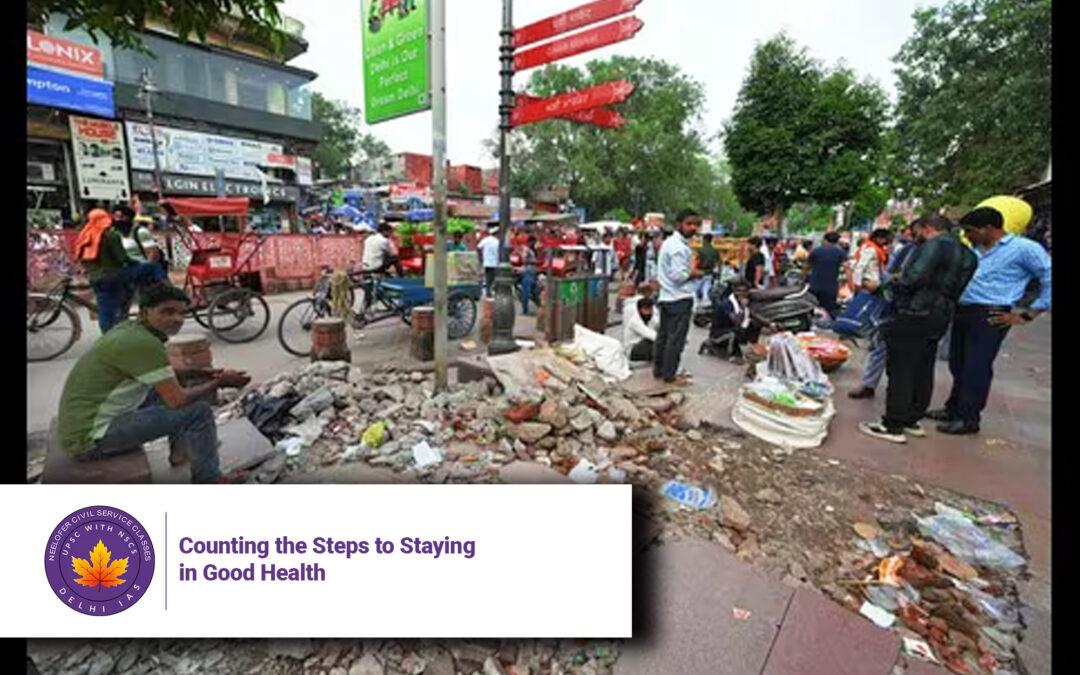
Counting the Steps to Staying in Good Health
Why in News
A recent Lancet study has challenged the widespread belief that 10,000 steps a day are essential for good health. It reveals that just 7,000 steps daily can significantly reduce risks of major diseases. The topic has reignited discussion on public infrastructure for walking, especially in Indian cities. 
Introduction
Walking, a basic human activity, has been touted for decades as the cornerstone of a healthy lifestyle. Health apps, fitness trackers, and influencers often champion the magic number: 10,000 steps a day. However, new scientific findings suggest that fewer steps may still provide most of the health benefits, and in doing so, reignite the call for walkable cities and better infrastructure for citizens.
Key Issues and Background
The new Lancet study found that walking 7,000 steps daily can reduce the risk of death and cardiovascular diseases by nearly 50%. It also significantly lowers the chances of developing type-2 diabetes, dementia, and depression. Interestingly, while increasing the count to 10,000 steps offers benefits, the difference is marginal—only about a 10% further drop in all-cause mortality.
Historically, walking has been more than just exercise. Ancient texts and philosophers have long recognized it as a remedy for mental and spiritual well-being. The Rig Veda’s mantra charaiveti, charaiveti (“keep walking”) captures the cultural reverence for movement. Similarly, thinkers like Basho and Jean-Jacques Rousseau turned walking into a meditative, reflective act—highlighting its ability to connect body, mind, and nature.
Specific Impacts or Effects
-
Health Benefits: Regular walking—even below the “10K” threshold—helps combat several lifestyle-related diseases, improves cardiovascular health, and enhances mental clarity.
-
Urban Design and Lifestyle: Modern urban life, dominated by vehicles and encroachment, offers fewer open or safe spaces for walking, especially in tier-II and tier-III cities.
-
Footpath Deficit: A 2024 Supreme Court committee report found that only 56% of roads in Delhi had footpaths. The numbers are likely worse in smaller cities.
-
Urban Population Growth: India’s urban population is set to rise from 480 million (2020) to 950 million by 2050 (World Bank estimate). Without urgent planning, walkable space may vanish altogether.
Challenges and the Way Forward
India’s cities are facing a double crisis: a health burden from sedentary lifestyles and an infrastructure gap that discourages walking. Though metros still offer some parks and green spaces, tier-II cities are increasingly dense, crowded, and unsafe for walkers. Footpaths are often missing or illegally encroached upon.
With the country’s urban population set to double by 2050, urgent state-level action is needed. Walkability must become a key urban planning goal. Low-cost but high-impact solutions—like building and maintaining footpaths, protecting walking trails, and preserving green zones—can foster a healthier, more active population.
Conclusion
Walking remains one of the simplest, most affordable ways to stay healthy, physically and mentally. As science confirms its power, cities must catch up. By investing in walking-friendly infrastructure, the state can empower citizens to lead longer, healthier lives. Because, sometimes, the first step to solving big health issues is simply… a step.
5 Questions and Answers
1. What did the recent Lancet study reveal about daily walking?
It showed that walking 7,000 steps daily significantly reduces the risk of death, cardiovascular disease, and several chronic conditions.
2. Is walking 10,000 steps much more beneficial than 7,000 steps?
Not greatly—the extra 3,000 steps only reduce overall mortality risk by around 10%.
3. What cultural or philosophical references support walking as a positive practice?
Texts like the Rig Veda and philosophers like Rousseau and Basho highlight walking as therapeutic and spiritually enriching.
4. What percentage of Delhi roads have footpaths, according to the 2024 report?
Only 56%, according to the Supreme Court committee on road safety.
5. What is the predicted urban population of India by 2050?
It is expected to nearly double from 480 million in 2020 to 950 million by 2050, per the World Bank.

