
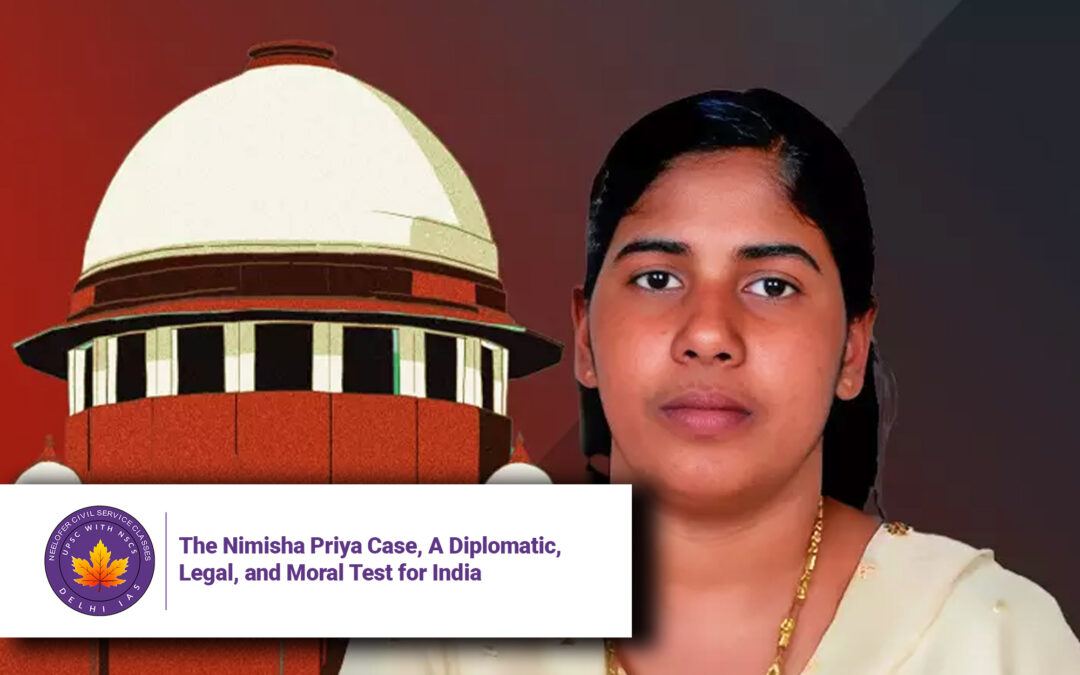
The Nimisha Priya Case, A Diplomatic, Legal, and Moral Test for India
Why in News?
Nimisha Priya, a 38-year-old Indian nurse from Kerala, has been sentenced to death by a court in Yemen for murdering her Yemeni business partner. As efforts continue to save her life, the case raises serious concerns about international human rights, the death penalty, India-Yemen relations, and the treatment of expatriates. The debate is now not only legal or diplomatic—but deeply moral and political. 
Introduction
Nimisha Priya, working in Yemen’s Iran-backed Houthi-controlled region, has been on death row for the alleged murder of her business partner. Her execution seems imminent unless India intervenes effectively. With her case echoing global conversations about the ethics of capital punishment and the treatment of foreign workers, India stands at a critical juncture: either assertively protect its citizen or risk losing moral ground.
Key Concerns and Global Implications
1. Death Penalty and Shifting Penal Norms
The global trend is moving away from the death penalty. The powers in Yemen’s Sanaa, however, remain firm in their capital punishment stance, showing little regard for international human rights pressure. The case questions whether India should remain passive as its citizen faces an outdated and inhumane form of punishment.
2. Legal and Political Diplomacy
India’s foreign ministry, backed by Prime Minister Modi and high-ranking diplomats like S. Jaishankar and Ajit Doval, must tread a sensitive path. On one hand, India does not wish to be seen as interfering in another country’s legal system. On the other, diplomatic silence could be interpreted as weakness or indifference.
3. Humanitarian and Nationalistic Dimensions
If Nimisha is executed, it will be seen not as just a legal enforcement issue, but as an act of disrespect towards the Indian state and its people. The article argues that India must not stay silent, as it did in the past when other Indian citizens abroad faced capital punishment.
4. Risk to Other Indian Nationals in Yemen
An execution could also endanger other Indians still in Yemen. Though few in number, their safety would become uncertain. It would also signal to other nations that India is not serious about protecting its diaspora.
5. Time for a Policy Shift
Gandhi suggests using this tragic moment to renew India’s demand for clemency in similar cases, such as that of Kulbhushan Jadhav in Pakistan. Furthermore, it should provoke national conversation about the continued use of the death penalty even within India’s borders.
Conclusion
The Nimisha Priya case is not just about one individual—it represents a larger issue of how India defends its citizens, deals with human rights abroad, and reflects on its own justice system. Whether or not she is saved, this incident must push India to rethink capital punishment, improve diplomatic protections, and set new global standards for justice.
Q&A Section
1. Q: Who is Nimisha Priya and why is she in the news?
A: Nimisha Priya is an Indian nurse from Kerala who has been sentenced to death in Yemen for murdering her Yemeni business partner. Her case has raised diplomatic and human rights concerns.
2. Q: Why is the case considered important for India?
A: The case tests India’s ability to protect its citizens abroad, challenges the ethics of capital punishment, and could affect relations with Yemen and Indian nationals still living there.
3. Q: What are the legal concerns around the case?
A: Yemen’s justice system, particularly in the Houthi-controlled region, is not accountable to international human rights norms. The trial and punishment raise questions of fairness and transparency.
4. Q: What steps can India take if the execution happens?
A: India may impose diplomatic pressure, sanction the Sanaa regime, recall its citizens from Yemen, and renew global campaigns against the death penalty, including in Pakistan’s case of Kulbhushan Jadhav.
5. Q: What broader issue does the article highlight?
A: The article urges India to reflect on its own use of the death penalty and advocate for a global shift toward more humane penal systems, both abroad and at home.

