
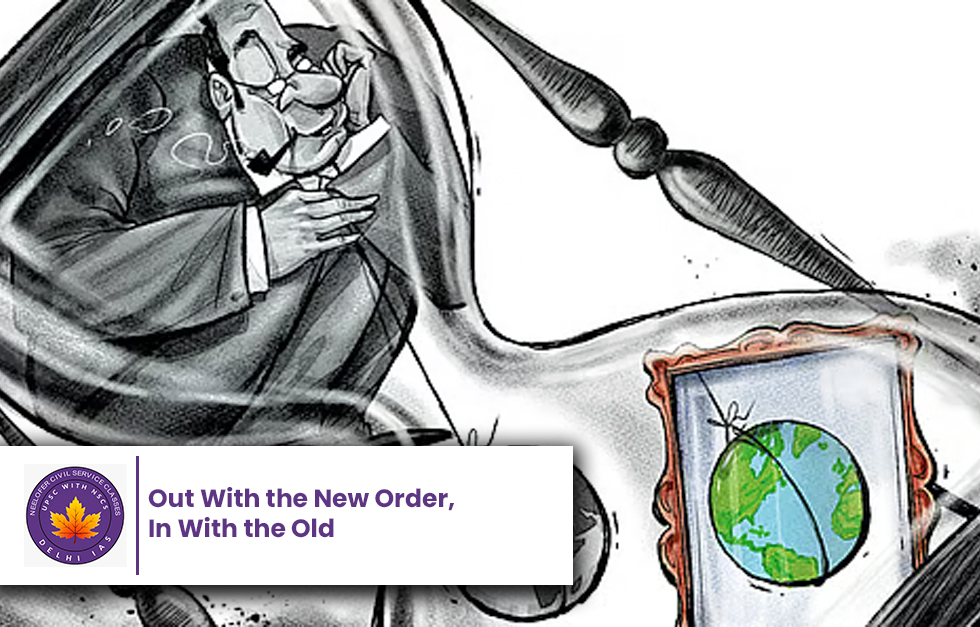
Out With the New Order, In With the Old
Current global conflicts show that the old world order — driven by power balance, national interest, and raw geopolitical competition — is resurfacing, challenging the ideals of the post-WW2 liberal international system.
Why in News?
Recent events such as the war in Ukraine, conflicts in West Asia, tensions between India and Pakistan, and the US’s actions in Iran signal a return to traditional geopolitics based on raison d’état — a state acting in its best national interest — rather than the ideals that defined the liberal global order after World War 2.
Introduction
Since the end of World War 2, the world order has been shaped by institutions, multilateralism, and efforts to maintain peace through collective security and cooperation. However, the re-emergence of conflicts, trade wars, and great power rivalries points to a revival of 17th and 18th century dynamics where states pursue national interest above all.
Key Issues and Background
Historical Roots of the Old Order
-
The Peace of Westphalia (1648) laid the foundation of modern nation-states, based on sovereignty and balance of power.
-
Cardinal Richelieu’s raison d’état idea legitimised actions driven by national interest.
-
Hugo Grotius and William of Orange developed early doctrines of international relations rooted in power balancing.
Evolution Through Modern Conflicts
-
The Concert of Vienna (1815) ensured peace in Europe for nearly a century.
-
The assassination of Archduke Franz Ferdinand in 1914 triggered WW1, driven by military alliances and power competition.
-
Post-WW2, the Cold War sustained balance-of-power logic between the US and USSR.
Specific Impacts or Effects
Resurfacing of Geopolitical Competition
-
Russia’s invasion of Ukraine since 2022, China’s assertiveness in Asia, and conflicts in Gaza and Iran highlight the limits of the liberal order.
-
US interventions in Afghanistan, Iraq, and Libya show how states use force to secure national interests.
-
The so-called “end of history” thesis by Fukuyama — that liberal democracy had triumphed — has not held true as ideological and cultural clashes persist.
Clash of Civilisations
-
Huntington’s prediction of civilisational clashes replacing ideological battles is visible in rising conflicts along religious and cultural lines.
-
Post-9/11 wars and the US ‘War on Terror’ reinforced traditional security doctrines.
Challenges and the Way Forward
Challenges
-
Growing distrust in multilateral institutions.
-
Risk of renewed arms races and security dilemmas.
-
Fragile peace threatened by rising nationalism and protectionism.
Steps Forward
-
Revive diplomacy and dialogue to resolve disputes.
-
Strengthen institutions to check unchecked power projection.
-
Promote cooperative security frameworks instead of unilateral actions.
-
Recognise new realities while safeguarding hard-won global norms.
Conclusion
Humanity is witnessing a rollback of the liberal global order. The return of raison d’état, balance of power politics, and raw national interests means states will act in self-interest, often ignoring collective ideals. The future will likely be shaped by how well nations balance power with responsibility and revive multilateral norms to manage conflicts.
5 Questions and Answers
Q1: What does ‘raison d’état’ mean?
A: It means a state acting in its own best national interest, even if that overrides moral or collective concerns.
Q2: Which events show the return of the old order?
A: The Ukraine war, Israel-Hamas conflict, US actions in Iran, and increasing great power competition.
Q3: What was the ‘end of history’ thesis?
A: Political scientist Francis Fukuyama’s idea that liberal democracy had triumphed globally after the Cold War.
Q4: How did Huntington challenge this view?
A: He argued that the world would face civilisational conflicts rather than ideological ones.
Q5: What is needed to prevent constant conflict?
A: Strong institutions, diplomacy, cooperative security, and a renewed commitment to peaceful resolution of disputes.

