
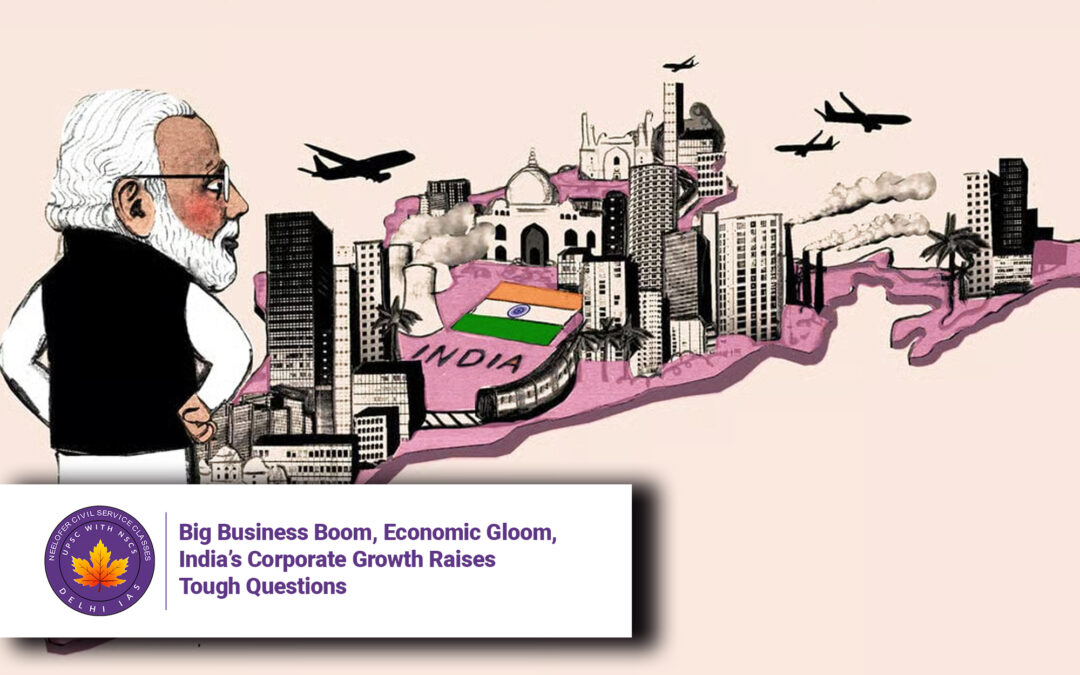
Big Business Boom, Economic Gloom, India’s Corporate Growth Raises Tough Questions
Why in News?
India’s corporate sector is witnessing increased business concentration, where a few giant firms dominate key industries like telecom, energy, and consumer goods. While this might seem like a sign of economic success, experts warn that this concentration is helping big businesses but not the wider economy. With mark-ups rising and industrial output declining as a share of GDP, the debate over “pro-business vs. pro-market” policies is back in the spotlight. 
Introduction
Luigi Zingales of the Chicago Booth School argues that “pro-market” policies, which promote competition and fair play, must be distinguished from “pro-business” policies that benefit select players. India appears to be drifting toward the latter, with the Big Five—Reliance, Tata, Adani, Aditya Birla, and Bharti Airtel—gaining dominance at the cost of competition.
Two recent studies—by Viral Acharya and Rahul Chauhan (NYU & Gokhale Institute), and Simon Commander et al.—highlight the growing power of these conglomerates. The trend is deeply linked to policy preferences, regulatory gaps, and structural flaws in India’s economic framework.
The Rise of the Big Five
According to the studies, these five business groups have seen:
-
A rise in their share of sales among the top 20 business groups from 35.3% in 2015 to 43.6% in 2022.
-
A surge in mark-ups (profits over costs), especially in telecom—now a duopoly between Reliance Jio and Bharti Airtel.
-
Massive control over capital expenditure and investment, often outpacing smaller competitors.
The market dominance of these groups has raised red flags. Exit is difficult for non-performing firms, while the Insolvency and Bankruptcy Code (IBC) has helped only marginally. Smaller businesses find it hard to grow, innovate, or survive in sectors dominated by big players.
The Hidden Costs of Concentration
While big companies bring investment, they may also stifle innovation, suppress competition, and inflate consumer prices through monopolistic practices. Indian industrial policy, influenced by Korean Chaebol-style models, lacks the discipline or export-led focus that made such models successful in countries like South Korea.
Instead, India’s top firms export little, thrive on domestic protectionism, and benefit from close relationships with policymakers. The lack of export competitiveness also means India’s manufacturing share in GDP has stagnated, as shown in the accompanying graph (hovering around 16-18%).
Policy Implications: Reform or Regression?
If India wants inclusive, innovation-driven growth, experts say it must:
-
Differentiate between supporting markets and businesses.
-
Strengthen regulatory frameworks, including the Competition Commission and Securities and Exchange Board of India.
-
Make it easier for new and small firms to enter and exit industries.
-
Focus on exports and medium enterprises, not just “national champions.”
The current tilt toward industrial concentration reflects a deeper ideological shift: a preference for business elites over market fairness.
Conclusion: Growth for Whom?
India’s economic strategy appears to be rewarding size over productivity, scale over competition. But this path carries risk. As Ajay Chhibber warns, unless pro-market reforms are prioritized—like those seen in successful Asian economies—India may find itself with big business and a small economy.
A nation’s growth is not judged by the size of its top firms, but by the vibrancy of its markets, the competitiveness of its sectors, and the prosperity of its people.
Q&A Section
1. Q: What is the difference between ‘pro-business’ and ‘pro-market’ policies?
A: Pro-business policies benefit specific large firms, while pro-market policies promote open competition and fairness for all players.
2. Q: Who are India’s Big Five business groups?
A: Reliance, Tata, Adani, Aditya Birla, and Bharti Airtel.
3. Q: Why is market concentration seen as a problem?
A: It leads to reduced competition, higher mark-ups, poor export performance, and stifles smaller businesses and innovation.
4. Q: How have mark-ups changed in India’s top business groups?
A: Average mark-ups among the Big Five rose from 1.45 in 2013 to 1.7 by 2020, indicating rising profitability without proportional productivity gains.
5. Q: What policy steps are recommended?
A: Encouraging competition, reducing regulatory capture, and promoting a more open, export-led and innovation-based economic model.
