
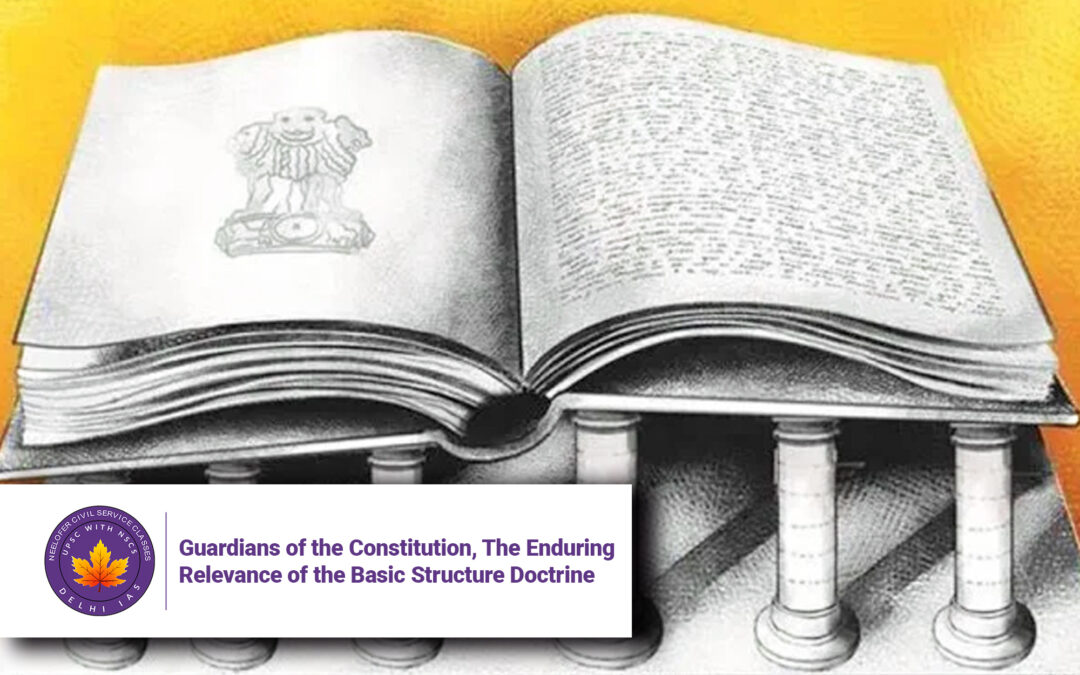
Guardians of the Constitution, The Enduring Relevance of the Basic Structure Doctrine
Why in News?
As India reflects on 50 years of the Emergency, the spotlight returns to one of the strongest bulwarks of our democracy—the Basic Structure Doctrine. In an era of rising executive assertion and constitutional amendments with political motives, the doctrine remains a vital judicial invention to preserve the core values of the Constitution. 
Introduction
The Indian Constitution enshrines justice—social, economic, and political—as well as a commitment to equality, liberty, and fraternity. Yet, Indian history reveals that even this grand vision can be threatened by majoritarian impulses and political excess. It is here that the Basic Structure Doctrine, evolved by the judiciary, acts as a constitutional safety valve.
This doctrine asserts that there are certain features of the Constitution—such as the supremacy of the Constitution, secularism, separation of powers, and judicial review—that cannot be amended or abrogated, even by Parliament.
Historical Background: From Agrarian Reform to Legal Confrontation
Post-independence India witnessed an intense debate on land reform, property rights, and social equity. The First Amendment (1951) and subsequent Amendments tried to limit property rights and place certain laws in the Ninth Schedule to shield them from judicial scrutiny.
But this led to a series of confrontations between Parliament and the judiciary. The landmark case of Shankari Prasad v. Union of India (1951) upheld the amendment. However, the real clash emerged in the Kesavananda Bharati v. State of Kerala (1973) case, when the court ruled that while Parliament could amend the Constitution, it could not destroy its “basic structure.”
This doctrine became the cornerstone of constitutional jurisprudence, protecting citizens from absolute legislative control.
Kesavananda Bharati: The Turning Point
The Kesavananda Bharati case, one of the longest heard in Indian history, involved a fierce debate on whether the Parliament could curtail Fundamental Rights. With the judiciary under pressure, the case became a defence of constitutional identity. The judgment saved India from slipping into legislative authoritarianism.
The decision, with a narrow 7–6 majority, asserted that Parliament was not supreme, and certain constitutional principles could not be violated, regardless of the political majority.
The Emergency and the Test of the Doctrine
Just two years after the Kesavananda verdict, Indira Gandhi’s government declared the Emergency (1975-77) and brought in the 42nd Amendment—an attempt to override the court’s power of review.
But post-Emergency, the court struck back. In Minerva Mills v. Union of India (1980), it declared that Parliament cannot alter the basic structure, reasserting the judiciary’s role as the final interpreter of the Constitution.
This reaffirmation became critical in saving Indian democracy and paved the way for restoring civil liberties and public confidence in constitutional order.
Conclusion: A Doctrine for Every Citizen
The Basic Structure Doctrine is not just a legal tool—it is the lifeline of Indian constitutional democracy. It safeguards free speech, judicial review, federalism, and secularism against majoritarianism and legislative overreach.
In an era of rising centralisation, populism, and executive dominance, the doctrine ensures that Parliament cannot rewrite the soul of the Constitution. As the article rightly notes, “If judges do not rise to protect judicial independence, civil liberties, and basic freedoms, and the ability to speak out, democracy is just a word.”
Q&A Section
1. Q: What is the Basic Structure Doctrine?
A: It is a judicial principle that certain essential features of the Constitution, like judicial review and secularism, cannot be amended by Parliament.
2. Q: Which landmark case established the Basic Structure Doctrine?
A: Kesavananda Bharati v. State of Kerala (1973).
3. Q: Why was the 42nd Amendment controversial?
A: It tried to limit judicial review and assert parliamentary supremacy, effectively undermining the Constitution’s checks and balances.
4. Q: How did the judiciary respond post-Emergency?
A: In Minerva Mills v. Union of India (1980), the court reaffirmed that Parliament cannot destroy the Constitution’s basic structure.
5. Q: Why is the Basic Structure Doctrine still relevant today?
A: It protects citizens’ rights and democratic values from political overreach and ensures constitutional integrity remains intact.

