
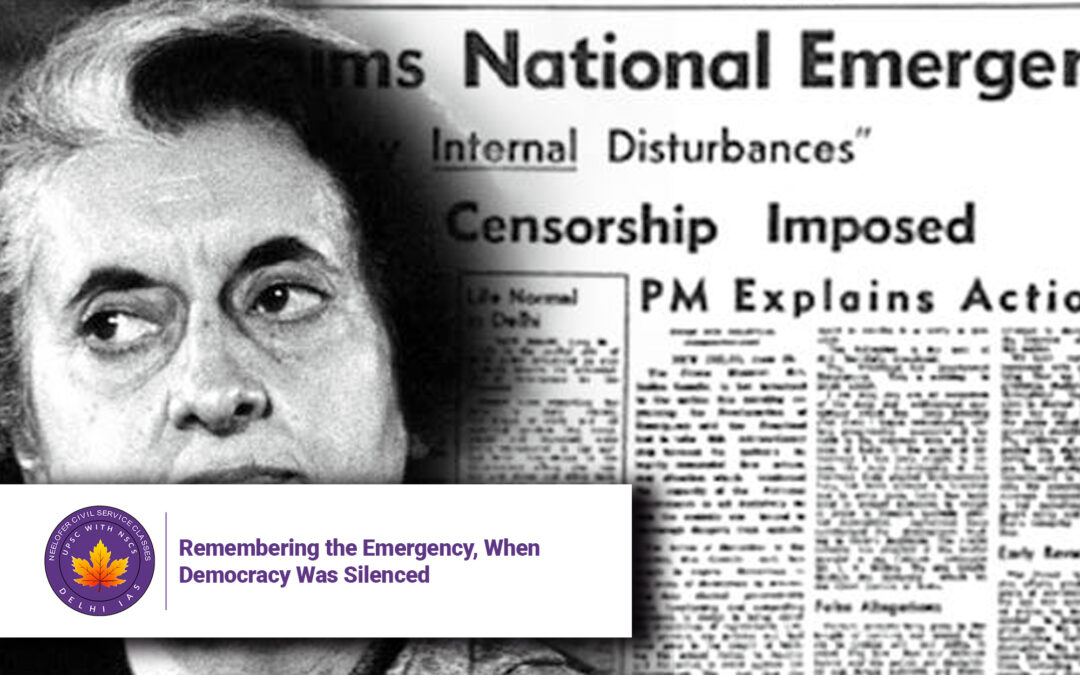
Remembering the Emergency, When Democracy Was Silenced
Why in News?
India recently marked the 50th anniversary of the Emergency (1975-1977)—a period when democracy was placed under lockdown, civil liberties were suspended, and the Constitution was weaponized to crush dissent. More than just a chapter in political history, the Emergency remains a living reminder of how fragile freedom can be when power is unchecked.
Introduction
On the night of June 25, 1975, India changed. Prime Minister Indira Gandhi’s government declared a state of Emergency, citing threats to national stability. But behind that justification lay political insecurity, a faltering economy, and a fear of dissent. What followed was a 19-month-long suspension of democracy, marked by mass arrests, censorship, and repression.
This historic moment is revisited not just through documents and debates—but through memory. Rohan Jaitley, son of late Arun Jaitley, reflects on the Emergency as both a political rupture and a personal reckoning—his father being one of its vocal and imprisoned critics.
A Nation in Chains, A Family Under Watch
Arun Jaitley, then a young student leader and DU Students’ Union President, was at the forefront of resistance. He aligned with Jayaprakash Narayan (JP) in opposing the authoritarian drift of the Congress regime. Like many others, he was jailed without trial—his only crime: the courage to differ.
Rohan recalls how his grandfather, in a desperate attempt to secure documents for Jaitley’s legal defence, found that no newspapers were delivered, political leaders had disappeared, and Delhi’s streets were gripped by fear. The family’s life narrowed to survival, their home surrounded by silence and surveillance.
Even inside jail, Arun Jaitley remained defiant. He studied law during his imprisonment, only to be denied exams because he was no longer “a public order” detainee. Yet, he continued to debate, write, and hope.
The Human Cost of Authoritarianism
Rohan shares intimate memories: of his mother taking him by train each week to meet his father in prison for a brief, heartbreaking encounter. Of his grandfather collapsing from stress and heartbreak. Of relatives distancing themselves, fearful of guilt by association.
These moments highlight the emotional trauma and social isolation inflicted not just on political prisoners but also on their families. Even children became unwilling witnesses to a nation’s democratic breakdown.
The Politics of Control and the Triumph of Memory
What made the Emergency more sinister was its normalisation. People were released only on the condition that they remained silent. Families avoided conversations about politics. Citizens learned to whisper.
Yet, within this darkness, embers of resistance glowed. Students, lawyers, writers, and leaders continued to defy the regime. And when elections returned in 1977, India rejected dictatorship at the ballot box. Indira Gandhi was defeated. Democracy, though battered, survived.
The 1977 elections were not just political—they were emotional. They signified the people’s uncompromising belief that power belongs to the people, not rulers.
Conclusion: A Warning from the Past
The Emergency teaches us that freedom cannot be taken for granted. Constitutions alone do not protect liberty—courage, vigilance, and memory do. As Rohan Jaitley rightly observes, “There is no Constitution to save it, and no judge can protect it, until the will of the people rises to act.”
Today, as India debates the health of its institutions, it must remember 1975—not as a relic of the past, but as a warning for the future.
Q&A Section
1. Q: What triggered the declaration of Emergency in 1975?
A: Indira Gandhi cited threats to national stability and internal disturbance, though critics argue it was a response to her political vulnerability after a court ruling invalidated her election.
2. Q: How did the Emergency affect civil liberties?
A: Articles 14, 19, 21, and 22 of the Constitution were suspended. Press was censored, dissent was criminalized, and thousands were jailed without trial.
3. Q: How was Arun Jaitley involved during the Emergency?
A: As a student leader aligned with JP, he led protests against the government and was imprisoned for 19 months.
4. Q: What personal hardships did Jaitley’s family face during the Emergency?
A: His family endured fear, health crises, and social isolation. His grandfather collapsed, and his mother faced the emotional burden of weekly jail visits.
5. Q: What lasting lesson does the Emergency offer India today?
A: That democracy must be constantly defended—not just through law, but by the will of people to resist authoritarianism.

