
Are Gig Workers a Part of India Labour Data?
Why in News?
The 2025 Union Budget introduced important steps to formally recognise gig and platform workers by extending various social protection measures. However, despite this move, the revised Periodic Labour Force Survey (PLFS) still lacks granular classification for this growing segment of the workforce, leaving many challenges unaddressed. 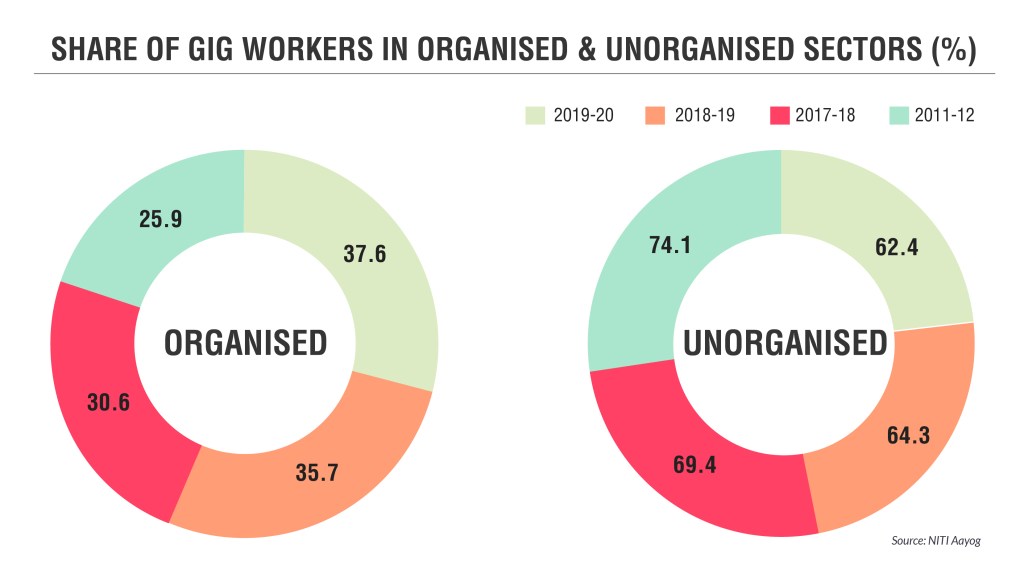
Introduction
India’s gig economy is rapidly expanding. According to NITI Aayog’s 2022 report, the gig workforce is expected to reach 23.5 million by 2029–30. Gig and platform workers were formally brought into the legal framework under the Code on Social Security, 2020. However, India’s labour data system, particularly the PLFS, has not adapted to reflect the complex and unique nature of gig work.
Key Issues and Institutional Concerns
-
Legal Inclusion Without Clarity
Gig workers were defined under Section 2(35) of the Code on Social Security, 2020, but the classification does not clearly distinguish between gig and traditional informal work. This lack of clarity causes difficulty in extending targeted welfare schemes. -
Lack of PLFS Classification
The PLFS does not have a dedicated category for gig work. As a result, gig workers are often forced into categories like ‘self-employed’ or ‘own-account workers’, which fail to capture their work conditions or social risks. -
Algorithmic and Digital Nature Ignored
Unlike traditional self-employment, gig work is guided by digital platforms and algorithms. It is task-based, often without formal contracts or consistent pay. The current data framework fails to account for these nuances. -
Need for Recognition and Representation
Recent initiatives like the e-Shram registry and Ayushman Bharat’s coverage of gig workers signal governmental recognition. But, unless statistical systems reflect this recognition, such interventions cannot be effectively monitored or evaluated. -
Way Forward for Labour Data Reform
The 2025 PLFS has introduced improvements such as a larger sample size and better rural-urban balance, but still lacks gig-specific categories. India must revise its labour statistics to include new classification systems or develop survey models that specifically capture the gig workforce.
Conclusion
As India’s digital labour market grows, it becomes critical to adapt the data collection frameworks to accurately represent gig and platform workers. Without statistical inclusion, the policy benefits announced will remain limited in scope and impact. Bridging the data gap is essential to uphold the rights and welfare of millions driving India’s modern service economy.
Q&A Section
1. Q: When were gig workers formally included in India’s labour law framework?
A: In 2020, under the Code on Social Security.
2. Q: What is the expected size of India’s gig workforce by 2029–30?
A: 23.5 million workers.
3. Q: Why does PLFS classification fail to capture gig workers accurately?
A: It lacks a separate category for gig work and forces them into broader classifications like ‘self-employed’, missing their unique working conditions.
4. Q: What are some of the features that make gig work different from traditional employment?
A: Gig work involves multiple job roles, digital platform dependency, lack of formal contracts, algorithm-based governance, and absence of social security.
5. Q: What improvements are recommended for India’s labour data?
A: Introducing dedicated PLFS categories for gig workers, developing new survey models, and ensuring statistical visibility for effective policy monitoring.

