
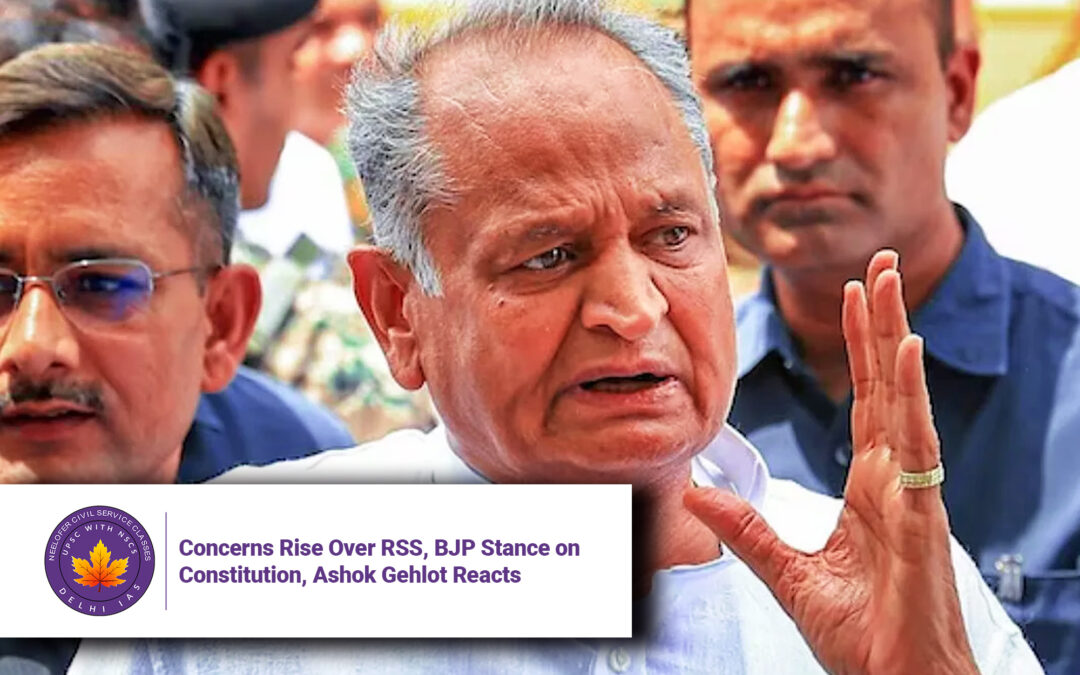
Concerns Rise Over RSS, BJP Stance on Constitution, Ashok Gehlot Reacts
Why in News?
Senior Congress leader and former Rajasthan Chief Minister Ashok Gehlot has raised strong objections to recent remarks made by RSS General Secretary Dattatreya Hosabale concerning “secularism” and “socialism” in the Constitution’s Preamble. Gehlot warned against attempts by the RSS-BJP to change the Constitution and described it as a threat to India’s democracy. 
Introduction
Ashok Gehlot’s remarks came after Hosabale allegedly questioned the inclusion of “Secularism and Socialism” in the Preamble of the Indian Constitution. These terms were added during the 42nd Constitutional Amendment in 1976 during the Emergency. Speaking on Twitter and at public events, Gehlot emphasized the dangerous consequences of such statements and accused the BJP-RSS of systematically trying to alter the foundational principles of the Indian Constitution.
Key Issues and Institutional Concerns
1. Questioning Constitutional Amendments
Dattatreya Hosabale’s comments implied that “secularism” and “socialism” were unnecessary insertions. This has raised alarms among constitutionalists and opposition leaders, as these terms are essential to India’s identity as a democratic, inclusive republic.
2. Ashok Gehlot’s Objections
Gehlot, who recently launched the ‘Save the Constitution’ campaign, stated that the BJP and RSS have long aimed to undermine the Constitution’s spirit. He referenced repeated judicial overreach and said the BJP is planning a constitutional overhaul if they win a third term.
3. Legal and Political Reactions
Gehlot’s statements also alluded to ongoing judicial appointments and the recent judgments from the Supreme Court, suggesting a coordinated effort to change constitutional norms. He pointed out how the RSS has always been uncomfortable with the Constitution, and now their influence is being institutionalized.
4. Historical Parallels
Gehlot invoked the 50th anniversary of the Emergency and said debates questioning secularism now are no different from the authoritarian tendencies seen in the 1970s.
5. Role of Opposition and Civil Society
Opposition leaders, including Rahul Gandhi, have echoed these concerns, claiming that the BJP aims to strip down constitutional values and rebuild India’s political system in a way that fits their ideological narrative.
Challenges and the Way Forward
-
Safeguarding Constitutional Integrity: All political parties must pledge to uphold the Constitution in its current form and avoid ideological tampering.
-
Judicial Vigilance: The Supreme Court must stay apolitical and protect the Constitution from ideological encroachment.
-
Public Awareness: Civil society, youth, and educators must increase awareness about constitutional values.
-
Institutional Independence: The autonomy of institutions such as the Election Commission, Supreme Court, and Parliament must be protected from political influence.
Conclusion
Ashok Gehlot’s concerns highlight a significant ideological clash over the future of India’s constitutional values. Whether it is just rhetoric or a planned constitutional rewrite remains to be seen, but the debate has once again underlined the importance of public vigilance and democratic resilience. As India approaches crucial political decisions, the Constitution must remain the guiding light, not a tool for political redesign.
Q&A Section
1. What triggered Ashok Gehlot’s remarks?
Gehlot reacted to RSS leader Dattatreya Hosabale’s comment suggesting a debate on removing “secularism” and “socialism” from the Constitution’s Preamble.
2. What is the ‘Save the Constitution’ campaign?
Launched by Gehlot and Congress, it is an initiative aimed at warning citizens about the BJP-RSS’s alleged long-term goal to alter the Constitution’s core values.
3. Why are secularism and socialism important in the Constitution?
These terms, added in 1976, define India as an inclusive and socially just state. Their removal would significantly shift the nation’s ideological direction.
4. What is the Congress party’s view on the matter?
Congress leaders, including Rahul Gandhi, believe that the BJP and RSS are planning a constitutional change by controlling institutions and silencing opposition.
5. How does this issue affect Indian democracy?
If the foundational values of the Constitution are undermined, it could pave the way for authoritarianism and weaken the democratic fabric of the country.

