
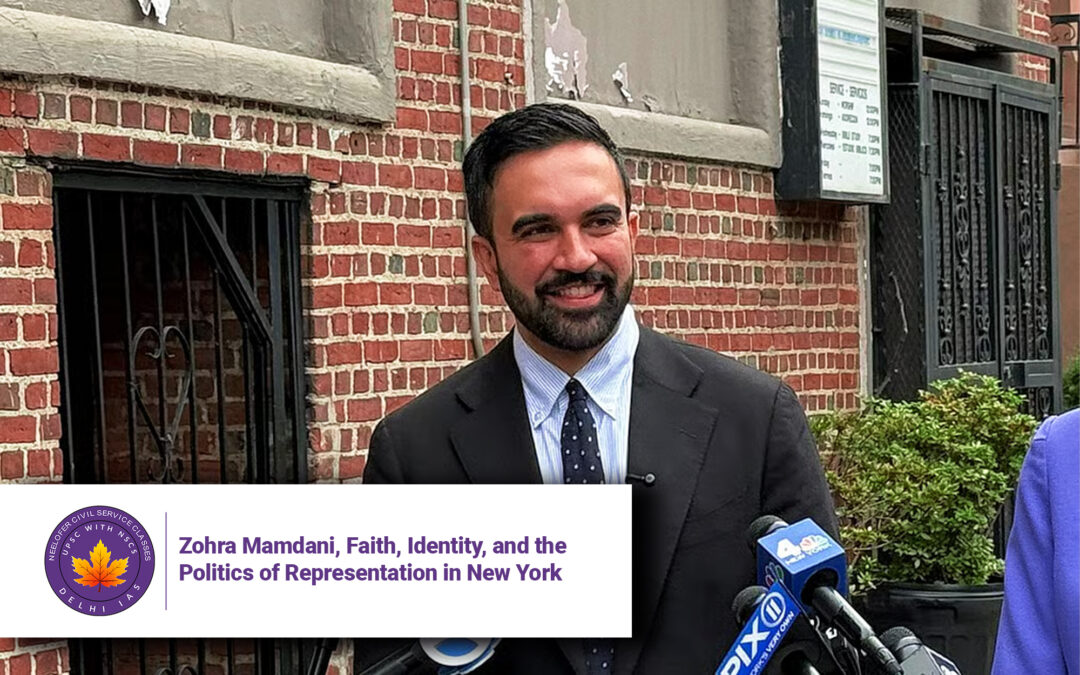
Zohra Mamdani, Faith, Identity, and the Politics of Representation in New York
Why in News?
Zohra Mamdani, a Muslim-American of South Asian descent and a progressive New York politician, is gaining prominence in U.S. politics. His political identity — shaped by his strong stance on Gaza, criticism of Narendra Modi and Benjamin Netanyahu, and alignment with far-left ideologies — has sparked debate in both the United States and India. 
Introduction
Zohra Mamdani’s meteoric rise in New York politics is more than just another immigrant success story. It represents a growing shift in American political identity and a reflection of global ideological divides. While some in the Indian diaspora celebrate his progress, others are uneasy due to his vocal positions on sensitive geopolitical issues.
Key Points from the Article
-
Zohra Mamdani’s Ideological Roots
Mamdani, son of renowned academic Mahmood Mamdani and filmmaker Mira Nair, represents a fusion of elite liberal education and leftist activism. He proudly supports Gaza and criticizes both the Modi-led Indian government and Israel’s Netanyahu, aligning himself with progressive and pro-Palestinian American groups. -
Reaction in India
Mamdani’s success hasn’t been universally celebrated in India. Many are uncomfortable with his sharp critique of Indian policies, especially towards Muslims, and his support for causes perceived as anti-Israel or anti-Hindu nationalism. -
Identity Politics and Perception
His faith and ideological positions make Mamdani a symbol of modern intersectional politics in the U.S., especially among Democrats. However, these very attributes — his Muslim identity, pro-Gaza stance, and critique of Modi — are controversial for many Indian observers, especially from the right. -
The Larger Narrative
The story of Mamdani raises broader questions about race, religion, and political alignment in global democracies. As immigrant demographics change the political landscape in places like New York, traditional identity politics is being challenged and redefined. -
Indian-American Political Divide
The Indian diaspora in the U.S. is increasingly polarized. While a section leans conservative and supports the BJP’s worldview, another section, especially younger generations, embraces progressive causes, including critiques of India’s domestic and foreign policies.
Conclusion
Zohra Mamdani’s story is not just about an individual’s political journey — it’s about how evolving identities, shifting loyalties, and global debates around justice and governance are transforming politics. His rise may discomfort some in India, but it also signals the deepening entanglement between domestic ideologies and global political narratives.
5 Q&A Based on the Article
Q1. Who is Zohra Mamdani and why is he in the news?
A1. Zohra Mamdani is a rising Muslim-American political leader in New York. His progressive stance on Gaza, criticism of Modi and Netanyahu, and association with far-left ideologies have gained attention globally.
Q2. Why is Mamdani’s political rise controversial in India?
A2. His outspoken criticism of Indian Prime Minister Narendra Modi, support for Palestinian causes, and association with progressive American politics are seen as contrary to the views of many in India, especially among right-leaning groups.
Q3. How does Mamdani’s identity influence his political stance?
A3. His Muslim identity and South Asian heritage, combined with his elite academic background and activist lineage, shape his alignment with anti-establishment, pro-justice movements.
Q4. What does the article say about Indian-American political divides?
A4. The article highlights a growing rift within the Indian diaspora in the U.S., where younger generations lean progressive, while older and more conservative segments align with BJP-like ideologies.
Q5. What broader theme does Mamdani’s rise reflect?
A5. It reflects how modern politics is shaped by intersections of race, religion, diaspora identity, and global ideological battles — especially in multicultural cities like New York.

