
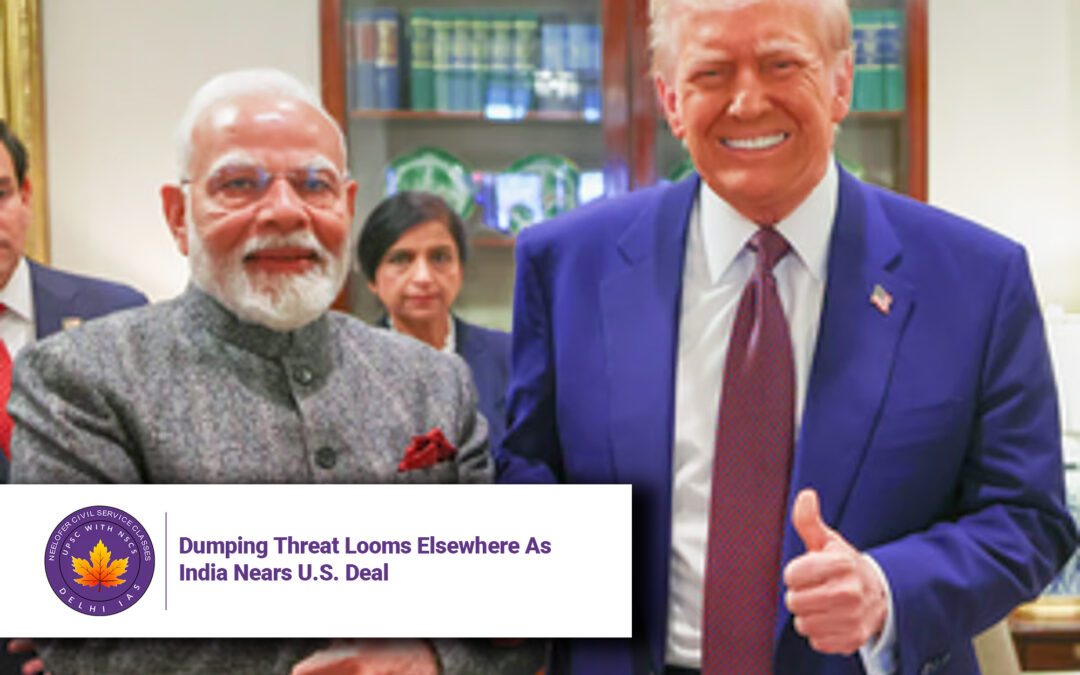
Dumping Threat Looms Elsewhere As India Nears U.S. Deal
Why in News?
U.S. President Donald Trump recently hinted at signing a “very big” trade deal with India, possibly by early July. This announcement, coupled with looming tariff adjustments, has sparked market volatility and deepened discussions about India’s global trade strategies. The deal could open doors for Indian exports but also brings challenges from emerging competition. 
Introduction
As India and the U.S. edge closer to formalizing a trade pact, discussions have intensified around the effects on tariffs, market access, and sector-specific opportunities and threats. At the core of this dialogue is how India can maximize its gains while shielding its key sectors from being undercut by countries that already enjoy easier access to the U.S. market.
Key Issues and Institutional Concerns
1. Tariff Uncertainty and Market Impact
Trump’s statements have already caused major movements in equity and bond markets. Investors are wary of how tariff negotiations could affect bilateral trade and foreign portfolio investments.
2. Export Gains vs. Sectoral Risks
India’s potential gains hinge on reducing tariffs on Indian exports like energy, aviation, defence, apparel, and electrical machinery. However, India’s electronics and jewellery sectors may lose market share to other countries offering lower tariffs on similar goods.
3. Global Competition from Emerging Economies
According to a paper by the National Institute of Public Finance and Policy (NIPFP), India faces stiff competition from countries like China, Vietnam, Indonesia, and Italy. These nations already account for 45.5% of U.S. imports in certain sectors where India seeks to expand.
4. Impact of Tariff Shifts on Trade Flows
If the U.S. reduces tariffs on some sectors, India could gain in areas like apparel and footwear. However, sectors like electrical goods and furniture may remain under pressure unless carefully calibrated trade-offs are secured.
5. Need for Diversification & Strategic Planning
India must not rely solely on tariff relief. Instead, the country should strengthen domestic manufacturing, enhance quality standards, and expand trade ties with EU, UK, ASEAN, and other blocs to cushion against future external shocks.
Challenges and the Way Forward
-
Watch Key Competitors: Keep a close eye on China, Vietnam, and Indonesia, which are poised to undercut India if tariff advantages shift.
-
Calibrated Trade-Offs: Any tariff concessions India offers to the U.S. (e.g., on food or agriculture) must be balanced with reciprocal gains in strategic sectors.
-
Invest in Make in India: Strengthen local production capabilities in high-value segments like defence, aerospace, and electronics.
-
Expand Market Access: Leverage global platforms to gain wider access to non-U.S. markets, especially in Europe and Southeast Asia.
-
Long-Term Export Strategy: Focus on building resilient export policies that align with multilateral trade agreements.
Conclusion
While a trade deal with the U.S. may unlock fresh opportunities for India, it must be approached with caution and strategic foresight. India needs to guard against dumping from other nations and use this opportunity to boost its global competitiveness through smart negotiations, diversification, and domestic capacity building.
Q&A Section
1. What triggered India-U.S. trade talks recently?
President Donald Trump indicated a “very big” deal may be signed by July, reviving interest in bilateral trade negotiations.
2. What are the key benefits India could gain from the U.S. deal?
India could get lower tariffs in sectors like defence, aviation, apparel, and electrical equipment, making exports more competitive.
3. Which sectors are at risk of losing market share?
Sectors like electronics and gems & jewellery may lose ground to China, Vietnam, and others that offer lower tariffs on similar goods.
4. What does the NIPFP report highlight?
It states that countries like China, Vietnam, Indonesia, and Italy account for nearly half of U.S. imports in sectors India targets—posing strong competition.
5. What should India focus on moving forward?
India should diversify export markets, enhance manufacturing through ‘Make in India,’ and negotiate smartly to protect key sectors.

