
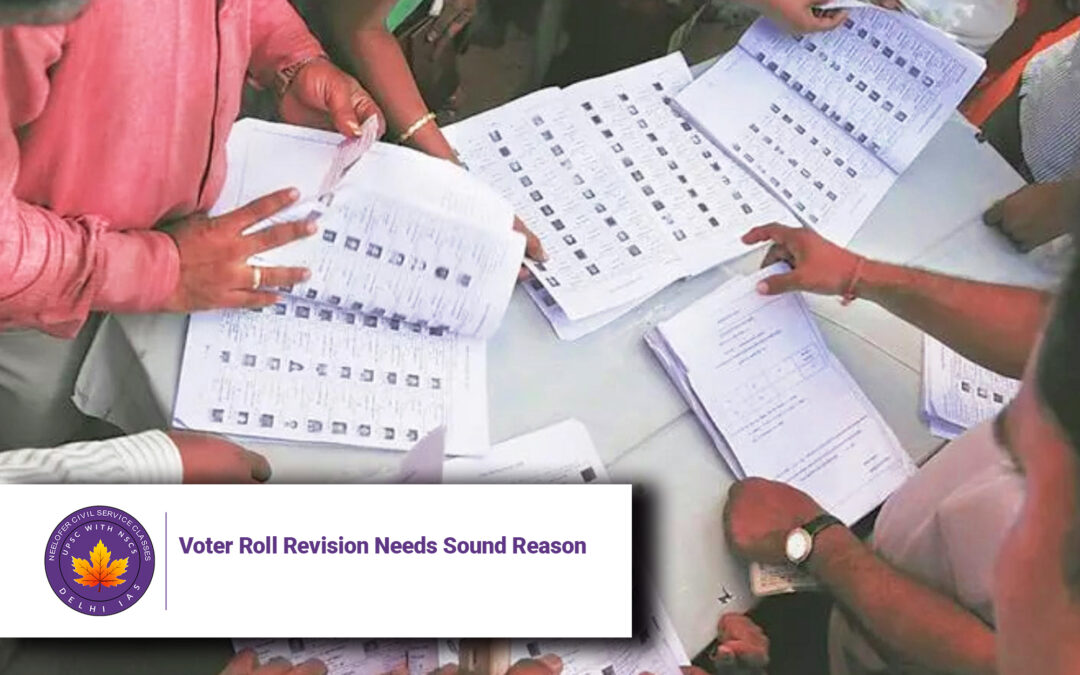
Voter Roll Revision Needs Sound Reason
Why in News?
The Election Commission of India (ECI) has recently announced a Special Intensive Revision (SIR) of electoral rolls in Bihar, just before the upcoming assembly elections. This decision has raised concerns of potential disenfranchisement of millions, especially among poor and minority communities. Experts and opposition parties have questioned the rationale, timing, and intent behind the revision. 
Introduction
Electoral roll revisions are not uncommon, especially ahead of elections, to ensure accuracy and legitimacy. However, when these revisions are sudden, massive in scale, and lack transparency or a credible justification, they raise serious concerns about democratic integrity. The current move in Bihar is one such instance.
Key Issues and Institutional Concerns
1. Lack of Transparent Justification
The ECI has cited reasons like “illegal voters,” “bogus entries,” and “cross-border infiltration,” echoing narratives often pushed by the Home Ministry. However, there has been no official data or detailed explanation from the Commission that supports these claims.
2. Timing Before Elections
The revision comes just before the 2024 Lok Sabha elections. Past experiences show similar revisions were used to allegedly manipulate voter lists in Maharashtra and Delhi. The political timing raises suspicions of electoral engineering to suppress or alter voter turnout in favor of particular parties.
3. Targeting Marginalised Communities
Reports show that SIR-type actions in other states, like Karnataka, have disproportionately affected Muslims. If Bihar’s poor and working-class migrants—many of whom work outside the state—are required to prove citizenship again, many could lose their right to vote.
4. Contradiction with RPA, 1950
The Representation of the People Act (RPA), 1950, outlines regular procedures for electoral roll updates. Extraordinary revisions must be justified with clear demographic indicators and must involve consultation with political stakeholders. This hasn’t been followed in the Bihar case.
5. Chilling Effect on Voter Participation
Forcing voters to re-establish citizenship can deter legal citizens from voting. This not only affects the inclusiveness of elections but also hits the very idea of democratic participation. It sets a dangerous precedent that could be misused elsewhere.
Challenges and the Way Forward
-
Restore Transparency: The ECI must release detailed guidelines, data, and justification for such large-scale revisions.
-
Safeguard Democratic Rights: No citizen should be arbitrarily removed from rolls without due process and opportunity to respond.
-
Avoid Disenfranchisement: Special care must be taken to ensure migrants and minorities are not targeted or excluded.
-
Strengthen Legal Frameworks: Amendments to the RPA should clearly define when and how SIRs can be conducted.
-
Public Scrutiny & Oversight: Independent watchdogs, courts, and civil society must scrutinize such electoral actions to prevent misuse.
Conclusion
Elections are the cornerstone of democracy, and voter participation is its soul. Moves like Bihar’s voter roll revision, especially without evidence and with vague explanations, risk undermining public trust and weakening democratic institutions. It’s essential that electoral reforms are based on sound reasoning, not political convenience.
Q&A Section
1. What is a Special Intensive Revision (SIR) of voter rolls?
An SIR is a large-scale update of the electoral roll to verify and update voter data. It’s usually justified by major demographic changes, but in this case, no such data has been provided.
2. Why is Bihar’s voter list revision controversial?
It lacks transparency, comes just before elections, and disproportionately affects poor and migrant voters—raising fears of targeted disenfranchisement.
3. What laws regulate voter list revisions in India?
The Representation of the People Act, 1950 governs these revisions. Any major update must be transparent and consultative.
4. Who could be most impacted by the revision in Bihar?
Poor, rural voters, especially those working outside the state and Muslim minorities, may struggle to meet new documentation demands.
5. What should the Election Commission do now?
Publish clear criteria, ensure no voter is arbitrarily removed, allow appeal mechanisms, and consult all political stakeholders to restore trust.

