
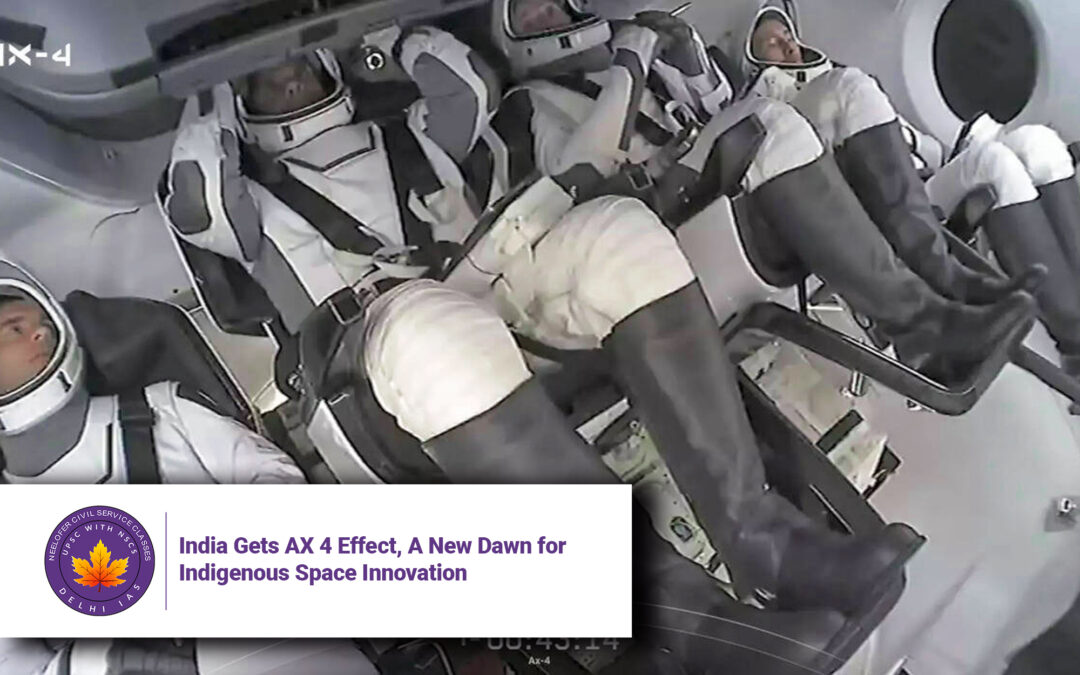
India Gets AX 4 Effect, A New Dawn for Indigenous Space Innovation
Why in News?
India made a historic mark in space history as Group Captain Shubhanshu Shukla became the first Indian astronaut to fly aboard a private mission—Axiom Space’s Ax-4 mission—to the International Space Station (ISS). His journey not only marks India’s first astronaut-in-space after nearly four decades but also signals a strategic boost for India’s space diplomacy and indigenous innovation. 
Introduction
The Ax-4 mission, launched by Axiom Space on a SpaceX Falcon 9 rocket, represents a significant milestone for India’s space trajectory. Shukla’s presence aboard the mission has catalyzed national enthusiasm, governmental support, and private sector involvement in space exploration. It’s not just a moment of national pride but a pivot for futuristic ambitions, including the Gaganyaan human spaceflight programme.
Highlights from the AX-4 Mission and Indian Involvement
-
Shubhanshu Shukla’s Journey:
Former test pilot from the Indian Air Force, Shukla is the first Indian to go to space since Rakesh Sharma’s 1984 mission aboard a Soviet capsule. -
Global Collaboration:
The mission had astronauts from Hungary, Poland, and Turkey, representing a new era of international partnerships in low-earth orbit (LEO) science. -
Private Sector Engagement:
Startups like Dhruva Space, Bellatrix Aerospace, and Skyroot Aerospace are gaining momentum, with India’s space economy now estimated at over $8 billion. -
The Gaganyaan Link:
The Ax-4 mission sets the stage for Gaganyaan, India’s first indigenous human spaceflight mission, now aiming for a launch window in 2026–27.
From R&D to Orbit: A Broader Perspective
Somak Raychaudhury, director of NISER, emphasized the momentum Ax-4 provides to Indian academia and industries. As ISRO prepares for Gaganyaan, efforts to scale up infrastructure and technical capability are gaining pace.
S Somanath, ISRO Chairman, stated that the AX-4 experience brings valuable insights to Gaganyaan’s planning, especially in areas like life-support systems, orbital operations, and crew health in space.
Key Takeaways
-
AX-4 symbolizes global cooperation while enhancing India’s credibility in manned missions.
-
ISRO is aligning scientific objectives and private partnerships to develop indigenous tech solutions.
-
The commercial space ecosystem is expanding, offering opportunities for private firms in launch tech, satellites, and AI for orbital management.
-
Academic and R&D institutions such as IISc, NIT, and ISRO labs are becoming integral to India’s space policy.
-
India’s Gaganyaan mission is projected for launch by 2026–27, and AX-4 acts as a learning platform.
Challenges and the Way Forward
Challenges:
-
Limited experience in human-rated spaceflight systems.
-
Budgetary constraints and dependency on international collaboration.
-
Need for rapid development of safety protocols, docking systems, and life-support modules.
Way Forward:
-
Increased funding and public-private partnerships.
-
Expand academic involvement in mission simulations and space medicine.
-
Create long-term policies for satellite constellations, asteroid missions, and space commerce.
Q&A Section
1. What is the AX-4 mission, and why is it important for India?
AX-4 is a private astronaut mission to the International Space Station. It is important because it marks the first Indian presence in space in 40 years and aids ISRO’s preparation for Gaganyaan.
2. Who is Shubhanshu Shukla?
Shubhanshu Shukla is an Indian Air Force Group Captain and test pilot who flew to space aboard the AX-4 mission, becoming India’s second astronaut after Rakesh Sharma.
3. How does AX-4 support India’s Gaganyaan mission?
AX-4 provides critical real-time data on space travel, including health and performance of astronauts, which will help in designing and testing India’s indigenous human spaceflight programme.
4. Which private companies are helping build India’s space sector?
Companies like Dhruva Space, Skyroot Aerospace, Pixxel, and Bellatrix Aerospace are actively contributing to India’s growing space innovation sector.
5. When is India’s first manned mission (Gaganyaan) expected to launch?
The mission is expected to launch in 2026–27, with preparations already underway including test flights, module development, and astronaut training.
Conclusion
The AX-4 mission is more than just a ride to space—it is a symbol of India’s space ambition aligning with global trends. It energizes the public imagination, strengthens national space policy, and fosters the development of a robust domestic ecosystem in the space domain. With Gaganyaan on the horizon, India is truly preparing to create its own space in the stars.

