
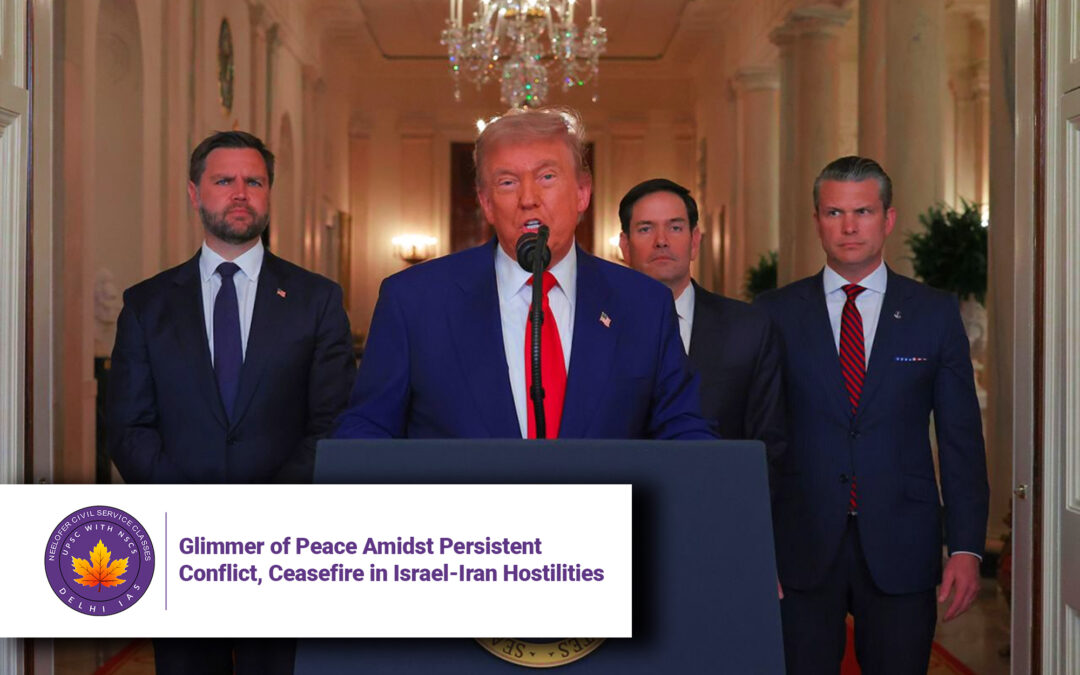
Glimmer of Peace Amidst Persistent Conflict, Ceasefire in Israel-Iran Hostilities
Why in News?
The sudden shift in US President Donald Trump’s stance on the Israel-Iran conflict—moving from threats of “total obliteration” of Iran’s nuclear program to supporting a ceasefire—has created a temporary window for peace. The 12-day conflict that posed threats beyond West Asia has paused, but deeper issues continue to simmer. 
Introduction
On Sunday night, Trump claimed Iran’s nuclear weapons programme had been completely destroyed. However, by Monday, he advocated a ceasefire, catching global observers by surprise. The US, Iran, and Israel welcomed the halt to violence, but with skepticism. The ceasefire is seen more as a pause in hostilities than a resolution to the root causes.
Key Developments
-
The ceasefire followed Trump’s announcement, Israel’s cautious acceptance, and Iran’s measured response, which included a veiled warning via actions in Qatar.
-
Despite initial calm, hostilities resumed briefly, questioning the durability of the ceasefire.
-
Trump’s strategic gain seems more domestic, lifting pressure from internal criticism without sacrificing American lives.
-
Israel’s Prime Minister Netanyahu declared no further strikes, signaling a temporary restraint.
Major Issues Still Unresolved
-
Iran’s Nuclear Programme: The US accuses Iran of nuclear weapons ambition; Iran insists its program is peaceful.
-
Non-Proliferation Pressure: Tensions mount over access to Iran’s facilities by the International Atomic Energy Agency (IAEA).
-
US-Iran Distrust: The US seeks disarmament; Iran sees this as external imposition.
-
Gaza Conflict: Continued Israeli-Palestinian tensions hinder regional peace.
-
Fordo Facility Concerns: Iran’s uranium enrichment at the Fordo site remains a sticking point, with ambiguity over its current status.
Challenges and the Way Forward
-
Lack of Trust: Any future peace depends on credible verification and mutual confidence.
-
Nuclear Oversight: Renewed dialogue on nuclear limits and IAEA access is essential.
-
Domestic Political Factors: In both the US and Israel, domestic agendas influence foreign policy moves.
-
Regional Stability: The European Union’s proposal for regional peace through diplomatic means must be revived.
Conclusion
While the ceasefire offers a short-term break, it does not address the long-term roots of conflict. Unless diplomatic channels are reopened and nuclear negotiations restart with transparency and commitment, peace will remain fragile. The world may be breathing easier, but only time will tell if the ceasefire leads to real stability or simply delays further strikes.
5 Questions & Answers
1. What recent development has brought temporary calm in the Israel-Iran conflict?
A ceasefire was announced after US President Trump shifted his stance and called for peace, which was cautiously supported by Israel and Iran.
2. Why is Trump’s change in narrative significant?
Trump shifted from a warlike tone promising to “obliterate” Iran’s nuclear program to promoting a ceasefire, likely aiming to reduce domestic pressure in the US.
3. What are the long-term concerns beyond the ceasefire?
Unresolved issues include Iran’s nuclear ambitions, IAEA access to Iranian sites, and continued unrest in Gaza.
4. How did Iran and Israel react to the ceasefire call?
Iran issued a warning by targeting US facilities in Qatar but restrained from escalation. Israel’s Netanyahu pledged not to carry out further strikes for now.
5. What is the international community’s role in this situation?
The international community, especially the EU, needs to revive and reinforce diplomatic channels to address nuclear verification and regional peace.

