
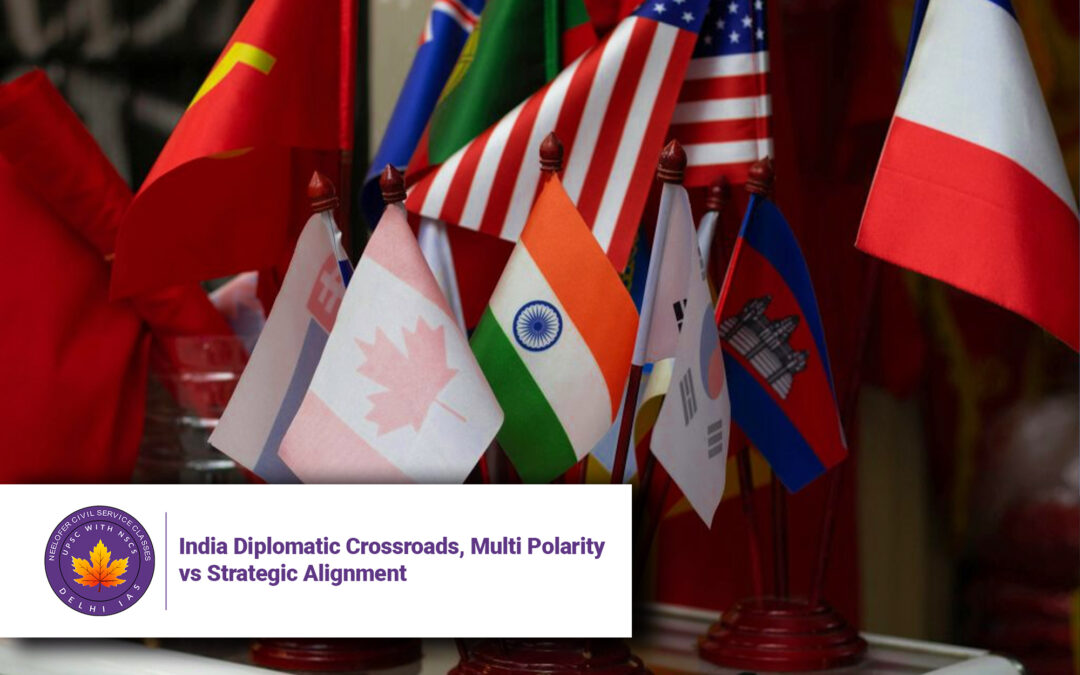
India Diplomatic Crossroads, Multi Polarity vs Strategic Alignment
Why in News?
A significant moment in global geopolitics unfolded recently at the United Nations Security Council (UNSC), where Pakistan and Russia backed a resolution condemning Israeli attacks on Iran’s nuclear facilities. The incident highlighted a sharp contrast in how countries like Pakistan and India are engaging with evolving global power dynamics—especially amidst rising tensions in West Asia.
Introduction
India has long championed a multi-polar world order, advocating for balanced diplomacy, non-alignment, and strategic autonomy. However, recent moves—particularly India’s increasing closeness with Israel and the U.S.—raise questions about whether its current foreign policy direction is consistent with its traditional diplomatic principles. Meanwhile, Pakistan has displayed an unusual level of diplomatic flexibility, balancing ties with Iran, China, the U.S., and even Russia. 
Key Issues
1. India’s Embrace of Israel
India’s deepening ties with Israel, particularly under Prime Minister Narendra Modi, signify a strategic shift. Israel, once considered a hostile power, is now viewed as a vital defence and technology partner. However, this closeness, especially when Israel is under global scrutiny for its actions in Gaza and Iran, puts India at odds with its past diplomatic approach.
2. Pakistan’s Strategic Autonomy
Ironically, Pakistan—often seen as diplomatically rigid—is exercising strategic autonomy. It supported Iran at the UN alongside Russia, while also maintaining a working relationship with the U.S. This signals Pakistan’s attempt to stay relevant in regional power play without fully aligning with any one bloc.
3. India’s Missed Opportunity at the UNHRC
India’s abstention from the vote condemning Israeli actions at the UN Human Rights Council (UNHRC)—despite its traditionally vocal stance on human rights—has led to criticism that India is drifting away from its balanced policy position, prioritizing short-term strategic gains.
4. Historical Perspective: Lessons from Rao & Singh
Former Prime Ministers Narasimha Rao and Manmohan Singh are cited as examples of wise foreign policy strategists. Rao’s balanced approach with Iran and Singh’s quiet diplomacy with both China and the U.S. ensured India’s geopolitical standing remained nuanced. Today’s foreign policy, by contrast, appears more reactionary and ideologically driven.
5. The China Factor
Both India and Pakistan are aligning their foreign policies with the broader regional chessboard, especially considering China’s influence in the region. Pakistan’s growing closeness with China and Russia and India’s pivot to the U.S. and Israel reflect a splintering of the old non-aligned order.
Challenges and the Way Forward
-
Maintain Strategic Balance: India needs to avoid over-commitment to any one power bloc. Balancing ties with Israel and Iran, and the U.S. and Russia, is critical.
-
Revive Smart Diplomacy: The foreign policy must return to the pragmatic, calculated moves that marked Rao and Singh’s era.
-
Engage the Islamic World: India’s silence on Muslim issues globally (e.g., Gaza, Uighurs, etc.) could alienate allies in the Middle East.
-
Avoid Short-Termism: A reactive foreign policy may deliver immediate gains but harm long-term global positioning.
Conclusion
India finds itself at a strategic crossroads, caught between its aspiration for global leadership and the need to preserve its traditional diplomatic identity. While India publicly champions multi-polarity, its recent diplomatic behaviour may be pulling it closer to unilateral alignments. The challenge is to balance ambition with wisdom—a lesson both India and Pakistan seem to be learning in very different ways.
5 Q&A Based on the Article
1. What is the central concern about India’s recent foreign policy direction?
India’s increasing closeness with Israel and the U.S. seems to contradict its long-standing advocacy for a balanced, multi-polar world order.
2. How has Pakistan displayed strategic autonomy at the UN?
Pakistan supported a Russia-backed resolution condemning Israel’s actions on Iran, showing independence in its foreign policy decisions.
3. Why was India’s abstention at the UNHRC controversial?
India chose not to support a resolution condemning Israel’s alleged human rights violations, which some see as a departure from its usual human rights advocacy.
4. Who are cited as examples of India’s past balanced diplomacy?
Former Prime Ministers Narasimha Rao and Manmohan Singh are praised for their calculated, non-aligned foreign policy.
5. What is the suggested way forward for India?
India should maintain balance in its global alliances, avoid reactive diplomacy, and revive its tradition of ‘smart power’ and strategic autonomy.
