
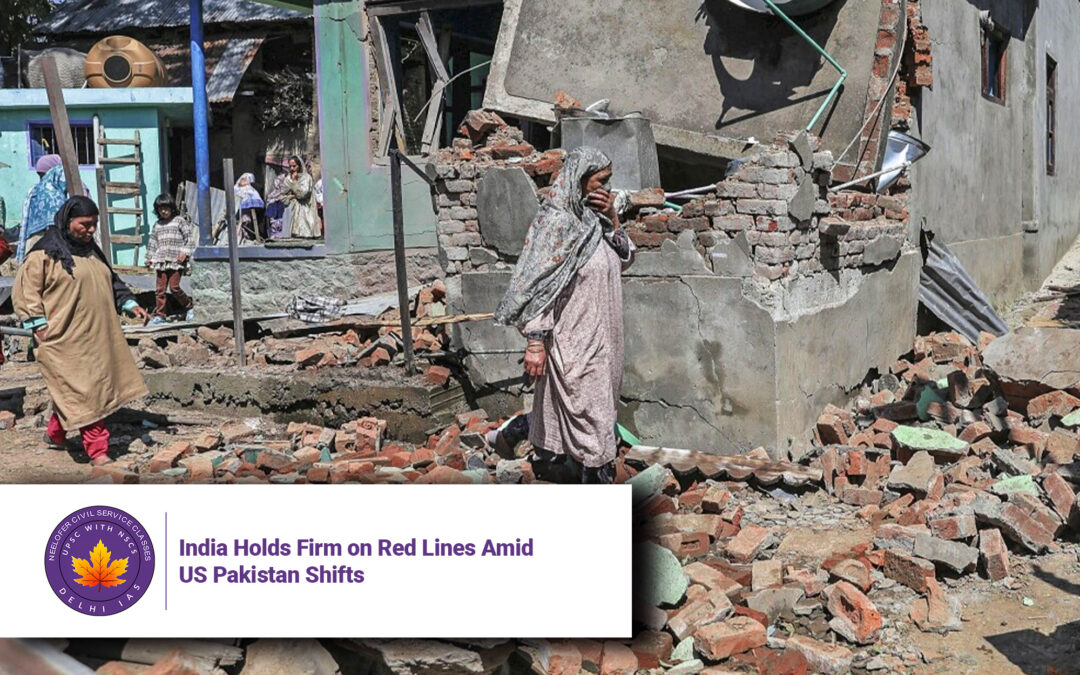
India Holds Firm on Red Lines Amid US Pakistan Shifts
Why in News?
A rare and notable event recently unfolded as General Asim Munir, Pakistan’s Army Chief, met with former US President Donald Trump at the White House. This has stirred new attention to the evolving dynamics between the US, Pakistan, and India—especially amid India’s strong stance on cross-border terrorism and strategic redlines drawn in response to Pakistan’s actions. 
Introduction
India has remained firm in its strategic positioning even as diplomatic equations shift rapidly. The recent engagement between General Munir and Trump, reportedly endorsed by the US crypto firm WLF and allegedly supported by influential lobbying, signals a possible thawing in US-Pakistan ties. However, India has made it clear that any such overtures cannot ignore its legitimate security concerns.
Background
In 2018, Trump famously accused Pakistan of deceit, citing over $33 billion in aid and accusing Islamabad of providing safe havens to terrorists. However, Trump’s statement during a recent interview—“I love Pakistan”—signaled a potential softening of rhetoric.
General Munir’s presence at the White House as the first Pakistani military chief to be so received underscores a shifting narrative. But this visit is mired in optics—alleged proposals to nominate Trump for a Nobel Peace Prize and rumored funding routes from WLF.
India’s Response and Strategic Posture
India’s firm rejection of any third-party tolerance for Pakistan-sponsored terrorism has been communicated through decisive actions such as Operation Sindoor, and by holding Pakistan accountable for attacks such as the Pulwama bombing, where 26 Indian soldiers were martyred.
-
India’s Red Lines: These include non-tolerance for attacks orchestrated via Pakistan’s soil and opposition to strategic ambiguity in nuclear and proxy warfare.
-
Operation Sindoor: Reinforced Delhi’s resolve by demonstrating its ability to strike back and punish terror sanctuaries even when shielded under nuclear ambiguity.
The Strategic Equation
-
Geography and Iran Factor: Pakistan’s proximity to Iran and its 900-km border may make it a tactical asset for Washington in the current West Asia calculations.
-
US Domestic Optics: Trump’s perceived outreach to Munir may be more about image-building and political theater, rather than a fundamental change in US foreign policy.
India, meanwhile, has warned that any policy shift which legitimizes Pakistan’s use of “proxies” and fails to hold it accountable for cross-border terrorism will have consequences on global order and India-US strategic cooperation.
Conclusion
While the optics of a Trump-Munir engagement may hint at recalibration, India has stood its ground—both diplomatically and militarily—on its core national security interests. The red lines drawn by Delhi in the wake of repeated provocations and attacks are firm. India’s strategic message is clear: any engagement with Pakistan must not come at the cost of legitimizing or ignoring terror networks operating from its soil.
Q&A Section
Q1. Who is General Asim Munir and why is his US visit important?
A1. General Asim Munir is Pakistan’s Army Chief. His visit to the US and meeting with Donald Trump is notable as it signals renewed engagement between the two countries.
Q2. What is India’s concern with US-Pakistan proximity?
A2. India is wary that the US might overlook Pakistan’s record of sponsoring cross-border terrorism, undermining regional security.
Q3. What does ‘Operation Sindoor’ symbolize for India?
A3. It represents India’s proactive stance against terrorism and its willingness to respond militarily when provoked.
Q4. What are India’s strategic red lines?
A4. India’s red lines include zero tolerance for terrorism emanating from Pakistan, rejection of proxy warfare, and upholding sovereignty in strategic and security matters.
Q5. How does Iran factor into this geopolitical dynamic?
A5. Pakistan’s border with Iran and its geography could make it a logistical partner for the US, particularly in a scenario of conflict or surveillance.

