
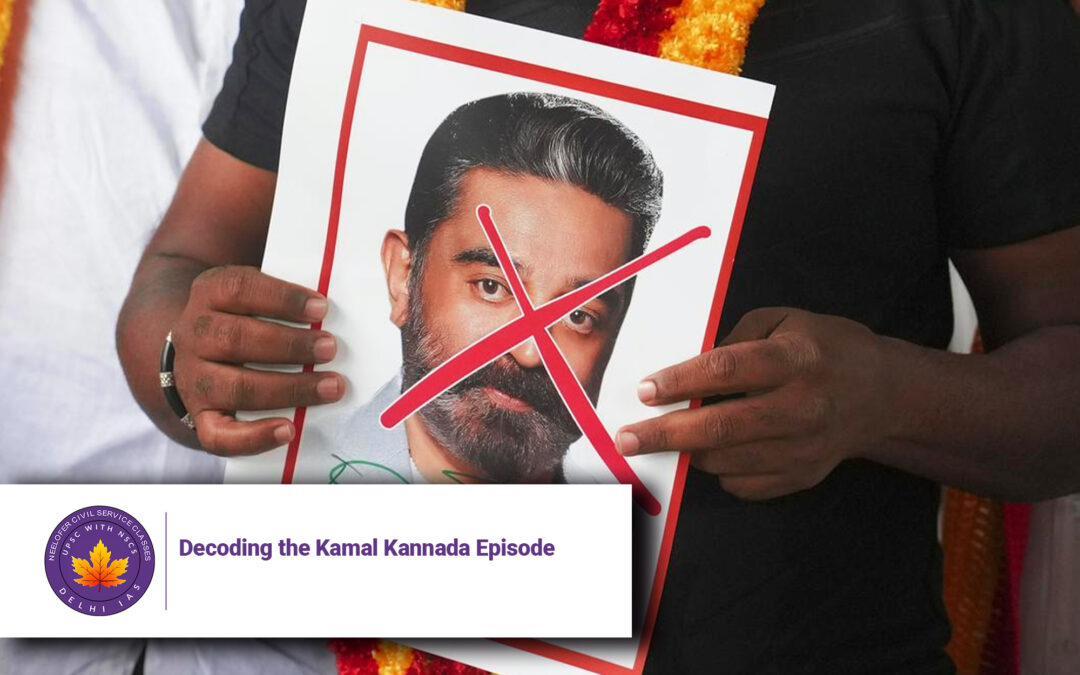
Decoding the Kamal Kannada Episode
Why in News?
A recent remark by actor Kamal Haasan that “Kannada was born from Tamil” has sparked widespread debate. Though not a new idea, this statement has reignited the Tamil linguistic discourse, drawing strong reactions from both linguistic fundamentalists and scholars. 
Introduction
The controversy revolves around language identity and historical interpretations of the relationship between Tamil and Kannada. While some see Haasan’s statement as rooted in a long-standing academic theory, others view it as an affront to Kannada language and identity.
This debate sheds light on deeper issues of multilingual coexistence in India and the need to balance freedom of speech with respect for cultural diversity.
Key Issues and Background
1. The Proto-Dravidian Theory
-
Linguists like Robert Caldwell argued that all Dravidian languages share a common origin in Proto-Dravidian.
-
Tamil nationalists, however, resist the idea of Tamil being on equal footing with other Dravidian languages. They often proclaim Tamil as the source of other languages.
2. Tamil Linguistic Pride
-
Tamil linguistic identity is tied to its ancient, rich literary tradition.
-
Some Tamil nationalists argue that Tamil should be seen as the superior language and source of all others.
-
Such ideas, while deeply rooted in cultural pride, often provoke controversy when articulated publicly.
Specific Impacts or Effects
1. Public Backlash
-
Kamal Haasan’s remarks were viewed by many Kannada speakers as insulting.
-
This led to violent threats and calls for an apology from Haasan.
-
Linguistic debates have shifted from academic discussions to emotional public confrontations.
2. Freedom of Expression
-
Haasan’s freedom to express his views must be protected.
-
However, public figures must also be sensitive to the plural linguistic landscape of India.
-
The court rightly observed that while Haasan’s speech was not criminal, violent threats against him must be treated seriously.
3. Political Misuse
-
Political groups often exploit linguistic issues for identity politics.
-
This escalates tensions and undermines India’s multilingual harmony.
Challenges and the Way Forward
Challenges
-
Linguistic fundamentalism poses a threat to freedom of speech and pluralism.
-
Lack of academic consensus on linguistic origins further fuels conflict.
-
Political opportunism often worsens such debates.
Way Forward
-
Opposition to views must be non-violent and respect democratic norms.
-
Courts must ensure free expression is protected while punishing those who issue violent threats.
-
Intellectuals and public figures must promote an ethos of mutual respect in India’s multilingual society.
-
The media must avoid sensationalising linguistic debates and instead foster reasoned discussion.
Conclusion
The Kamal-Kannada episode reflects deeper challenges in managing India’s linguistic diversity. While academic debates about language origins are valid, they should not be used to provoke or belittle others.
At the same time, any attempt to suppress speech through threats of violence must be firmly rejected. India’s strength lies in its pluralism and ability to engage in dialogue without compromising freedom of expression or mutual respect.
5 Questions & Answers
Q1: What triggered the Kamal-Kannada controversy?
A: Kamal Haasan stated that “Kannada was born from Tamil,” sparking strong reactions, especially from Kannada speakers.
Q2: What is the Proto-Dravidian theory?
A: It is the linguistic theory that all Dravidian languages, including Kannada and Tamil, originated from a common ancestor called Proto-Dravidian.
Q3: How did the public react to Kamal Haasan’s remark?
A: The remark led to a wave of public backlash, with violent threats issued against Haasan and calls for an apology.
Q4: What was the court’s observation on the matter?
A: The court ruled that Haasan’s speech was not criminal, but stressed that violent threats must be treated as punishable crimes.
Q5: What is the way forward in such linguistic debates?
A: Promote non-violent, reasoned discourse, protect freedom of expression, and encourage respect for linguistic diversity.

