
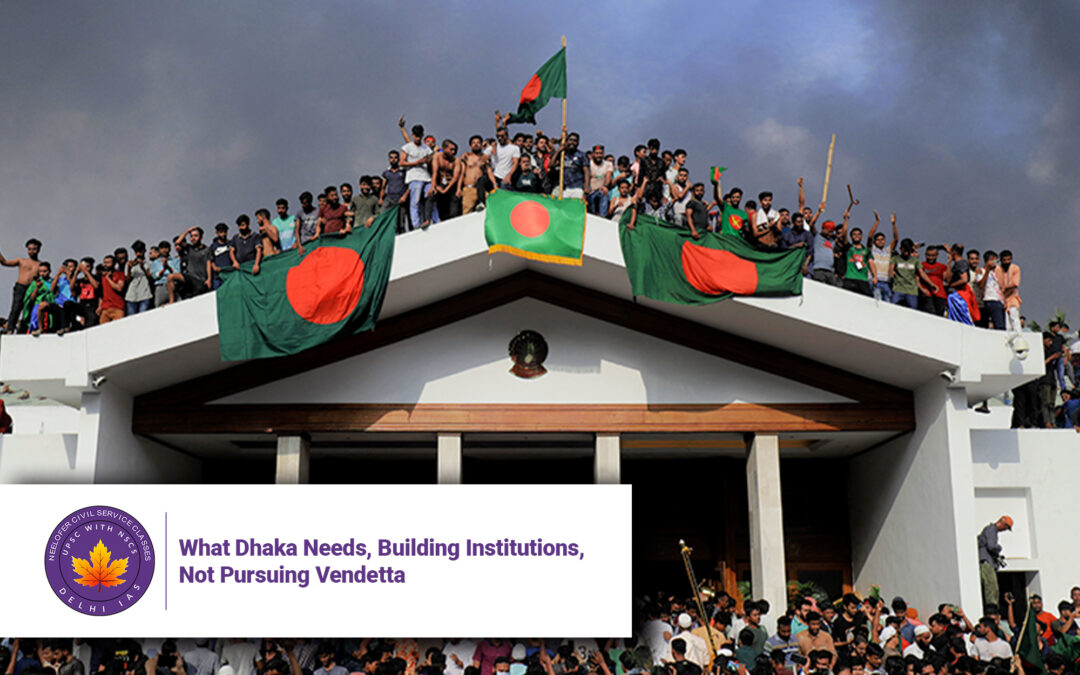
What Dhaka Needs, Building Institutions, Not Pursuing Vendetta
Why in News?
Bangladesh stands at a crucial political crossroads. The recent actions by its interim government and judicial processes have triggered international concern. As Bangladesh prepares for a new chapter, the focus must shift from revenge politics to institution building to ensure long-term democratic stability. 
Introduction
Bangladesh’s political environment has remained tense despite the promise of reforms. The interim government headed by Muhammad Yunus initially brought hope of a new consensus between political parties and civil forces, but recent developments—including the banning of the Awami League and actions against its leader Sheikh Hasina—have raised alarm.
Key Issues and Institutional Concerns
1. Targeted Actions Against Political Leaders
-
The UN Office of the High Commissioner for Human Rights released a fact-finding report documenting human rights abuses in Bangladesh from July 1 to August 15, 2024.
-
Over 14,000 political leaders and activists have been arrested.
-
The current actions against Sheikh Hasina and the Awami League resemble a cycle of revenge politics, not democratic accountability.
2. Question of Fair Trials
-
Sheikh Hasina is being tried in absentia, raising serious questions about the fairness of the process.
-
The UN Human Rights Office emphasized that any trials should meet international fair trial standards.
-
Crimes against humanity, such as those linked to war crimes, cannot be used as political tools without due process.
3. International Concerns
-
The International Criminal Court (ICC) may review whether such trials adhere to international standards.
-
The principle that justice delayed is not justice denied applies here, but must not be exploited for political vendetta.
4. Lessons from International Law
-
War crimes and crimes against humanity are not subject to statutes of limitation.
-
However, justice must be applied through proper institutions and not as an instrument of political power.
5. Building Democratic Institutions
-
The focus must be on creating strong democratic institutions that guarantee rule of law and due process.
-
Bangladesh needs institutional reforms, not a return to personalized rule or retribution.
-
Many citizens, particularly the youth, demand a governance framework based on transparency and accountability.
Conclusion
As Bangladesh moves forward, it must break with the past. The temptation to use judicial mechanisms to settle political scores is dangerous. Instead, Bangladesh should prioritize building robust institutions that safeguard the rights of all citizens. Only through such an approach can the country secure a truly democratic future.
Q&A Section
Q1. What recent event triggered international concern about Bangladesh’s political situation?
The interim government’s actions against the Awami League and Sheikh Hasina, including her trial in absentia, raised international alarm.
Q2. What did the UN Human Rights Office report on Bangladesh?
It documented human rights abuses and the arrest of over 14,000 political leaders and activists between July 1 and August 15, 2024.
Q3. Why is Sheikh Hasina’s trial controversial?
The trial is being conducted in absentia, raising questions about its fairness and compliance with international standards.
Q4. What role does the International Criminal Court (ICC) play in this issue?
The ICC monitors whether trials of war crimes or crimes against humanity adhere to international legal standards and are not politically motivated.
Q5. What is the editorial’s main recommendation for Bangladesh?
Bangladesh should focus on building strong democratic institutions and rule of law, rather than pursuing revenge politics.
