
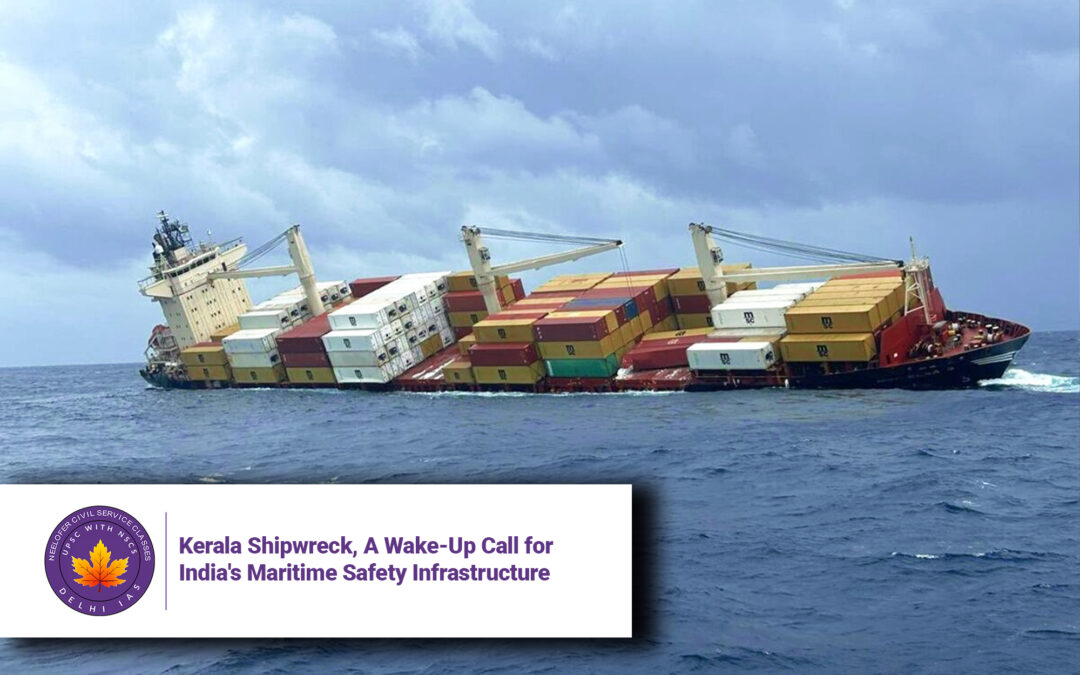
Kerala Shipwreck, A Wake-Up Call for India’s Maritime Safety Infrastructure
Why in News?
The recent shipwreck off the coast of Kerala has once again highlighted the high-risk stakes of India’s busy shipping routes. With major vessels frequently navigating through Indian waters—especially near Kerala—it is crucial to build robust emergency response systems to manage potential disasters like oil spills.
Introduction
Kerala, often seen as a peaceful and scenic coastline, is paradoxically also a high-risk zone due to heavy maritime traffic. The increasing frequency of Very Large Crude Carriers (VLCCs) and cargo ships passing through this region means that any accident could have environmental and economic consequences. 
Key Issues and Institutional Concerns
-
Kerala’s coastline resembles a “home on a highway.” At any time, ships may turn into disasters, especially oil tankers.
-
Recently, a vessel sank off the coast of Kerala. Though it wasn’t carrying a full oil cargo, it still had fuel tanks filled with furnace oil, creating a high spill risk.
-
The major concern is India’s lack of a tier-3 oil spill response capability. There is:
-
No stockpiled gear or ready equipment.
-
No local availability of international-grade cleanup tools.
-
Reliance on foreign cooperative networks like OSRL (Oil Spill Response Limited) based in Singapore or Bahrain.
-
-
The current framework assumes shared responsibility between vessel operators, charterers, port authorities, and insurers, often leaving gaps in actual emergency response.
Lessons from the Shipwreck
-
Heavy oil spills require immediate action. The spill spreads rapidly, turns into viscous ‘mousse’ and becomes environmentally dangerous.
-
Sunken vessels remain hazards long after the accident. Rusting tanks can slowly leak oil for years.
-
The lack of pre-stocked gear delays response, especially in India’s diverse terrain like Kerala’s rocky, sandy, and forested coasts.
-
India needs to develop its own technology and logistics infrastructure to deploy response systems swiftly across all coastal states.
-
The X-Press Pearl incident in 2021 off Sri Lanka’s coast was a harsh lesson. Containers carrying chemical waste were not tracked well, and there was no equipment to skim hazardous content from the water.
The Way Forward
-
Create a tiered, Indian-owned oil spill response system.
-
Use innovative Indian tech, not just import models.
-
Stockpile critical gear near key ports and deploy emergency training programs.
-
Legislate tighter safety compliance for vessels entering Indian waters.
-
Build cooperation between coastal states, shipping firms, port authorities, and insurance companies.
Conclusion
India cannot afford to be reactive anymore. With one of the busiest shipping lanes passing through its waters, especially near Kerala, the balance between maritime revenues and risk must be taken seriously. Let’s use our geographic advantage wisely—and invest in preparedness, not just post-crisis solutions.
Q&A Section
Q1. Why is the Kerala coastline considered risky despite being scenic?
Because it lies along a busy shipping route where VLCCs and cargo ships pass frequently, increasing the chance of maritime accidents.
Q2. What was lacking during the recent Kerala shipwreck?
India lacked a tier-3 oil spill response system with no local stockpiled equipment or trained emergency crew, relying on foreign-based organizations.
Q3. What are the dangers of oil spills from sunken ships?
Oil like furnace oil becomes mousse-like and difficult to contain, and over time, corroded steel tanks leak oil into marine ecosystems.
Q4. What lesson can India learn from the X-Press Pearl incident?
That chemical-laden containers lost in the sea are a real threat and require real-time tracking and responsive equipment, which India currently lacks.
Q5. What steps should India take to mitigate future maritime risks?
India should build domestic response capabilities, stockpile emergency equipment at ports, train personnel, and enforce stricter vessel compliance laws.

