
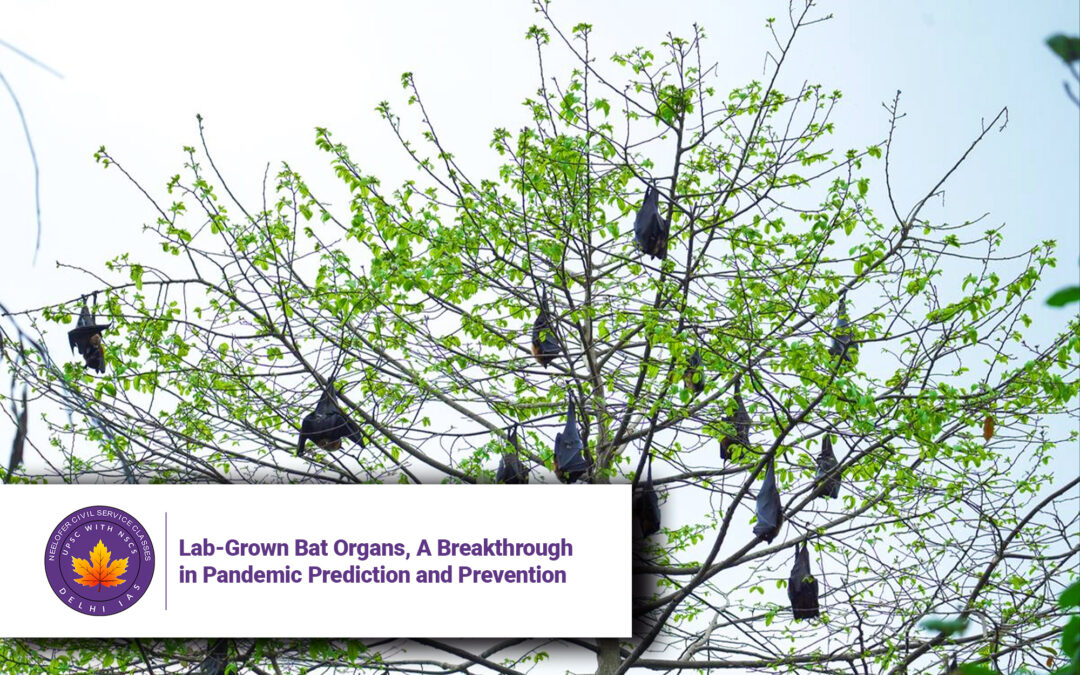
Lab-Grown Bat Organs, A Breakthrough in Pandemic Prediction and Prevention
Why in News?
Scientists have developed the world’s most comprehensive platform of lab-grown bat organoids and immortalized bat cell lines, marking a significant leap in understanding how bats harbor deadly viruses without falling ill. Published in Science and PLoS Biology, these studies could revolutionize India’s preparedness for future pandemics, given its rich bat diversity and history of zoonotic outbreaks like Nipah. 
The Science Behind Bat Organoids and Cell Lines
Bats are natural reservoirs for viruses like SARS-CoV-2, Ebola, and Nipah, yet they rarely show symptoms. Traditional research tools have failed to replicate bat-virus interactions accurately. Two groundbreaking studies address this gap:
-
Bat Organoids:
-
Developed from five insect-eating bat species (Asia/Europe), mimicking lungs, kidneys, intestines, and trachea.
-
Exposed to viruses like SARS-CoV-2, MERS-CoV, and influenza, revealing species-specific vulnerabilities. For instance, SARS-CoV-2 could only infect bat respiratory tissues when modified with a human gene (TMPRSS2).
-
Isolated two new viruses from wild bat fecal samples: a mammalian orthoreovirus and a paramyxovirus.
-
-
Immortalized Bat Cell Lines:
-
Created from Seba’s short-tailed fruit bat (Carolila perspicillata), supporting replication of MERS-CoV and hantaviruses.
-
Enable high-throughput testing of viral entry and immune responses, complementing organoid studies.
-
Why This Matters for India
-
Rich Bat Diversity: India hosts 120+ bat species, but virological data are scarce. Antibodies to Ebola and Marburg have been detected in Northeast bats, while Kerala’s Nipah outbreaks are linked to fruit bats.
-
Research Challenges: Legal restrictions, biosafety concerns, and inadequate infrastructure hinder bat studies.
-
Policy Push: The Government of India launched an inter-ministerial initiative in April 2024 to study zoonotic risks.
Key Benefits of the New Tools:
-
Safer Research: Avoids direct handling of wild bats, reducing biosafety risks.
-
Precision Insights: Reveals why some viruses jump to humans and others don’t.
-
Pandemic Preparedness: Enhances surveillance of emerging viruses in Indian bats.
Challenges and the Way Forward
-
Scalability: Expanding organoid models to cover India’s diverse bat species.
-
Collaboration: Partnering with global repositories (e.g., ATCC) to access cell lines.
-
Funding: Prioritizing research on high-risk species (e.g., Pteropus fruit bats).
Conclusion
These innovations transform bats from enigmatic virus reservoirs into predictable sentinels for pandemics. For India, integrating organoid and cell-line research could decode the Nipah mystery, monitor Northeast bats for Ebola-like viruses, and ultimately shield the nation from future zoonotic threats.
5 Key Questions Answered
Q1: What are bat organoids, and how do they help pandemic research?
A: Lab-grown tissues that mimic real bat organs, enabling safe study of virus-host interactions without live bats.
Q2: Why couldn’t SARS-CoV-2 infect bat organoids naturally?
A: Bat respiratory tissues lack TMPRSS2, a human gene critical for viral entry.
Q3: How do these studies address India’s Nipah virus challenges?
A: Organoids can test Kerala’s fruit bats for Nipah susceptibility, guiding outbreak prevention.
Q4: What’s the advantage of immortalized bat cell lines?
A: They allow rapid, large-scale virus testing and immune response analysis.
Q5: What’s the next step for India’s bat research?
A: Leveraging these tools to study high-risk species and align with the national zoonotic risk initiative.

