
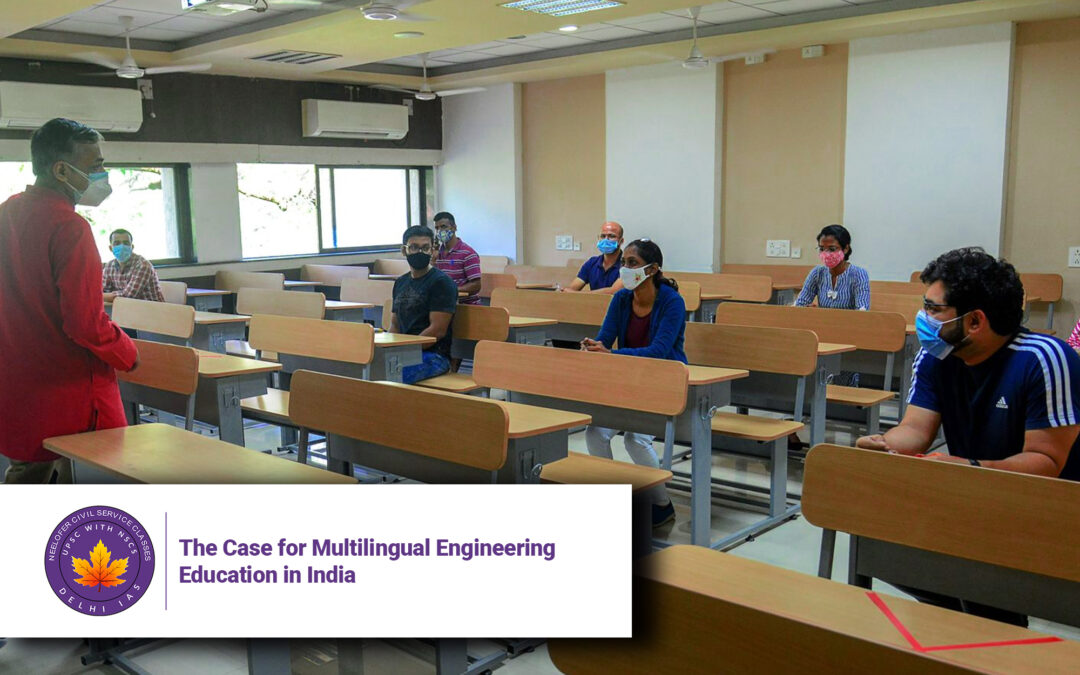
The Case for Multilingual Engineering Education in India
Why in News?
The debate over language in technical education has gained momentum following IIT Jodhpur’s pioneering initiative to offer first-year B.Tech courses in Hindi. This move aligns with the National Education Policy (NEP) 2020’s vision of leveraging mother tongues to enhance learning outcomes, challenging the decades-long dominance of English in India’s engineering education system.

Key Issues and Challenges
1. The English Barrier in Technical Education
-
Linguistic Exclusion: 94% of Indians are not English-literate, creating an accessibility gap in engineering education.
-
Rural-Urban Divide: Students from vernacular mediums often struggle with technical jargon, despite strong analytical abilities.
-
Global vs. Local: While English remains the lingua franca of science, its monopoly in classrooms alienates non-native speakers.
2. NEP 2020 and the Push for Multilingualism
-
The policy advocates instruction in regional languages to improve comprehension and inclusivity.
-
IIT Jodhpur’s Pilot: Offering Hindi-medium courses resulted in:
-
Higher participation from Hindi-belt students (80% of intake).
-
Improved academic performance (e.g., vernacular-medium students securing top grades).
-
Enhanced confidence, as noted by students like Kanak Khandelwal: “We think in Hindi, so we ask questions more easily.”
-
3. Societal and Systemic Hurdles
-
Perception Bias: Vocational and vernacular education is often stigmatized as inferior.
-
Implementation Gaps: Lack of standardized textbooks, bilingual faculty, and tech tools for translation.
Benefits of Mother Tongue-Based Engineering Education
-
Deeper Conceptual Clarity: Studies show complex topics are better grasped in native languages.
-
Inclusivity: Empowers rural/semi-urban students to compete equitably.
-
Cultural Relevance: Solutions designed by engineers rooted in local contexts address India-specific challenges.
-
Global Competence: Multilingual engineers are more adaptable in international collaborations.
Way Forward
-
Policy Implementation:
-
Scale up IIT Jodhpur’s model to other institutes and languages (e.g., Tamil, Bengali).
-
Develop standardized technical glossaries in Indian languages.
-
-
Technology Integration:
-
Use AI tools for real-time translation of lectures and study materials.
-
Create multilingual digital platforms (e.g., SWAYAM in regional languages).
-
-
Faculty and Infrastructure:
-
Train bilingual educators and incentivize vernacular-medium teaching.
-
Collaborate with states to align school and college curricula.
-
-
Changing Mindsets:
-
Highlight success stories of multilingual engineers.
-
Partner with industries to value language diversity in hiring.
-
Conclusion
India’s journey to becoming a Viksit Bharat and Vishwa Guru in technology hinges on making engineering education accessible to all. By embracing multilingual instruction, we can democratize learning, foster innovation, and unlock the potential of millions of students currently sidelined by language barriers. As IIT Jodhpur’s experiment proves, the future of engineering is not English-only—it is “English-and.”
5 Key Questions
Q1: Why is English a barrier in Indian engineering education?
*A1: It excludes 94% of non-English-literate Indians, especially rural students, despite their technical aptitude.*
Q2: How has IIT Jodhpur’s Hindi-medium initiative performed?
*A2: Improved grades, participation, and confidence among Hindi-background students in its pilot semester.*
Q3: What does NEP 2020 say about language in education?
A3: It promotes mother tongues for better learning outcomes while retaining English for global needs.
Q4: How can technology aid multilingual engineering education?
*A4: AI translation tools, bilingual e-resources, and platforms like SWAYAM can bridge language gaps.*
Q5: Will regional-language engineers be globally competitive?
A5: Yes—multilingual engineers combine local relevance with adaptability, a key asset in global tech.

