
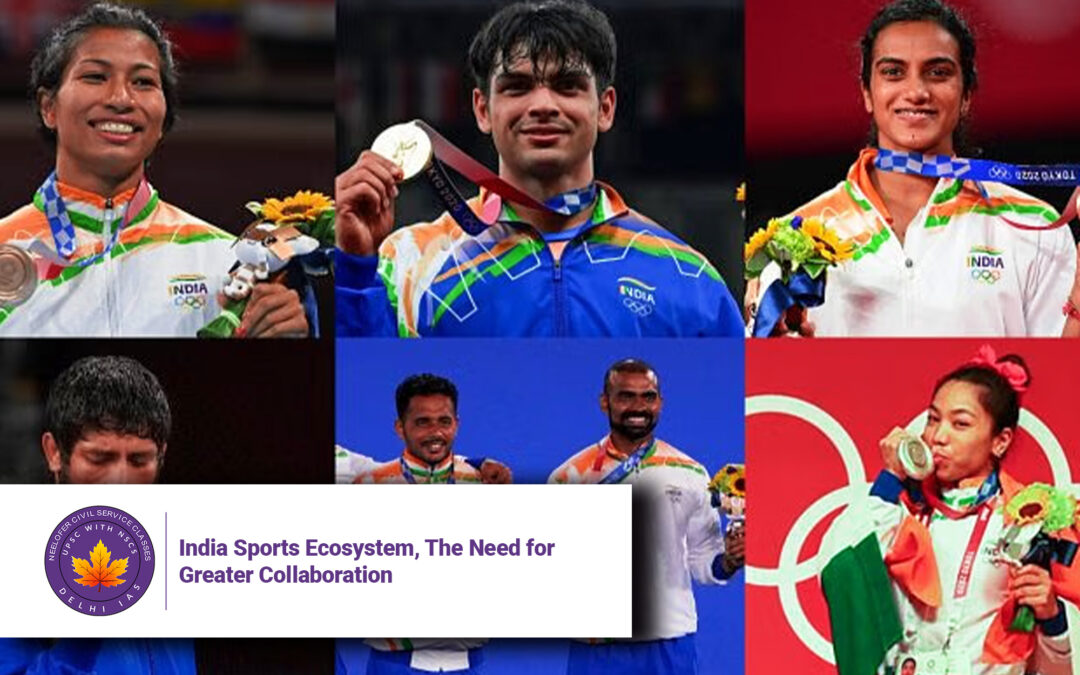
India Sports Ecosystem, The Need for Greater Collaboration
Why in News?
Bhavit Sheth, Co-founder and COO of Dream11 & Dream Sports, recently highlighted the urgent need for collaboration between public and private institutions, corporates, and entrepreneurs to improve India’s sports ecosystem. The editorial emphasizes that to unlock India’s true sports potential, all stakeholders must come together to promote infrastructure, grassroots talent, and competitive opportunities.

Introduction
India is home to one of the world’s largest youth populations, but its success rate in global sports remains disproportionately low. This paradox exists despite a growing enthusiasm for sports among Indian youth. The article argues that the key to bridging this gap lies in collaboration—between corporate entities, government bodies, educational institutions, and local communities.
Key Issues
-
Low Contribution to Sports GDP: The sports industry in India contributes only 0.1% to the GDP, far below the global average of 0.5% to 2%.
-
Limited Employment in Sports: Globally, 2–4% of jobs are sports-related. In India, it’s just 0.1%, highlighting untapped potential for job creation.
-
Underfunded Grassroots Programs: Most sporting success stories begin at the grassroots. But structured investments in training, infrastructure, and identification of talent remain inadequate.
-
Lack of Collaboration: While initiatives by NGOs and private organizations exist, they operate in silos. This fragmentation reduces the impact of these programs.
Alternative Approaches
-
Integrated Programs: Sports should be embedded into health and education frameworks through local community efforts. For example, sports as a part of physical literacy programs, mental health awareness, or school curriculums.
-
Role of Corporates: Beyond funding, companies need to invest in scalable, inclusive initiatives that create local-level impact. For example, Dream Sports Foundation’s work in Meghalaya, J&K, and Gujarat serves as a model.
-
Use of Data and Technology: Efficient athlete tracking, performance monitoring, and AI-based scouting platforms can help recognize and support talent early.
Challenges and the Way Forward
-
Need for Uniform Vision: Public-private partnerships must work with a shared, long-term vision to build scalable sports ecosystems.
-
Lack of Trained Professionals: More trained coaches, sports scientists, and infrastructure managers are needed to ensure quality delivery.
-
Systematic Competition Structure: Athletes need frequent and structured opportunities to compete at local, regional, and national levels.
The Way Forward:
India needs an “overhauled” sports strategy rooted in equity and access. Only through deeper collaboration, inclusion of corporate stakeholders, and community engagement can India boost participation, performance, and employment in the sports sector.
Conclusion
India stands at a crossroads where interest in sports is high, but infrastructure, planning, and coordination are lacking. To make India a true sporting powerhouse, the country needs an inclusive, collaborative, and systemic approach—starting from the grassroots and moving upwards. The time to act is now.
Five Questions & Answers
1. What is the current contribution of the Indian sports industry to the national GDP?
It is only 0.1%, compared to the global average of 0.5%–2%.
2. Why is collaboration important in India’s sports ecosystem?
Because fragmented efforts by various stakeholders reduce impact. Collaboration enables scaling and improves efficiency, access, and long-term development.
3. How can sports be integrated into broader social goals?
By embedding it into education, health literacy, and mental well-being programs at the community level.
4. What are some of Dream Sports Foundation’s initiatives?
They have supported athletes and infrastructure in states like Meghalaya, Jammu & Kashmir, and Gujarat through education, training, and talent identification programs.
5. What key structural reform is needed for athlete development?
A systematic competition structure that provides regular opportunities for players to perform, improve, and be scouted.

