
Three Ancient Tombs Unearthed in Luxor, A New Window into Egypt’s Glorious Past
Why in News?
Egyptian archaeologists have unveiled three new tombs in Luxor’s Dra Abu el-Naga necropolis, believed to belong to prominent statesmen from the New Kingdom period. This discovery is being hailed as a significant scientific and archaeological breakthrough that adds to Egypt’s rich historical narrative. 
Introduction
In a momentous revelation, Egypt announced the discovery of three tombs dating back to the New Kingdom period (1550–1070 BCE) in Luxor’s ancient necropolis. These tombs, believed to belong to high-ranking officials, provide fresh insights into burial customs, artistic styles, and administrative systems of ancient Egypt.
Key Findings and Highlights
-
Tombs Belonging to Prominent Figures
-
One of the tombs was identified as belonging to Amennakht (or Ammu-en Ipet), a prominent figure from the Ramesside Period.
-
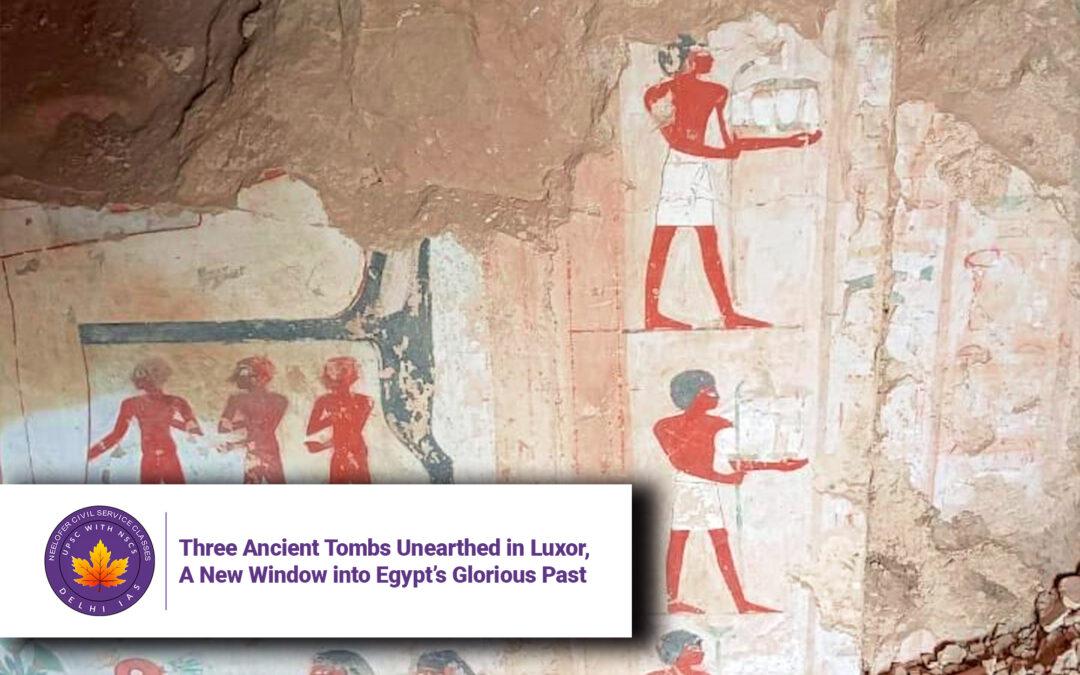
The tombs feature hieroglyphic inscriptions, burial shafts, and frescoes with colorful art depicting ancient rituals.
-
-
Two of the Tombs Connected to the 18th Dynasty
-
One tomb belonged to an official named Rai, who served as a scribe of the grain.
-
Another tomb belongs to a man named Baki, a priest and official of the Temple of Amun at Karnak.
-
-
Architectural Complexity
-
The tombs include courtyards, burial shafts, and long corridors—some leading to additional chambers.
-
One tomb features a transverse hall, a notable architectural element rarely seen in private tombs.
-
-
Artifacts and Artistic Elements
-
The ministry shared pictures showing funeral furniture, amulets, canopic jars, and tools, offering glimpses into the burial traditions of the time.
-
Hieroglyphs and wall inscriptions are crucial to understanding the lives and roles of the deceased.
-
-
Cultural and Touristic Impact
-
The Ministry of Tourism and Antiquities described the find as a “significant scientific and archaeological achievement”.
-
The discovery is expected to boost heritage tourism and attract more global visitors to Luxor, which already houses the world-famous Valley of the Kings and Karnak Temple.
-
Five Key Takeaways
-
Three new tombs have been discovered in the Dra Abu el-Naga necropolis, Luxor.
-
The tombs date back to the New Kingdom (1550–1070 BCE), Egypt’s most powerful era.
-
Tombs belonged to officials including Amennakht, Rai, and Baki.
-
The site includes courtyards, burial chambers, wall paintings, and inscriptions.
-
Egypt sees this as a boost for both archaeology and tourism, reaffirming its position as a cradle of ancient civilization.
Challenges and the Way Forward
Challenges:
-
Restoration and preservation of fragile wall paintings and artifacts is delicate and time-consuming.
-
Limited historical records about minor officials require extensive interpretation from material findings.
-
Need for global funding and technical collaboration to ensure ongoing excavation and study.
Way Forward:
-
Strengthen international partnerships to enhance research capabilities.
-
Digitally document and preserve inscriptions and wall art.
-
Promote these discoveries through museum exhibitions and documentaries to expand public engagement.
Conclusion
The unearthing of these three tombs offers a fresh chapter in Egypt’s archaeological story, shedding light on the lives of statesmen and officials during one of the country’s most prosperous eras. These findings are not only a gift to historians and archaeologists but also a magnet for tourists and history enthusiasts worldwide.
Q&A Section
1. Where were the tombs discovered?
The tombs were found in the Dra Abu el-Naga necropolis in Luxor, Egypt.
2. Which time period do the tombs date back to?
They belong to the New Kingdom period (1550–1070 BCE), particularly the 18th Dynasty and Ramesside era.
3. Who are the individuals believed to be buried in these tombs?
The tombs are believed to belong to Amennakht (a statesman), Rai (a grain scribe), and Baki (a priest of Amun).
4. What kind of structures were found within the tombs?
The tombs featured courtyards, burial shafts, wall inscriptions, artistic frescoes, and funeral items.
5. Why is this discovery considered significant?
It is hailed as a scientific and archaeological milestone, offering new insights into burial customs, administrative roles, and art of ancient Egypt, and is expected to boost tourism and historical understanding.

