
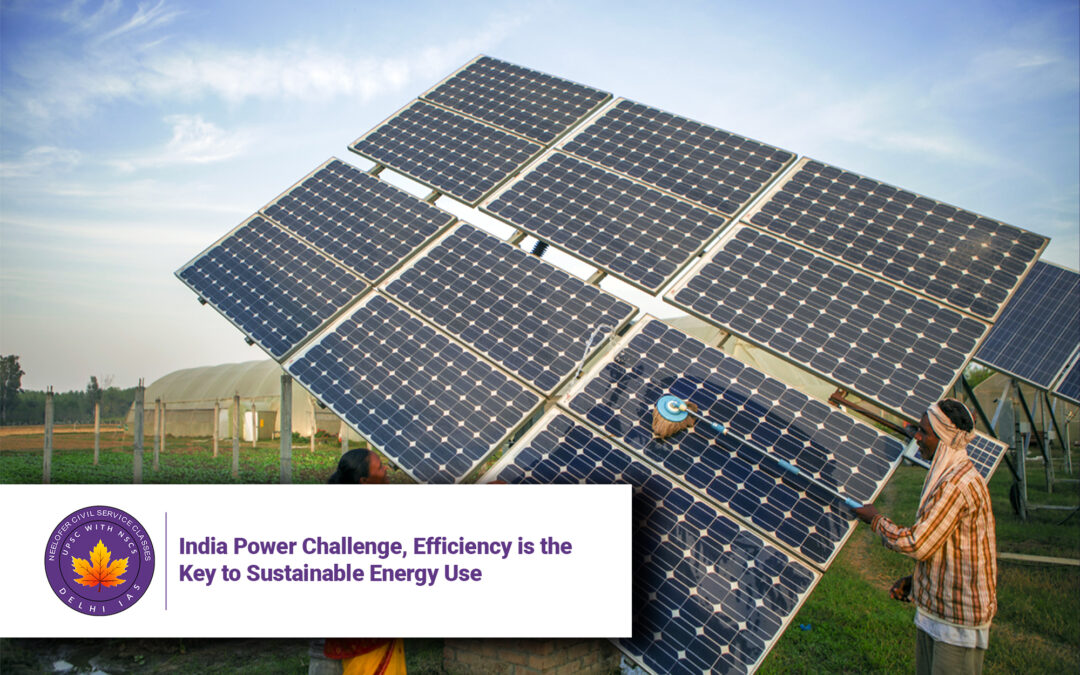
India Power Challenge, Efficiency is the Key to Sustainable Energy Use
Why in News?
India’s electricity generation has grown significantly over the last two decades, but its peak power demand continues to outpace supply. With a growing energy deficit, India is focusing on increasing efficiency to manage demand and reduce dependency on new fossil-fuel-based capacity. 
Introduction
Despite significant additions in power generation and renewable energy, India’s energy ecosystem faces a persistent challenge: rising demand and insufficient supply during peak hours. The power deficit has increased from 0.6% in FY20 to about 5% in FY24. This has prompted a shift towards energy efficiency as a quicker and more cost-effective solution.
Key Issues and Institutional Concerns
1. Rising Power Deficit
India’s peak power demand is growing faster than new energy capacity additions, leading to an energy shortfall. This threatens industrial productivity, economic growth, and household electricity reliability.
2. Need for Efficient Energy Use
Energy efficiency offers a faster and more affordable alternative to infrastructure expansion. Efficient appliances, lighting, and systems can drastically reduce consumption and peak load.
3. Government Initiatives: UJALA & SLNP
-
UJALA (Unnat Jyoti by Affordable LEDs for All): Since its launch, it has drastically reduced the price of LED bulbs from ₹300 to ₹20, driving widespread adoption.
-
Street Lighting National Programme (SLNP): Over 1.34 crore LED streetlights have been installed across India, cutting energy use by more than 1400 MW.
4. Scale of Impact
As of January 2023, 37 crore LED bulbs and over 13 lakh energy-efficient fans have been distributed. The cumulative energy savings are estimated at 50,000 million kWh annually—equivalent to the output of a 500 MW power plant.
Challenges and the Way Forward
Challenge 1: Implementation Gap
While government-led schemes have performed well, adoption in the private sector and among residential users remains uneven.
Challenge 2: Energy-Hungry Appliances
Despite efficiency gains, many households still use inefficient appliances, especially cooling and heating systems.
Challenge 3: Urban Growth and Electrification
Urbanization is pushing up energy consumption, especially in ACs and electronics, straining the grid during peak hours.
Way Forward:
-
Enforce stricter appliance standards through the Energy Conservation Act.
-
Expand coverage of UJALA and SLNP to rural and tier-2/3 cities.
-
Invest in smart grids and demand-response systems to balance load effectively.
-
Enhance public awareness about energy efficiency and long-term cost savings.
Conclusion
With the International Energy Agency (IEA) noting that nearly 40% of energy demand reduction from now until 2040 must come from efficiency, India must embrace smart energy use. By scaling up proven solutions like LED adoption and efficient appliances, India can reduce its dependence on new fossil fuel capacity and build a more sustainable energy future.
Q&A Section
Q1: What is India’s current power deficit rate?
A: It has increased from 0.6% in FY20 to about 5% in FY24.
Q2: What are UJALA and SLNP?
A: UJALA promotes affordable LED use; SLNP focuses on efficient street lighting.
Q3: How much energy does UJALA save annually?
A: Around 50,000 million kWh—equivalent to a 500 MW power plant.
Q4: What was the cost of LED bulbs under UJALA?
A: Reduced from ₹300 a decade ago to ₹20.
Q5: Why is energy efficiency important for India?
A: It’s the fastest, cheapest way to reduce power demand and meet environmental goals.
Q6: How many LED streetlights have been installed under SLNP?
A: More than 1.34 crore as of January 2023.
Q7: What global benchmark does India aim to follow?
A: The IEA’s recommendation to meet 40% of energy savings through efficiency by 2040.
Q8: What law supports energy efficiency in India?
A: The Energy Conservation Act of 2001.
Q9: What appliances are targeted for efficiency improvements?
A: LED bulbs, ceiling fans, and increasingly, air-conditioners and other home appliances.
Q10: What is the biggest benefit of energy efficiency?
A: It reduces the need for new energy capacity while lowering bills and emissions.

