
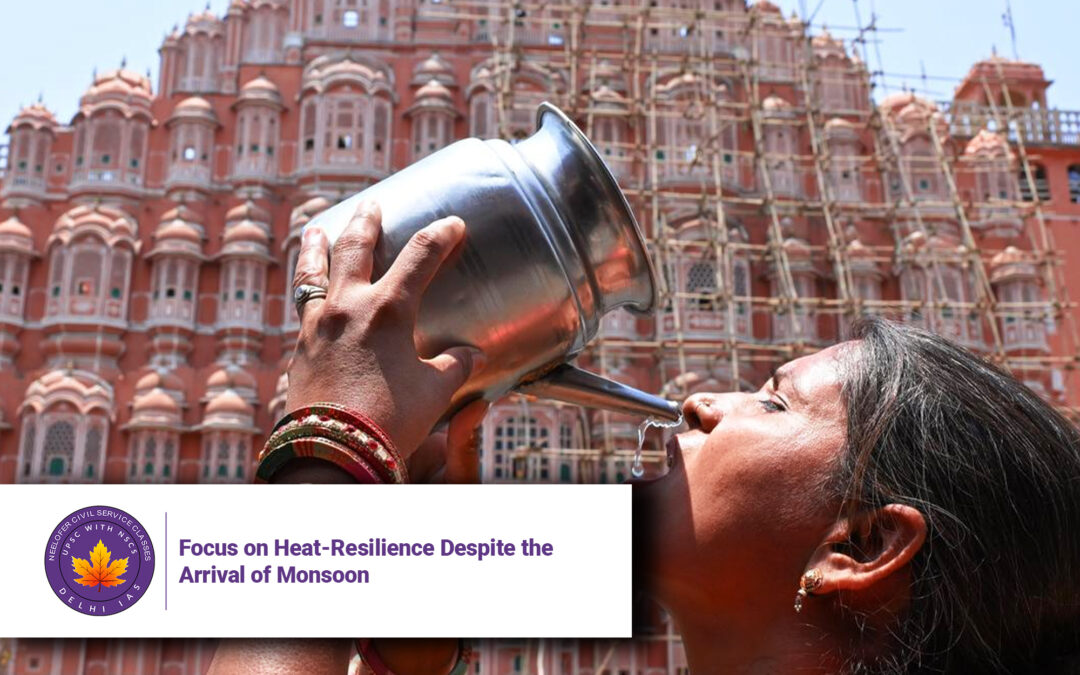
Focus on Heat-Resilience Despite the Arrival of Monsoon
Why in News?
A national conference titled ‘India 2047: Building a Climate-Resilient Future’ highlighted the urgent need for heat-resilience policies, even as the monsoon arrives. The event brought together government officials, climate experts, public health professionals, and NGOs, emphasizing that India must address heat-related health crises proactively, rather than reactively. 
Introduction
While the monsoon may seem to signal relief from rising temperatures, heat risks persist, especially due to delayed and uneven rainfall. India is highly vulnerable to extreme heat, which not only affects health but also economic productivity, urban infrastructure, and marginalized communities.
Key Issues and Background
1. Underestimated Heat Risks
-
Heatwaves are no longer a seasonal threat but an ongoing public health crisis.
-
The monsoon’s arrival doesn’t negate the heat stress, particularly in poorly ventilated and densely populated urban areas.
-
India faces rising cases of heatstroke, dehydration, heart conditions, and worsening mental health due to extreme heat.
2. Need for Systemic Heat Action
-
Traditional health systems react late or insufficiently.
-
Experts suggest anticipatory planning and early warnings, especially for vulnerable groups like the elderly, outdoor workers, and slum dwellers.
-
ASHA workers and local NGOs have been vital in distributing ORS and spreading awareness, especially in places like Ahmedabad, where their interventions have saved lives.
The Core of the Concern
India’s public health framework lacks coordinated, forward-looking policies to address extreme heat. There’s an over-reliance on episodic responses. Most health services still operate in emergency mode, with limited scope for long-term adaptation. There’s a need to mainstream heat-related illness treatment and improve primary care and community outreach.
Key Observations
-
Health professionals emphasize that heat is a climate equity issue. The most vulnerable suffer the most due to poor housing, lack of green spaces, and limited healthcare access.
-
Urban planners must rethink infrastructure: cool roofs, shaded shelters, green corridors, and accessible emergency services are essential.
-
Health workers must be trained to recognize and treat heat stroke and cardiovascular collapses linked to high temperatures.
Challenges and the Way Forward
Challenges:
-
Lack of integrated heat-health policies.
-
Limited public awareness and misinformation.
-
Inadequate data on heat-related deaths and illnesses.
-
Overlapping and fragmented health responsibilities across departments.
Steps Forward:
-
Establish ‘centres of excellence’ that combine urban planning, health, climate science, and disaster management.
-
Institutionalize the Heat Action Plans (HAPs) across cities and rural areas.
-
Prioritize climate-informed urban design.
-
Ensure community outreach through platforms like WhatsApp groups and door-to-door awareness by ASHA workers.
-
Train frontline health workers to treat and manage heat-related illnesses efficiently.
Conclusion
India must not treat the arrival of monsoon as the end of heat worries. Instead, it should see climate resilience as a year-round agenda. With rising global temperatures and unpredictable weather patterns, heat action planning must be mainstreamed, not seasonal. A collaborative, equity-focused, and technology-integrated health system will be the key to surviving a hotter, more uncertain future.
Q&A Section
-
Why is heat-resilience still important after the monsoon arrives?
Because erratic rainfall and persistent humidity continue to pose heat risks, especially in dense urban areas. -
What is the main suggestion from the national conference on climate and health?
To develop a climate-resilient, community-centered health strategy focused on anticipating and managing heat impacts. -
What role do ASHA workers play in heat resilience?
They help distribute ORS, run awareness campaigns, and check on vulnerable residents in advance of heatwaves. -
Why is heat considered a climate equity issue?
Because its worst impacts are borne by the poor, elderly, slum dwellers, and those without access to health care or cool shelter. -
What long-term strategy is recommended for India?
Move away from reactive crisis management toward integrated urban planning, climate-health collaboration, and grassroots action.

