
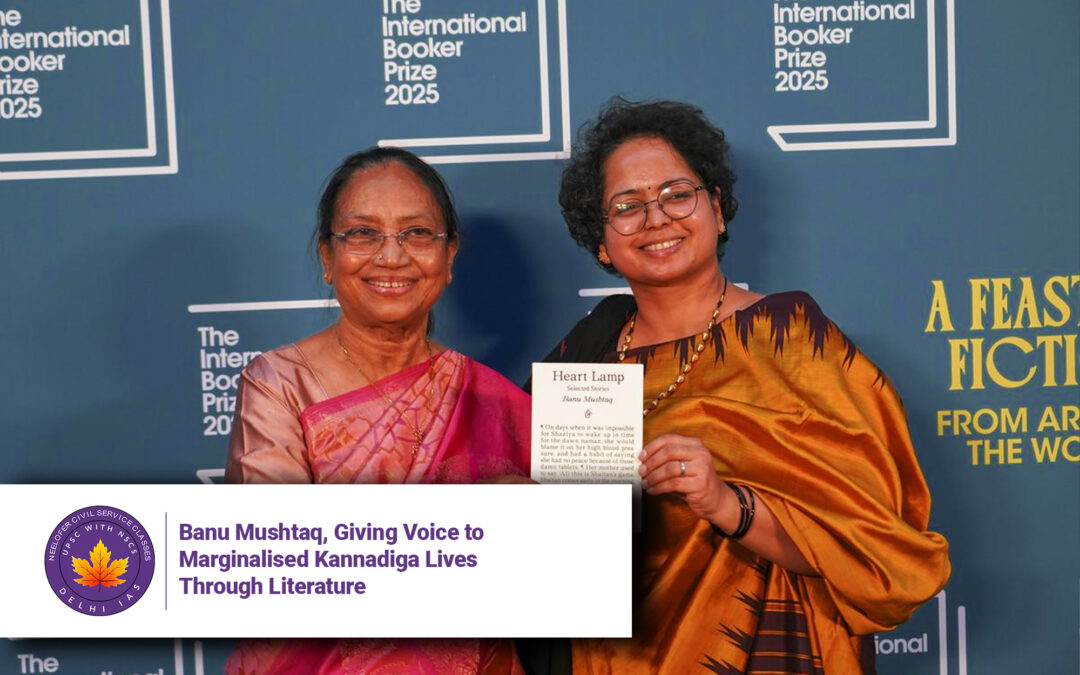
Banu Mushtaq, Giving Voice to Marginalised Kannadiga Lives Through Literature
Why in News?
Renowned Kannada writer Banu Mushtaq has received renewed attention following the English translation of her celebrated collection Harijan Lampi by scholar Deepa Bhasha. Her work has spotlighted the lives of marginalised Kannadiga communities, opening new literary and cultural dialogues in Indian and international circles. 
Introduction
Banu Mushtaq is a powerful voice from Karnataka whose stories reflect the socio-political and emotional struggles of people living on the margins—Dalits, women, religious minorities, and the working class. Through her unique lens as a Muslim woman and writer, Mushtaq has chronicled the untold stories of everyday lives with rare honesty and literary brilliance.
Key Issues and Background
1. Breaking Social Barriers in Kannada Literature
-
Banu Mushtaq was one of the first non-Brahmin women to lead a literary forum in Karnataka.
-
She created space for marginalised voices—Dalits, Muslims, women—in Kannada literature, once dominated by upper-caste perspectives.
-
Her stories were revolutionary in the way they centered on poverty, discrimination, and oppression.
2. Deepa Bhasha’s Contribution Through Translation
-
Deepa Bhasha’s English translation of Harijan Lampi introduces Mushtaq’s work to non-Kannada readers.
-
It also provides academic recognition and elevates Mushtaq’s stories to a global literary platform.
-
The translation is part of the JCB Prize’s international Booker-inspired initiative, giving voice to diverse Indian regional writers.
The Core of the Concern
-
Despite her powerful contributions, Banu Mushtaq remained relatively unknown outside Kannada-speaking regions.
-
Her work reflects gendered and communal marginalisation, often overlooked in mainstream Indian literature.
-
Mushtaq’s life and writings challenge the dominant narrative structures and advocate for the literary agency of oppressed communities.
Key Observations
-
Her storytelling captures the intersection of gender, caste, class, and religion, making it vital for academic and literary circles.
-
The universality of pain and injustice in her characters makes her work resonate beyond regional boundaries.
-
Recognition from scholars like Deepa Bhasha and institutions like the JCB Prize is helping her legacy transcend linguistic barriers.
Challenges and the Way Forward
Challenges:
-
Lack of translations limits access to regional literature from India’s non-Hindi states.
-
Marginalised voices in Indian literature are still underrepresented in national and global awards.
-
Societal prejudices may still restrict Muslim women writers from full recognition.
Steps Forward:
-
Support and fund literary translations from regional Indian languages.
-
Include voices like Mushtaq’s in mainstream academic syllabi and cultural discussions.
-
Encourage cross-cultural literary projects that amplify hidden voices from across India.
Conclusion
Banu Mushtaq’s writing is a testament to the power of storytelling from the margins. With scholars like Deepa Bhasha and platforms like the JCB Prize translating and promoting her work, the world now has a rare opportunity to discover the richness of Kannadiga literature and the resilient voices it contains. Recognising and uplifting such voices is not just a literary act—but a social and political necessity.
Q&A Section
-
Who is Banu Mushtaq?
A Kannada writer known for her stories that highlight the lives of marginalised communities in Karnataka. -
What is Harijan Lampi?
It is a short story collection by Mushtaq that explores themes of caste, gender, and poverty, now translated into English. -
Who translated her work and why is it significant?
Scholar Deepa Bhasha translated Harijan Lampi, helping introduce Mushtaq’s work to a broader, English-speaking audience. -
Why is Banu Mushtaq’s work important?
It reflects real-life struggles of communities often ignored in mainstream literature, offering both literary depth and social commentary. -
What should be done to promote such writers?
Support literary translations, include them in syllabi, and elevate marginalised voices through national and international platforms.

