
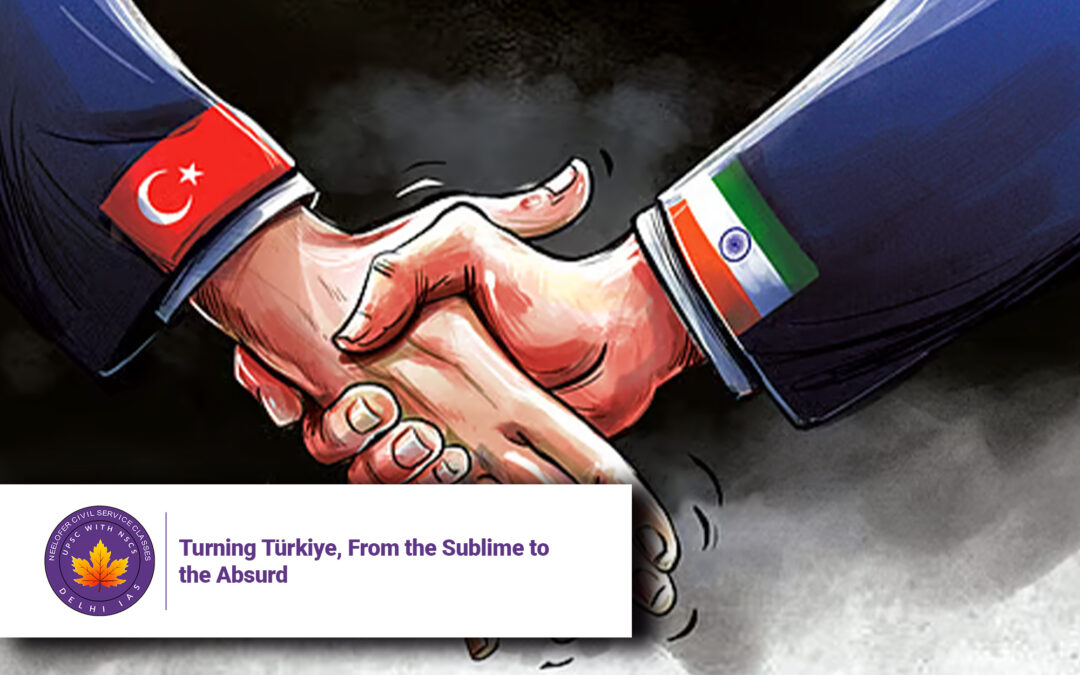
Turning Türkiye, From the Sublime to the Absurd
Why in News?
A recent shift in Türkiye’s diplomatic posture towards India, including the cancellation of a major Indian ship-building contract, has stirred concerns in New Delhi. The episode highlights deeper issues in India-Türkiye relations, which have often oscillated between promise and provocation. Former diplomat M.K. Bhadrakumar reflects on the trajectory of this relationship, warning of missed opportunities and misunderstood intentions. 
Introduction
Despite ideological differences—especially over Pakistan and Kashmir—Türkiye is an important nation for India, not only because of its strategic location and history but also its economic and technological potential. Yet, as the article outlines, diplomatic missteps and reactive foreign policy choices have prevented a mature relationship from flourishing.
Key Issues and Background
1. History of Strained Relations
The author recalls his early diplomatic posting to Türkiye during the 1980s. Even then, the relationship was complex. Türkiye’s foreign policy often leaned toward Pakistan, especially on the Kashmir issue, largely driven by its Islamic identity and leadership perceptions.
2. Missed Diplomatic Opportunities
Despite Türkiye’s openness to broader engagement beyond the India-Pakistan lens, India failed to seize opportunities. Examples include:
-
A lack of consistent high-level visits.
-
No strong follow-up after key meetings with Turkish leadership.
-
Ignoring Türkiye’s cultural and strategic overtures.
3. Symbolic Misunderstandings
When Atal Bihari Vajpayee visited Türkiye, a major diplomatic moment, the symbolic gestures and goodwill were not capitalized on. More recently, the nixing of a multi-billion-dollar ship-building contract with India by Türkiye may signal deep dissatisfaction.
Current Situation
Türkiye recently cancelled a massive ship-building deal with India, possibly due to heightened sensitivity over diplomatic positions and historical grievances. The decision reflects the broader cooling of bilateral ties.
At the same time:
-
Türkiye continues strong ties with Pakistan.
-
It maintains complex relations with the West and Russia.
-
Its leaders, particularly President Erdoğan, use foreign policy to assert national pride and Islamic leadership.
India, meanwhile, has engaged more with Middle Eastern states like the UAE and Saudi Arabia, leaving Türkiye relatively marginal.
Challenges and the Way Forward
Challenges
-
Persistent divergence on Kashmir.
-
Türkiye’s alliance with Pakistan and role in Islamic forums.
-
India’s lack of sustained diplomatic engagement with Ankara.
Recommendations
-
De-hyphenate Türkiye from the Pakistan context.
-
Engage Turkish civil society, business elites, and academia through cultural diplomacy.
-
Rebuild trust through trade, tourism, and education exchanges.
-
Prioritize consistent, long-term strategy over short-term reaction to provocations.
Conclusion
India-Türkiye relations are at a low point, but they do not have to stay there. Strategic patience, cultural respect, and a broader diplomatic outlook can pave the way for mutual growth. Türkiye is not defined only by its Islamic identity or its Pakistan ties; it is a modern state with complex aspirations. Ignoring or sidelining it only diminishes India’s global reach.
5 Questions and Answers
Q1: Why has Türkiye-India diplomacy often been strained?
A: Mostly due to Türkiye’s position on Kashmir and its close ties with Pakistan.
Q2: What recent event triggered a diplomatic setback?
A: Türkiye cancelled a significant ship-building contract with India.
Q3: What mistake has India made in its Türkiye policy?
A: India failed to engage Türkiye consistently, often seeing it only through a Pakistan-centric lens.
Q4: What was a missed opportunity under PM Vajpayee’s tenure?
A: Despite goodwill during his visit, India did not build on the momentum with long-term initiatives.
Q5: How can India improve relations with Türkiye?
A: By developing an independent Türkiye strategy based on trade, culture, and mutual respect—distinct from its Pakistan policy.

