
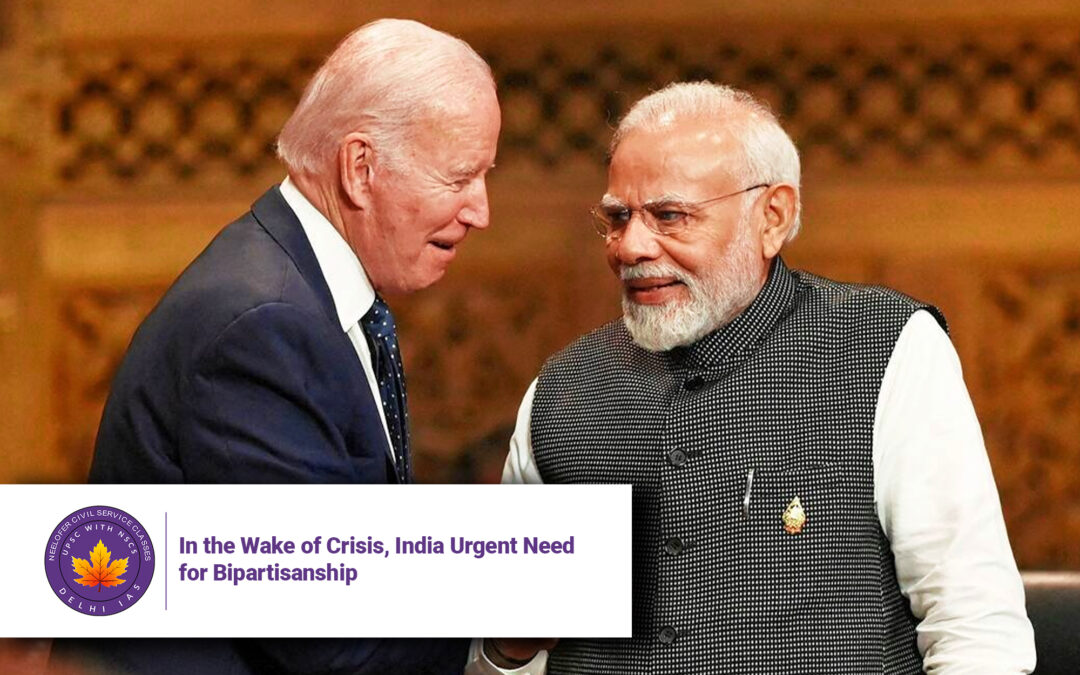
In the Wake of Crisis, India Urgent Need for Bipartisanship
Why in News?
The recent terrorist attack in Pahalgam on April 22, 2023, has once again brought to light the urgent need for political unity and national solidarity. In the face of such crises, political parties in India are being urged to set aside their differences and work together for national security, avoiding politicization and partisanship. 
Introduction
Terrorism remains one of the gravest challenges India faces, particularly in regions like Jammu and Kashmir. However, the tendency of political parties to turn such tragedies into platforms for blame games and electoral gains undermines not only national security but also the spirit of democracy. The article highlights the need for bipartisanship—a unified, cross-party approach—especially during times of national crisis.
Key Issues and Institutional Concerns
1. Politicization of National Security
-
Following attacks like Pulwama (2019) and Pahalgam (2023), there is a recurring pattern of parties blaming each other or using the incidents to gain political mileage.
-
This erodes public trust, delays cohesive action, and damages democratic institutions.
2. Partisan Approach Weakens Strategic Response
-
Effective responses to terror threats require long-term strategies, coherent diplomacy, and cross-border negotiations, which are often disrupted by short-term political agendas.
-
When national security becomes a partisan issue, it limits the government’s ability to create and implement comprehensive security policies.
3. Historical Lessons from Bipartisanship
-
The editorial references moments of cross-party unity in Indian history—such as India’s stance after Pokhran-II in 1999, or Atal Bihari Vajpayee’s Geneva speech, which showed bipartisan strength in foreign policy.
-
Global examples include New Zealand, United States, and Finland, where political parties united in response to terrorism.
Challenges and the Way Forward
1. The Grey Areas of Political Blame
-
Issues like national security are not black and white. There are nuances and complexities that get lost when parties indulge in blame games.
-
This results in a weakened national response, which terrorists exploit.
2. Call for a Non-Partisan Security Doctrine
-
India needs a national security doctrine that transcends party lines and focuses on long-term, strategic goals.
-
Security and foreign policy should be immune to electoral cycles and vote bank politics.
3. Unity in Diversity
-
In a country as diverse and democratic as India, strength lies in unity.
-
Bipartisanship ensures that decisions taken for national interest are respected and implemented across regimes, regardless of which party is in power.
Conclusion
India’s strength must lie in its ability to rise above political rivalries when it comes to matters of national security. As the editorial rightly points out, terrorism does not distinguish between party ideologies. To protect the nation, political unity is not optional—it is essential. Leaders must avoid inflammatory rhetoric and come together with maturity, restraint, and responsibility.
Q&A Section
Q1. What incident sparked the call for bipartisanship in this editorial?
The terrorist attack in Pahalgam on April 22, 2023, prompted this call for unity among political parties in India.
Q2. What is the main concern regarding political behavior after such attacks?
Parties often use national tragedies for political posturing, instead of cooperating to address the core issue of terrorism.
Q3. What is bipartisanship and why is it important here?
Bipartisanship means political cooperation between rival parties. It’s crucial for building coherent, long-term policies, especially in security and foreign affairs.
Q4. What are some historical or global examples of bipartisanship?
-
In India: Pokhran-II (1999), and Atal Bihari Vajpayee’s Geneva speech.
-
Globally: New Zealand after the Christchurch attack, and United States post-9/11.
Q5. What is the suggested solution to avoid politicizing security?
India should adopt a non-partisan security doctrine that focuses on national interest and is immune to electoral politics.

