
Scientists Uncover Key Reason Behind Failures in Solid-State Li-ion Batteries
Why in News?
Recent research published in Science has identified the main cause of failure in solid-state lithium-ion (Li-ion) batteries. While these batteries offer enhanced safety and energy density, they suffer from unexpected short circuits. A team led by researchers from Tongji University and other institutions has now linked these failures to dendrite growth and related metal fatigue in the battery’s lithium anode. 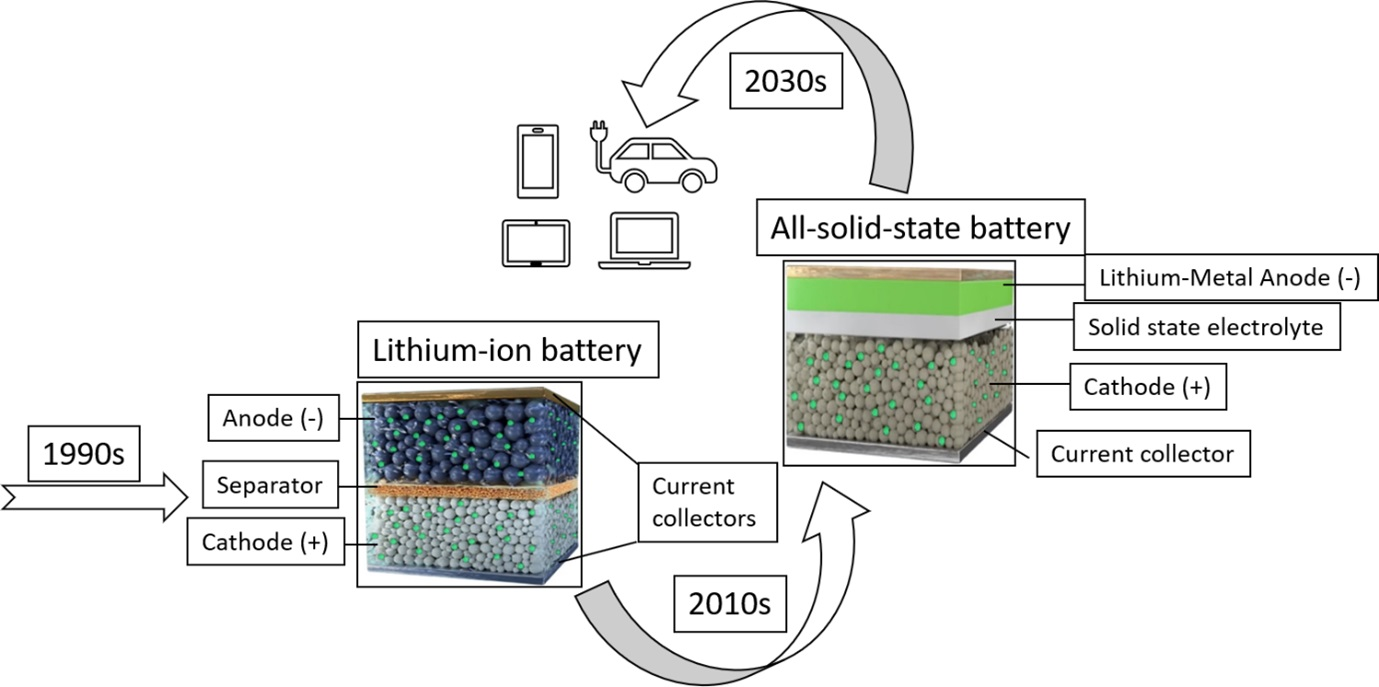
Introduction
Solid-state batteries (SSBs) are increasingly used in modern electronics like smartphones, wearables, and even electric vehicles. They use solid electrolytes instead of liquid ones, offering longer life, higher energy density, and better safety. However, they still fail prematurely — often without obvious external damage. This study reveals that the root of these failures lies in mechanical stress and microscopic damage caused by repeated charging cycles.
Key Features
-
Structure of SSBs: Solid electrolyte lies between the anode and cathode, unlike the liquid electrolyte used in traditional batteries
-
Main Issue: Dendrite formation — lithium ions form tree-like structures that pierce the electrolyte and cause internal short circuits
-
Key Finding: Repeated charging and discharging cycles cause fatigue fractures at the anode-electrolyte interface, similar to how metal breaks under stress
-
Microscopy Insight: Researchers used operando scanning electron microscopy, a tool that allows scientists to observe the battery while in operation, to identify cracks, swelling, and damage at the interface
-
Critical Threshold: In testing, the battery short-circuited at the 145th charge, even at low current levels
-
Main Culprit: Fatigue at the lithium interface — accounting for over 80% of failure cases in the study
Specific Impacts or Effects
-
Consumer Electronics: The findings can help improve battery design for smartphones, laptops, and wearables, increasing device life
-
Electric Vehicles: Safer, longer-lasting batteries are crucial for EV performance and reliability
-
Manufacturing: Battery makers can now design better fatigue-resistant materials and reduce dendrite risks
-
Microscopy Technology: Demonstrated how live imaging can help pinpoint failure modes in real-time
-
Scientific Breakthrough: First study to link mechanical fatigue at the atomic level with dendritic battery failure
Challenges and the Way Forward
Challenges:
-
Dendrite growth through solid electrolytes
-
Lack of flexibility in solid materials compared to liquids
-
Failure even under small charging currents
-
Limited durability over repeated cycles
Steps Forward:
-
Develop fatigue-resistant solid-state materials
-
Use real-time electron microscopy in battery R&D
-
Improve interface bonding between anode and electrolyte
-
Explore temperature and stress variations during battery use
-
Conduct long-term testing under different usage scenarios
Conclusion
The new research offers a major leap in understanding solid-state battery failures. By identifying microscopic cracks and fatigue fractures as the root cause, scientists have opened the door to smarter, more durable battery designs. The study stresses that even safe batteries like SSBs can fail due to internal mechanical stress, not just external damage — a revelation that could transform the future of energy storage.
5 Questions and Answers
Q1: What is the main cause of failure in solid-state Li-ion batteries according to the study?
A: Mechanical fatigue at the anode-electrolyte interface caused by repeated charging and discharging cycles.
Q2: What are dendrites and how do they affect batteries?
A: Dendrites are root-like lithium structures that grow from the anode and can pierce the electrolyte, causing short circuits.
Q3: What technology was used to study the failure in real time?
A: Operando scanning electron microscopy, which allows live monitoring of battery behavior.
Q4: How long did the tested battery last before short-circuiting?
A: It short-circuited at the 145th cycle, even under low-stress conditions.
Q5: Why is this study important for future battery design?
A: It helps engineers understand how and why failures occur internally, allowing for the creation of stronger, more reliable solid-state batteries.

