
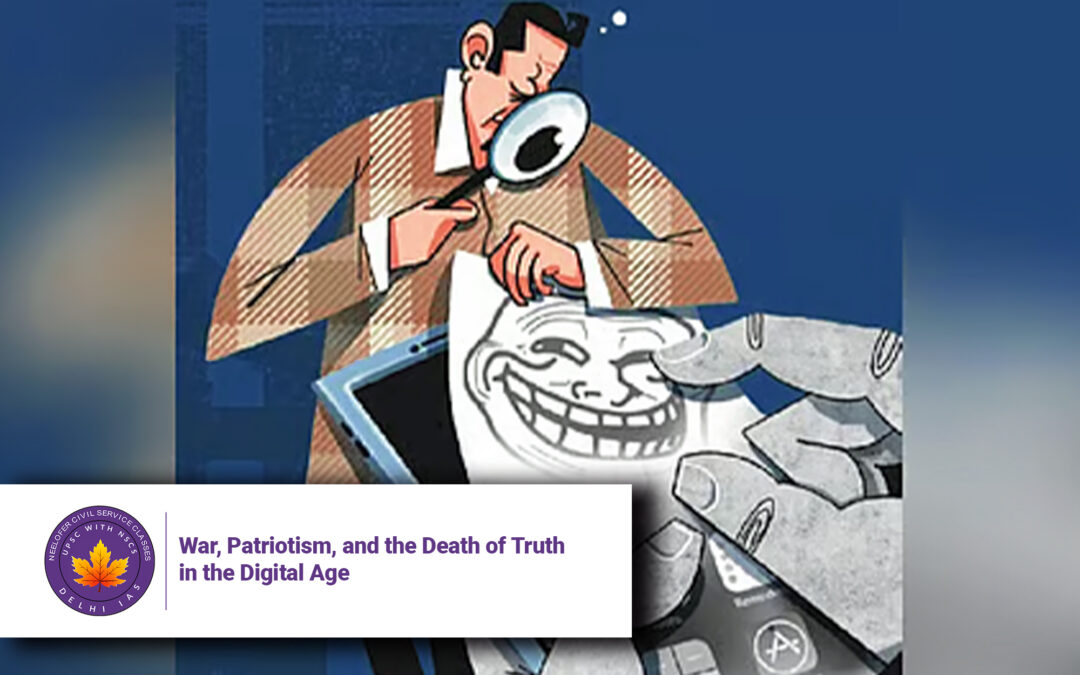
War, Patriotism, and the Death of Truth in the Digital Age
Why in News?
In the wake of the India-Pakistan conflict, a new wave of misinformation, exaggerated claims, and emotion-driven narratives has emerged. As war rhetoric intensifies, truth becomes the first casualty, replaced by a version of patriotism that is more saleable than factual. The editorial by Sanjoy Chakravorty examines how truth is manipulated during conflicts and how modern media contributes to this phenomenon.
Introduction
The ancient maxim, “Truth is the first casualty of war,” has regained relevance. In an age of instant news, memes, WhatsApp forwards, and TV debates, patriotic sentiment is increasingly being manufactured and sold to the public. Real facts are pushed aside in favor of emotional appeals and exaggerated victories.
Key Themes and Background
1. Ancient Wisdom Meets Modern Media
-
The phrase is often attributed to US Senator Hiram Johnson (1918), but its roots go back to the Greek dramatist Aeschylus (around 500 BC).
-
The concept suggests that misinformation and propaganda are integral parts of war.
2. India-Pakistan Conflict and Media Hype
-
During a recent India-Pakistan conflict, media houses aired unverified claims of high casualties and damage.
-
Examples like “300 terrorists killed” and “Black Hole of Chakrata” trended widely, yet lacked proof.
-
The Pakistani response was equally emotional and lacked transparency.
3. Emotional Patriotism vs Factual Accuracy
-
The public was fed fantastical stories which were repeated by news anchors, influencers, and politicians.
-
Criticism or questioning of the official narrative was treated as unpatriotic.
-
Fake news and doctored images gained traction, especially on social media.
4. Information as a Weapon
-
Information is no longer just for awareness; it’s weaponized to manipulate public opinion.
-
Media outlets are pressured to conform to patriotic storytelling to retain viewership and political support.
5. Implications for Democracy
-
When truth is sacrificed for momentary nationalistic pleasure, democratic accountability suffers.
-
The role of journalism as a watchdog of truth is endangered.
Conclusion
In modern warfare, truth competes with emotion—and often loses. While nationalism and pride are essential in times of conflict, they must not replace factual discourse and critical thinking. India, like other democracies, must evolve to safeguard its information ecosystem from being hijacked by fake news and propaganda.
5 Questions and Answers
Q1. What is the meaning of the phrase “Truth is the first casualty of war”?
A: It means that during war, accurate and factual information is often suppressed or distorted in favor of emotional or misleading narratives.
Q2. How did the India-Pakistan conflict reflect this idea?
A: Both countries circulated exaggerated or false claims, such as inflated enemy casualty numbers, with little verification or factual evidence.
Q3. Why is misinformation so powerful during times of conflict?
A: Because people are emotionally charged, they are more likely to believe and spread stories that align with national pride or anger.
Q4. What is the role of media in such conflicts?
A: Ideally, media should verify facts and present unbiased news, but in such scenarios, it often becomes a tool for spreading state-endorsed narratives.
Q5. What is the danger of equating questioning with anti-nationalism?
A: It suppresses critical thinking and dissent, leading to a blind acceptance of misinformation and weakening democratic accountability.

