
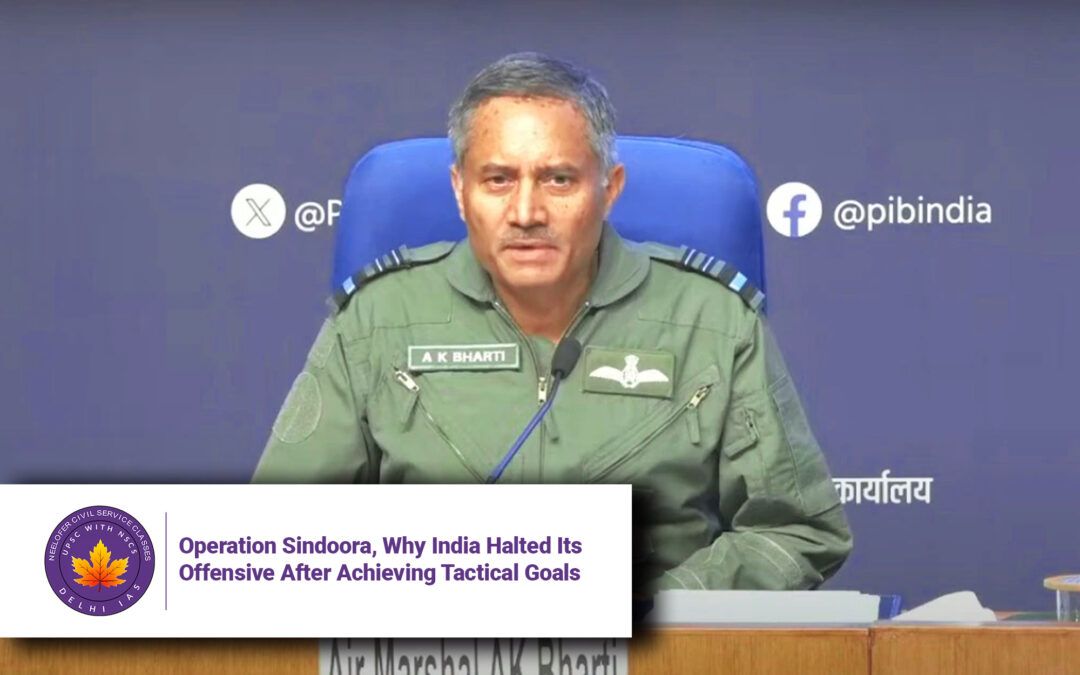
Operation Sindoora, Why India Halted Its Offensive After Achieving Tactical Goals
Why in News?
Following India’s calibrated military operation—Operation Sindoora—against Pakistan in response to cross-border terrorism, the temporary pause in hostilities has raised questions. Prime Minister Narendra Modi clarified that the cessation is conditional and driven by India’s broader national security strategy, marking a departure from previous responses. 
Introduction
India’s recent military response under Operation Sindoora was unique. Unlike earlier retaliations that were either restricted to J&K or purely symbolic, this mission was decisive, precise, and strategically calibrated. Though the operations have paused, officials stress that this is a tactical break, not the end of deterrence.
Key Developments and Strategic Shifts
1. Military Retaliation with Political Clarity
-
Operation Sindoora targeted terror infrastructure across the LoC and inside Pakistan-occupied Kashmir.
-
For the first time, India targeted both terror and Pakistan army infrastructure, highlighting that non-state actors will no longer be seen as separate from state entities.
2. New Doctrine of Deterrence
-
India refrained from repeating predictable retaliation patterns like surgical strikes or airstrikes.
-
Military action was aligned with economic, political, and diplomatic efforts, including leveraging the Indus Waters Treaty and scaling down trade.
3. Rationale Behind the Pause
-
The pause is not weakness, but part of a recalibrated doctrine focused on long-term cost imposition on Pakistan.
-
India chose not to engage in large-scale land capture, as it doesn’t alter Pakistan’s terror mindset but escalates international risks.
4. Targeting Terror Infrastructure Directly
-
India struck military targets that support terrorism: control centers, storage facilities, and communication nodes.
-
It marked a clear policy shift: No longer will India restrict retaliation to terrorist launchpads only.
5. Diplomatic and Psychological Pressure
-
India’s calculated halt avoids triggering full-scale war, yet sends a clear message: future strikes will follow if provoked again.
-
The operations have enhanced India’s international image as a responsible yet resolute power.
Conclusion
India has signaled a clear shift in its security doctrine. Operation Sindoora wasn’t just a tactical strike—it was a message of strategic maturity, meant to impose long-term costs on Pakistan for its support of terrorism. The operation met its military and political objectives without escalating into uncontrollable conflict, and leaves open the door for swift future responses if necessary.
Q&A Section
Q1. What is Operation Sindoora?
Operation Sindoora was a strategic Indian military operation aimed at neutralizing Pakistan-backed terrorist infrastructure across the LoC and in PoK.
Q2. Why did India stop the operation after initial success?
India paused the operation after achieving tactical goals to avoid escalation, focusing instead on imposing long-term strategic costs.
Q3. How is this operation different from past responses like Balakot or Uri?
Unlike earlier limited responses, Operation Sindoora targeted military infrastructure and terror networks alike and was accompanied by diplomatic, trade, and economic actions.
Q4. What message does this operation send to Pakistan?
India has made it clear that state and non-state actors will no longer be treated separately, and any provocation will be met with a proportional but decisive response.
Q5. What are India’s broader goals beyond military action?
India seeks to reshape Pakistan’s cost-benefit calculations around terrorism, apply global diplomatic pressure, and reinforce its strategic autonomy in security matters.

