
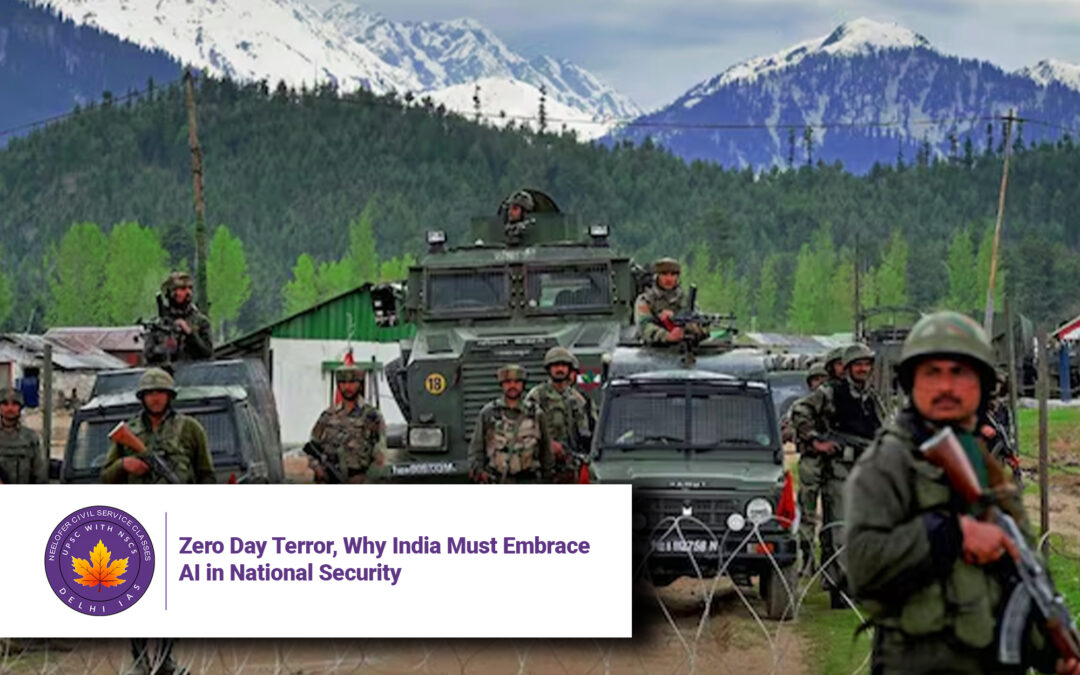
Zero Day Terror, Why India Must Embrace AI in National Security
Why in News?
The recent terrorist attack in Pakistan’s Rahimyar Khan district, allegedly orchestrated by Lashkar-e-Taiba, has reignited the debate around intelligence failures and preventive security. With terror threats becoming more complex and time-sensitive, India must urgently integrate Artificial Intelligence (AI) into its national security architecture. 
Introduction
The nature of terrorism has evolved. Modern terror strikes, like the Pulwama attack or recent incidents in Pakistan, are “zero-day” threats—unexpected, highly coordinated, and devastating. Traditional intelligence methods are no longer sufficient. To defend itself in today’s high-speed digital and physical battlefield, India must deploy AI-powered surveillance, prediction, and response systems.
Key Issues and Background
-
The Threat of Zero-Day Attacks
-
A “zero-day” attack refers to an event that happens with no prior warning and causes significant damage before authorities can react.
-
Pulwama, 26/11, and the Rahimyar Khan attack all highlight India’s and Pakistan’s vulnerability to surprise terror strikes.
-
-
Limitations of Traditional Intelligence
-
Current human intelligence (HUMINT) and surveillance systems are often too slow or fragmented to detect and respond to fast-evolving terror plans.
-
Gaps in inter-agency coordination and outdated systems delay real-time action.
-
-
Why AI is the Future of Security
-
AI can predict, detect, and neutralize threats using data from video, social media, audio, sensors, and public records.
-
Projects like the US Defense Department’s Project Maven use AI to process battlefield data, enhancing the speed and accuracy of counterterrorism.
-
-
Five AI Applications India Must Adopt
-
Predictive modeling: Detects terror planning and suspicious activity before attacks happen.
-
Autonomous surveillance craft: Drones and robotic monitors can patrol borders like in Jammu & Kashmir with minimal human input.
-
Natural Language Processing (NLP): Tracks terror chatter in regional languages across platforms.
-
Cross-sector AI: Uses civil data (like traffic, communication, social media) for pattern recognition and prediction.
-
Smart robotics & response units: AI can enable automated countermeasures, reducing human risk during neutralization efforts.
-
-
Challenges in Adoption
-
Requires infrastructure investment, hardware-software synergy, and policy standardization.
-
India needs centralized AI command centers, trained analysts, and a national AI military doctrine.
-
Five Key Takeaways
-
Terror threats have outpaced traditional responses—AI is no longer optional.
-
AI enables rapid decision-making, intelligence fusion, and predictive monitoring.
-
India needs an AI security ecosystem, not isolated tools, with interlinked networks and real-time analysis.
-
Social media and open-source intelligence can be valuable assets when processed using AI.
-
National security must evolve technologically to match the scale and sophistication of emerging threats.
Challenges and the Way Forward
Challenges:
-
Lack of a coordinated AI security strategy.
-
Inadequate investment in defense tech infrastructure.
-
Resistance from traditional bureaucracies to adopt tech-based solutions.
Way Forward:
-
Build a centralized AI security command similar to Project Maven.
-
Train security personnel in AI applications and recruit AI professionals.
-
Foster public-private partnerships for AI development and deployment.
-
Create legal and ethical frameworks to govern AI use in national defense.
Conclusion
The next Pulwama or Uri cannot be prevented by relying on old methods. With hostile actors constantly innovating, India must match pace with intelligent, integrated defense systems powered by AI. National security in the 21st century demands data-driven foresight, not just reactive force.
Q&A Section
1. What is a ‘zero-day’ terror attack?
A zero-day attack is a surprise assault with no prior warning, making it extremely hard to defend against using conventional security systems.
2. Why is AI essential for modern national security?
AI helps analyze large data sets quickly, detect threats early, and automate surveillance, making responses faster and more accurate.
3. What are some AI tools India should adopt?
Tools include predictive models, autonomous drones, NLP systems to monitor terror chatter, and smart surveillance networks.
4. What is Project Maven?
It is a U.S. Defense initiative that uses AI to interpret military data and support battlefield decisions in real time.
5. What steps should India take now?
India should invest in AI infrastructure, train specialists, set up a central AI-security unit, and build an ethical and legal framework for AI use in defense.

