
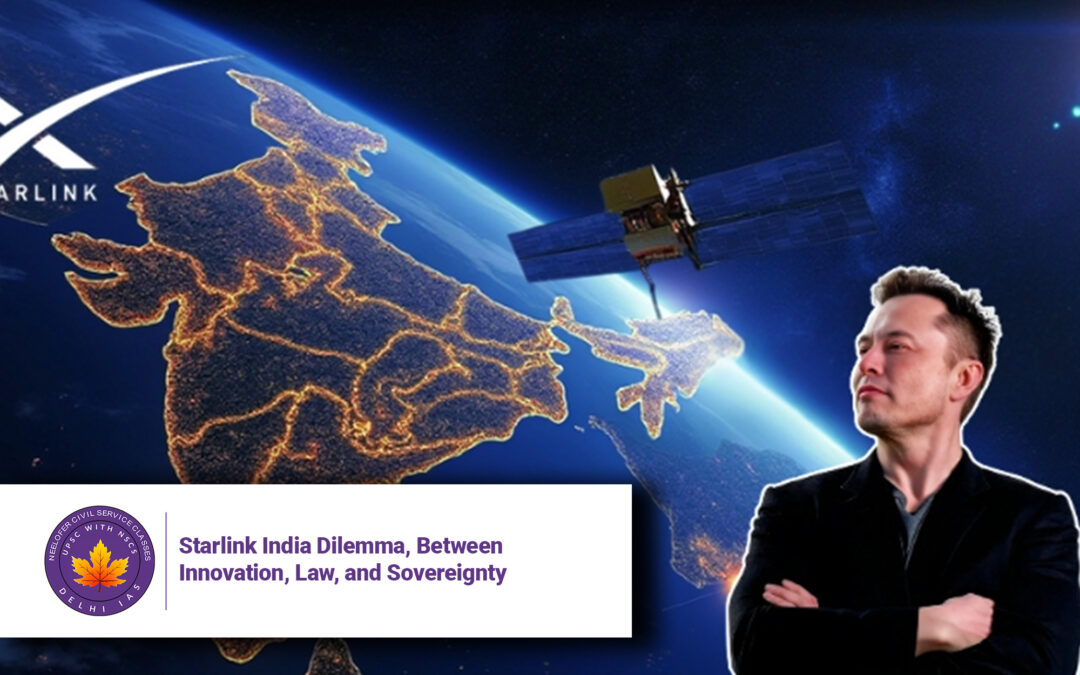
Starlink India Dilemma, Between Innovation, Law, and Sovereignty
Why in News?
Starlink, the satellite internet arm of Elon Musk’s SpaceX, has faced significant regulatory and infrastructural challenges in its efforts to expand into India. These challenges reflect the broader tension between technological innovation and government regulations tied to sovereignty, security, and digital priorities. 
Introduction
India’s vision of digital growth and rural connectivity could benefit immensely from satellite-based internet services like Starlink. However, the path to operationalization is riddled with legal complexities, security requirements, spectrum licensing hurdles, and bureaucratic delays. The experience of Starlink in India highlights the critical importance of early and structured collaboration between tech providers and government agencies.
Key Issues / Background
-
Regulatory Complexity
-
To operate in India, Starlink must obtain a Very Small Aperture Terminal (VSAT) license under the Indian Telegraph Act, 1885.
-
This involves approvals from multiple ministries (DoT, MEITY, MHA, etc.) and coordination with TRAI and ISRO.
-
-
Spectrum and Security Concerns
-
Spectrum in India is a finite national resource; allocation is tied to public interest and national security.
-
The government demands strict compliance with data laws, security audits, and lawful interception capabilities.
-
-
Pricing and Accessibility
-
Equipment costs for terminals and routers are high.
-
Monthly subscription rates may not be viable for low-income rural households without government subsidies.
-
-
Space-Sector Coordination
-
Starlink’s operations must align with the Indian Space Policy (2023) and work closely with IN-SPACe and the Indian National Space Promotion and Authorization Center (IN-SPACe).
-
Integration with India’s satellite network is critical for safe orbital management.
-
-
Delays and Lack of Clarity
-
Starlink has not yet launched in India due to delays in obtaining permissions and meeting data privacy, encryption, and security requirements under the IT Act (2000) and Digital Personal Data Protection Act (2023).
-
5 Key Takeaways
-
Starlink’s entry into India is stalled due to complex licensing and national security regulations.
-
The government is cautious, prioritizing sovereignty and data protection over rapid tech deployment.
-
Spectrum allocation, foreign ownership policies, and satellite infrastructure sharing are core friction points.
-
Starlink needs to comply with surveillance and real-time user tracking laws to operate.
-
Affordable access remains a major challenge, especially for rural and low-income users.
Challenges and the Way Forward
Challenges:
-
Navigating India’s multi-layered regulatory approvals.
-
Balancing affordability and profitability for rural populations.
-
Meeting stringent data privacy and interception norms.
-
Competing with Indian initiatives like BharatNet.
Way Forward:
-
Establish an integrated single-window clearance system for foreign tech infrastructure.
-
Create a clear, transparent spectrum policy specific to satellite broadband.
-
Offer subsidies or public-private models to lower Starlink’s high terminal and service costs.
-
Promote collaborative ventures between foreign companies and Indian agencies.
Conclusion
Starlink’s experience in India serves as a case study of how innovation intersects with governance and sovereignty. While India welcomes digital progress, it must strike a balance between protecting national interests and allowing disruptive technologies that can empower underserved regions. The need of the hour is structured dialogue, policy clarity, and a shared vision for India’s digital future.
Q&A Section
1. Why hasn’t Starlink launched services in India yet?
Starlink has not launched due to delays in getting regulatory approvals, complying with data and security laws, and awaiting spectrum allocation.
2. What are India’s key concerns regarding Starlink?
The Indian government prioritizes security, lawful surveillance, data protection, and spectrum sovereignty, all of which require thorough vetting of foreign satellite firms.
3. How can Starlink benefit rural India?
Starlink’s satellite internet can bring high-speed connectivity to remote and underserved areas where fiber-optic or mobile networks are unreliable or absent.
4. What makes the equipment costly for Indian consumers?
The terminal (dish), router, and setup costs are high, and monthly fees can be prohibitive without subsidies or pricing support.
5. What is the significance of this issue globally?
It reflects the growing tension between tech innovation and national regulation, especially as companies like Starlink enter new markets with different legal and sovereignty norms.

