
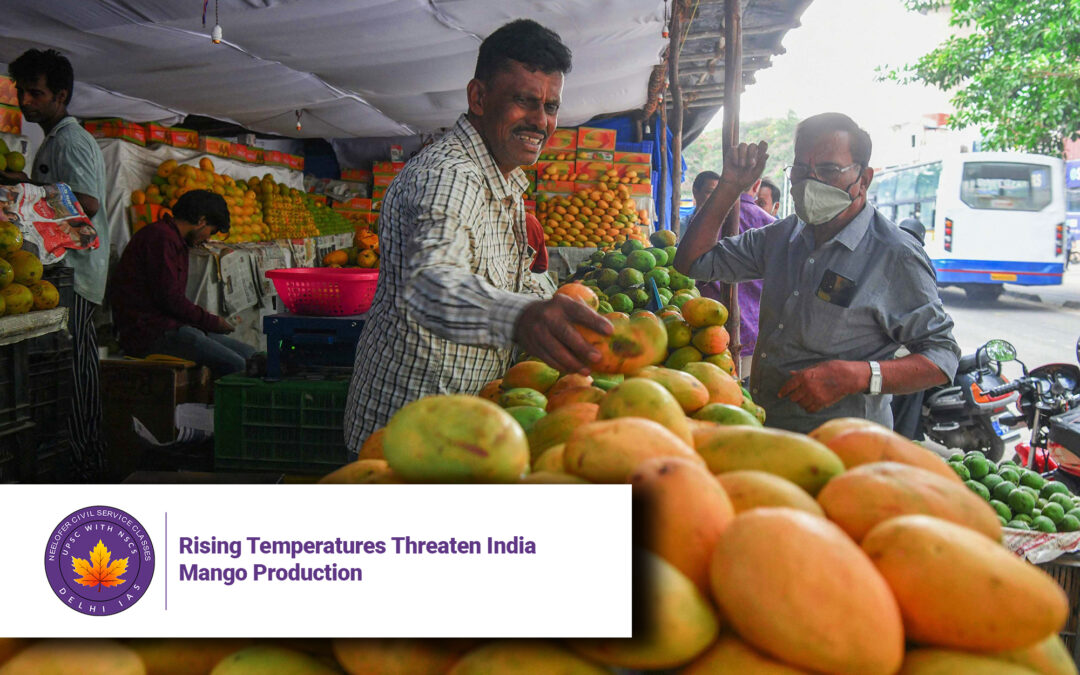
Rising Temperatures Threaten India Mango Production
Why in News?
A new concern has emerged in Indian agriculture — high temperatures are significantly impacting mango production. As per recent observations and studies, earlier flowering, poor yield, and reduced sweetness of mangoes have been linked to climate change, raising alarms for farmers, scientists, and consumers. 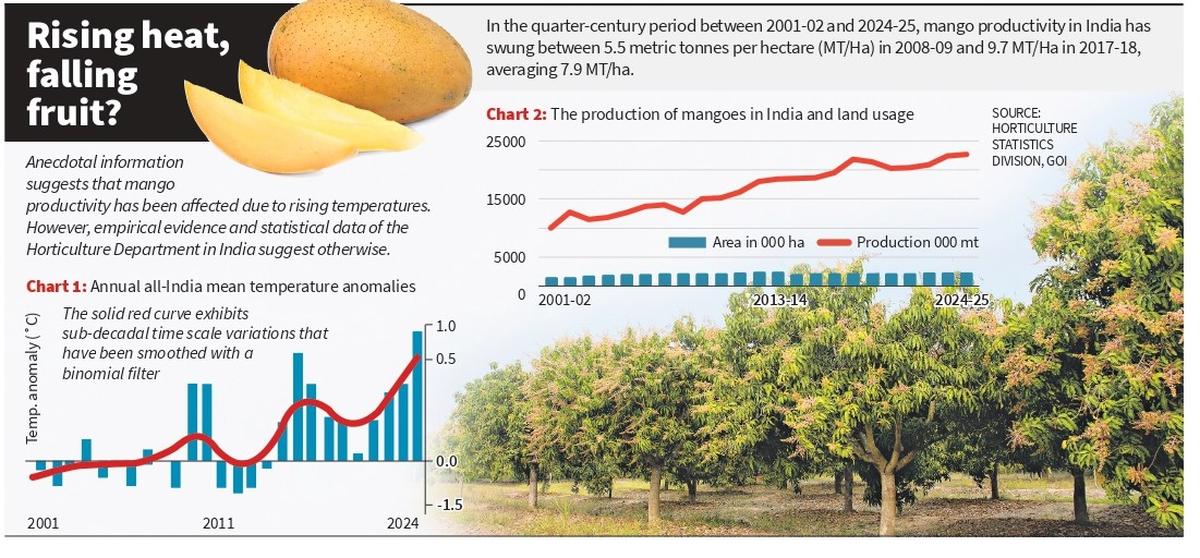
Introduction
Mangoes, often called the “king of fruits,” are a staple of Indian summers and a crucial part of the country’s agricultural economy. However, a drop in harvest, rising prices, and changing taste patterns have been noticed over recent years. Scientists are now increasingly attributing these changes to rising temperatures, unpredictable weather patterns, and climate-induced stress.
Key Issues and Background
1. Rising Temperatures and Early Flowering
According to the India Meteorological Department’s (IMD) Annual Climate Survey 2024:
-
The average mean land surface air temperature in 2024 was +0.65% above the 1991–2020 average.
-
2024 is the second warmest year after 1901.
-
11 out of the last 12 years have seen above-normal temperatures.
These anomalies have caused early flowering of mango trees, resulting in reduced fruiting and lower sweetness. Scientists note this pattern may be linked to global warming.
2. Production Trends and Land Use
Between 2001–02 and 2024–25, mango productivity in India grew slowly:
-
2008–09: 5.5 metric tonnes/hectare (MT/Ha)
-
2017–18: 9.7 MT/Ha
However, despite some increase in land under mango cultivation (13.4 lakh hectares in 2023–24), productivity fluctuated due to climate variability.
India’s mango productivity still lags behind:
-
China: 8.74 MT/Ha
-
Thailand: 8.36 MT/Ha
3. Role of Weather Extremes
Unpredictable weather events such as hailstorms, high winds, and cold waves can severely affect mango flowering and ripening, further adding to seasonal instability.
The Core of the Concern
Anecdotal and statistical evidence indicate that mangoes are flowering earlier and producing fewer, less sweet fruits. These shifts, compounded with unseasonal weather and increasing input costs, are posing a serious threat to mango orchard sustainability.
Key Observations
-
Scientific Studies: Indian researchers led by Rajdeep Haldar (2024) linked mango production drop to higher temperatures and genetic diversity.
-
Genetic Variation Benefits: Mangoes possess physiological traits that allow them to adjust to diverse climates. Genetic diversity supports better yield, adaptation, and breeding innovation.
-
Mango Tree Response: Some species cope better with extreme temperatures, offering hope for future adaptability.
-
New Breeding Strategies: Researchers emphasize the need for climate-resilient mango varieties, using modern breeding techniques.
-
Farmers’ Dilemma: Despite expanded land use, extreme heat and poor rainfall patterns are undermining efforts to boost production.
Conclusion
Climate change is now undeniably impacting India’s beloved mango crop. While some resilience exists due to genetic diversity, the sharp rise in temperature, erratic weather, and early flowering are disrupting production cycles. Urgent focus is needed on crop adaptation strategies, scientific research, and sustainable orchard practices to protect India’s mango heritage.
5 Questions and Answers
Q1. What major factor is contributing to the decline in mango production in India?
A) Overuse of fertilizers
B) Labor shortage
C) Rising temperatures and early flowering
D) Pest outbreaks
Answer: C) Rising temperatures and early flowering
Q2. Which year was recorded as the second warmest since 1901 by the IMD?
A) 2020
B) 2022
C) 2024
D) 2019
Answer: C) 2024
Q3. What is India’s current mango productivity compared to Thailand and China?
A) Higher than both
B) Equal to China
C) Lower than both
D) Data not available
Answer: C) Lower than both
Q4. What key advantage does genetic diversity provide to mango trees?
A) Increases pesticide resistance
B) Helps in adapting to diverse climatic conditions
C) Reduces the cost of farming
D) Delays flowering
Answer: B) Helps in adapting to diverse climatic conditions
Q5. Who led the Indian research linking temperature changes to mango productivity and genetic diversity?
A) Serish Nanisetti
B) Jayashankar T.A.U.
C) Rajdeep Haldar
D) IMD Director
Answer: C) Rajdeep Haldar

