
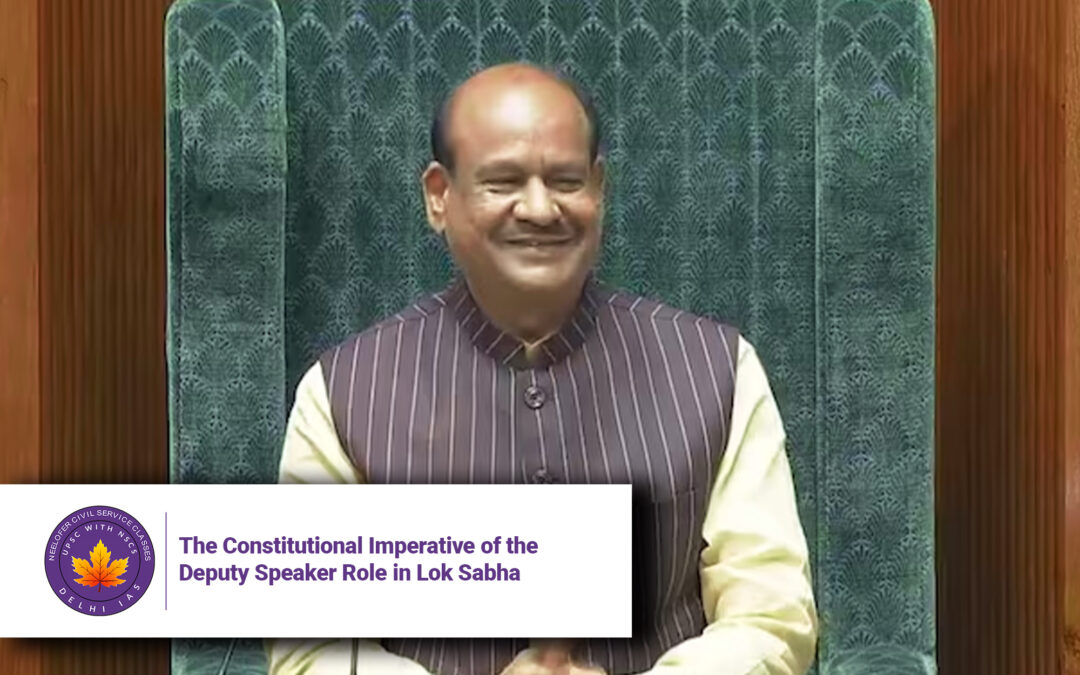
The Constitutional Imperative of the Deputy Speaker Role in Lok Sabha
Why in News?
The prolonged vacancy in the post of Deputy Speaker of the Lok Sabha (since 2019) has sparked debates about constitutional adherence and parliamentary norms. Despite its mandated role under Article 93, the 17th Lok Sabha (2019–2024) and the newly constituted 18th Lok Sabha (2024) have failed to elect a Deputy Speaker, raising concerns about institutional integrity and democratic balance. 
Introduction
The Deputy Speaker of the Lok Sabha is a constitutionally mandated office (Articles 93–94) designed to ensure continuity in parliamentary proceedings. Historically, this role has been pivotal in maintaining impartiality and bipartisanship, often offered to the Opposition. However, recent neglect of this position reflects a troubling departure from constitutional and conventional practices.
Key Issues
1. Constitutional Mandate
-
Article 93 directs the Lok Sabha to elect a Speaker and Deputy Speaker “as soon as may be”, implying urgency.
-
Article 94 ensures the Deputy Speaker remains in office until resignation, removal, or disqualification as an MP.
-
The framers of the Constitution envisioned this role as a safeguard against leadership vacuums (e.g., Speaker’s absence or demise).
2. Historical Significance
-
Originated in the Central Legislative Assembly (British era) as “Deputy President”; first held by Sachidanand Sinha (1921).
-
Post-independence, M.A. Ayyangar (first Deputy Speaker) exemplified its critical role by stepping in after Speaker G.V. Mavalankar’s death in 1956.
3. Functional Relevance
-
Presides over sessions when the Speaker is unavailable, ensuring uninterrupted legislative business.
-
Chairs committees and debates, upholding neutrality (like the Speaker).
-
Convention: Traditionally offered to the Opposition to foster bipartisan trust (e.g., BJP’s Mangal Das in 1991, Congress’s Charanjit Atwal in 2004).
4. Current Vacancy: A Constitutional Anomaly
-
Unprecedented delay: First time in history the post remains vacant for an entire Lok Sabha term (17th LS) and beyond.
-
Risks: Centralizes power with the ruling party, weakens institutional checks, and risks procedural chaos in emergencies.
5. Erosion of Conventions
-
The unwritten rule of offering the post to the Opposition is ignored, exacerbating political polarization.
-
Reflects a broader trend of bypassing consensus-driven parliamentary practices.
Alternative Approaches
-
Legislative Reform: Amend the Constitution to specify a timeframe (e.g., 60 days) for electing the Deputy Speaker.
-
Judicial Intervention: Supreme Court could interpret “as soon as may be” to enforce timely appointments.
-
Political Consensus: Revive the convention of appointing an Opposition member to restore institutional balance.
Challenges and Way Forward
-
Political Will: Ruling parties may resist sharing power with the Opposition.
-
Legal Ambiguity: Lack of penalties for non-compliance with Article 93.
-
Solution: Parliament must prioritize constitutional morality over short-term political gains.
Conclusion
The Deputy Speaker’s office is a constitutional necessity, not a ceremonial formality. Its prolonged vacancy undermines democratic resilience and parliamentary integrity. Restoring this role—preferably through bipartisan consensus—is critical to upholding the “checks and balances” envisioned by India’s founding leaders.
5 MCQs Based on the Article
Q1. Under which Article of the Constitution is the Deputy Speaker’s post mandated?
A) Article 94
B) Article 93
C) Article 95
D) Article 96
Answer: B) Article 93
Q2. Who was the first Deputy Speaker of independent India’s Lok Sabha?
A) Sachidanand Sinha
B) G.V. Mavalankar
C) M.A. Ayyangar
D) Charanjit Atwal
Answer: C) M.A. Ayyangar
Q3. What is the historical convention regarding the Deputy Speaker’s appointment?
A) Reserved for the ruling party
B) Offered to the Opposition
C) Elected by state assemblies
D) Appointed by the President
Answer: B) Offered to the Opposition
Q4. Why is the current vacancy in the Deputy Speaker’s post controversial?
A) It violates Article 94
B) It is the first such delay in India’s history
C) The Speaker has refused to delegate powers
D) The post was abolished in 2019
Answer: B) It is the first such delay in India’s history
Q5. What phrase in Article 93 emphasizes urgency in electing the Deputy Speaker?
A) “From time to time”
B) “As soon as may be”
C) “At the earliest convenience”
D) “Within six months”
Answer: B) “As soon as may be”
Authors:
-
Vinod Bhanu (Executive Director, Centre for Legislative Research and Advocacy)
-
Raviendra Garimella (Former Joint Secretary, Lok Sabha)
Key Takeaway: The Deputy Speaker’s vacancy is a constitutional anomaly and a deliberate sidelining of bipartisan norms. Parliament must act to restore this critical office.
