
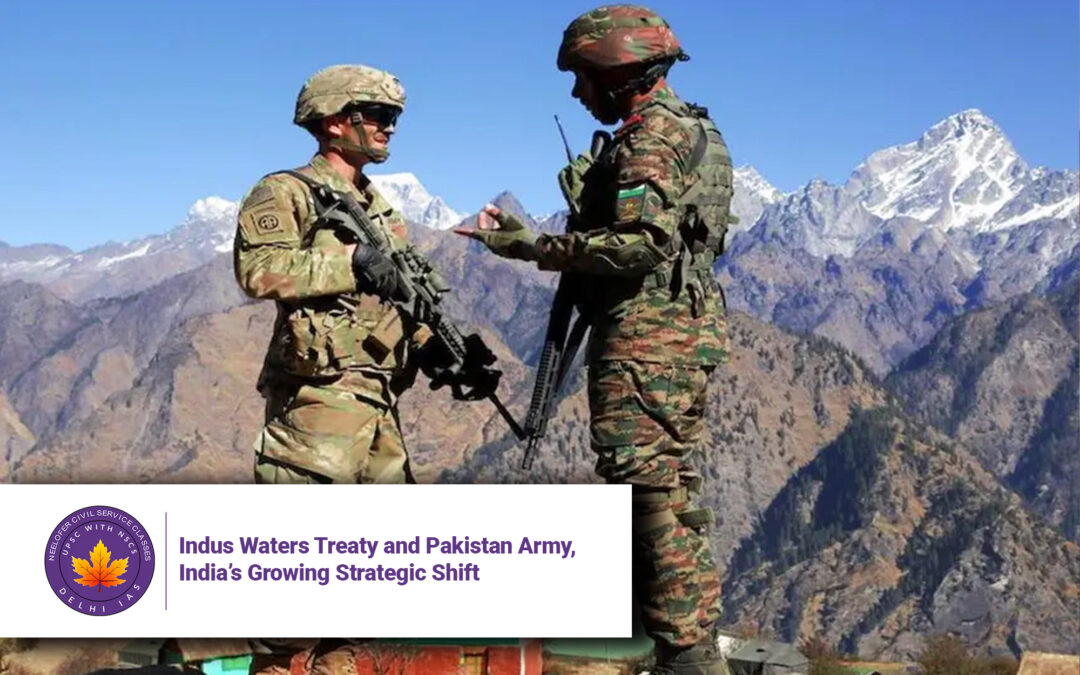
Indus Waters Treaty and Pakistan Army, India’s Growing Strategic Shift
Why in News?
India’s decision to review and potentially suspend the Indus Waters Treaty with Pakistan is seen as a major strategic move, reflecting the continuing burden posed by the Pakistani military’s antagonistic policies towards India.
Introduction
The Pakistan army has, since 1948, persistently tried to seize Kashmir by force but has repeatedly failed. Its militaristic approach has remained unchanged despite changing geopolitical conditions. India’s consideration to suspend the Indus Waters Treaty must be understood against this historical background.
Key Issues
1. The Burden of the Pakistan Army
-
Pakistan’s army operates independently, pursuing aggressive policies towards India irrespective of changing political climates.
-
It has repeatedly failed in its attempts to take Kashmir but continues its hostility, making peaceful relations difficult.
2. Indus Waters Treaty (IWT) Context
-
Signed in 1960, the IWT allocated about 80% of river waters from the Indus system to Pakistan and 20% to India.
-
India got only 30% of the water resources, although 70% of the river basin lies in India.
-
Recent considerations suggest a reversal: 70% for India, 30% for Pakistan, reflecting changing realities.
3. Strategic Implications
-
The move signals a shift in India’s patience and policy approach, linking water resources to national security.
-
India is no longer willing to ignore Pakistan’s support for terrorism and cross-border hostility.
-
Control over rivers like the Chenab and Jhelum, vital for Pakistan’s agriculture, could create strategic pressure.
Alternative Approaches
-
Diplomatic Isolation: India can continue working to isolate Pakistan internationally rather than escalating water-related tensions.
-
Negotiated Adjustments: If possible, renegotiating terms of the treaty to ensure fairer resource distribution without abrogation.
Challenges and the Way Forward
-
International Reaction: Any suspension of the Indus Waters Treaty may invite global attention and possible backlash, especially from China and international bodies.
-
Water Management Infrastructure: India will need rapid development of infrastructure to utilize the additional water efficiently.
-
Long-term Stability: The move must be strategically managed to avoid unintended consequences like escalation into direct conflict.
Conclusion
India’s reassessment of the Indus Waters Treaty reflects a broader shift in its policy towards Pakistan, rooted in historical lessons of repeated aggression. The burden of the Pakistan army’s hostility continues, but India’s strategic patience appears to be giving way to a more assertive posture.
5 Q&A Based on the Article
Q1. What is the significance of the Indus Waters Treaty?
A: Signed in 1960, it allocated 80% of the Indus river system’s water to Pakistan and 20% to India, aiming to peacefully share water resources.
Q2. Why is India reconsidering the Indus Waters Treaty now?
A: Due to Pakistan’s persistent hostility, mainly led by its army, India is considering reversing the treaty to assert strategic pressure.
Q3. What has been the role of the Pakistan army regarding Kashmir?
A: Since 1948, the Pakistan army has repeatedly tried and failed to capture Kashmir through military means, sustaining hostility against India.
Q4. How much of the Indus system’s waters is India planning to retain under the new proposed terms?
A: India may retain 70% of the Indus system’s waters under the reconsidered terms, reversing the original 30% share.
Q5. What challenges might India face if it abrogates or suspends the treaty?
A: India could face international criticism, strained diplomatic relations with Pakistan and China, and the need for rapid water infrastructure development.
