
India Critical Minerals Strategy, The Key to Clean Energy Leadership
Why in News?
As the world accelerates its shift towards clean energy and advanced technology, critical minerals like lithium, cobalt, and rare earth elements have become essential. India must now take urgent steps to reduce import dependency and boost domestic capabilities to remain geopolitically competitive and energy-secure. 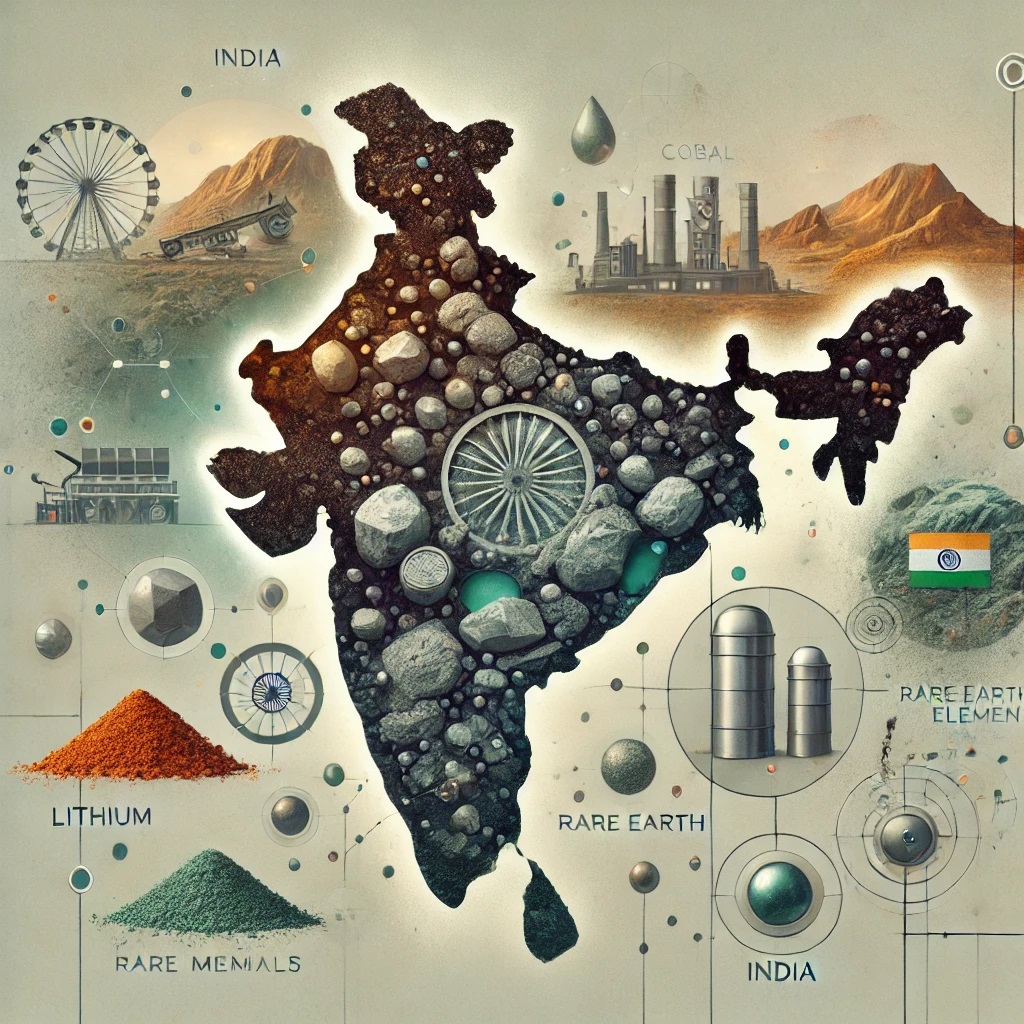
Introduction
Critical minerals, once obscure, are now central to geopolitics and economic security. These minerals are vital for batteries, electric vehicles (EVs), renewable energy systems, and electronics. However, India is highly dependent on imports. To become a clean energy leader, India must enhance domestic production, build global partnerships, and strengthen its refining and processing infrastructure.
Key Issues
1. High Import Dependency
India imports 100% of its lithium, cobalt, and nickel requirements. This poses a major strategic risk as the country pushes toward electrification, green technology, and energy security.
2. Geopolitical Pressures and Global Scramble
China dominates the global supply chain for critical minerals and uses this leverage for geopolitical influence. The EU, U.K., U.S., and other countries are strengthening ties, securing supplies, and diversifying sources. India must respond to this race strategically.
3. Domestic Underdevelopment
India has large reserves of minerals like bauxite, graphite, and manganese, but lacks investment in refining, processing, and value-chain infrastructure. This underdevelopment reduces self-reliance and economic competitiveness.
4. Lack of Private Sector Participation
There are limited incentives and support for private and foreign firms to invest in mining, exploration, and refining in India. Regulatory bottlenecks, delays, and inadequate data further hamper growth.
5. Need for Technology and Collaboration
To reduce risks and dependency, India needs to collaborate with countries like Australia, Chile, Argentina, and DR Congo while building domestic processing and recycling systems.
India’s Strategic Measures
-
Government Initiatives:
India launched the National Critical Mineral Mission and allocated ₹6,300 crore for mineral exploration and capacity building. -
International MoUs:
MoUs signed with Australia, Argentina, Chile, and DR Congo for collaboration in exploration and investment. -
Diversification Efforts:
India is seeking to expand its supplier base via QUAD, IEA, and MSP partnerships for trusted, transparent, and secure mineral trade. -
Private Participation Push:
Amendments to the Mines and Minerals Act (MMDR) aim to enable private sector entry and remove auction bottlenecks. -
Circular Economy:
India promotes mineral recycling and sustainable mining practices to reduce dependency and environmental impact.
Challenges and the Way Forward
-
Enhance domestic exploration with scientific methods and geological mapping.
-
Improve refining capacity with public-private partnerships and technology transfers.
-
Promote investor confidence through stable policy, timely approvals, and transparency.
-
Diversify supply chains by leveraging global diplomacy and participating in multi-nation mineral security platforms.
-
Launch incentive schemes to attract critical mineral-based manufacturing and FDI.
Conclusion
India’s future as a clean energy superpower depends on securing critical mineral resources. It must act fast to create a resilient, sustainable, and globally competitive mineral supply chain. A coordinated approach combining diplomacy, investment, and innovation is the need of the hour.
5 Q&A Based on the Article
Q1. Why are critical minerals important for India’s energy future?
A: Critical minerals like lithium, cobalt, and rare earths are essential for electric vehicles, renewable energy, batteries, and electronics — key to India’s clean energy transition.
Q2. What are the main challenges India faces in the critical mineral sector?
A: India faces high import dependency, lack of domestic refining infrastructure, limited private sector participation, and geopolitical risks from supplier nations.
Q3. What global partnerships has India formed for critical mineral access?
A: India has signed MoUs with Australia, Chile, Argentina, and DR Congo for exploration, supply security, and investment in critical minerals.
Q4. What domestic steps is India taking to address critical mineral shortages?
A: India launched the National Critical Mineral Mission, amended mining laws to attract private investors, and committed ₹6,300 crore for exploration and production.
Q5. How can India become self-reliant in critical minerals?
A: Through enhanced domestic exploration, international partnerships, investment in refining, and adopting circular economy practices such as recycling and sustainable mining.
