
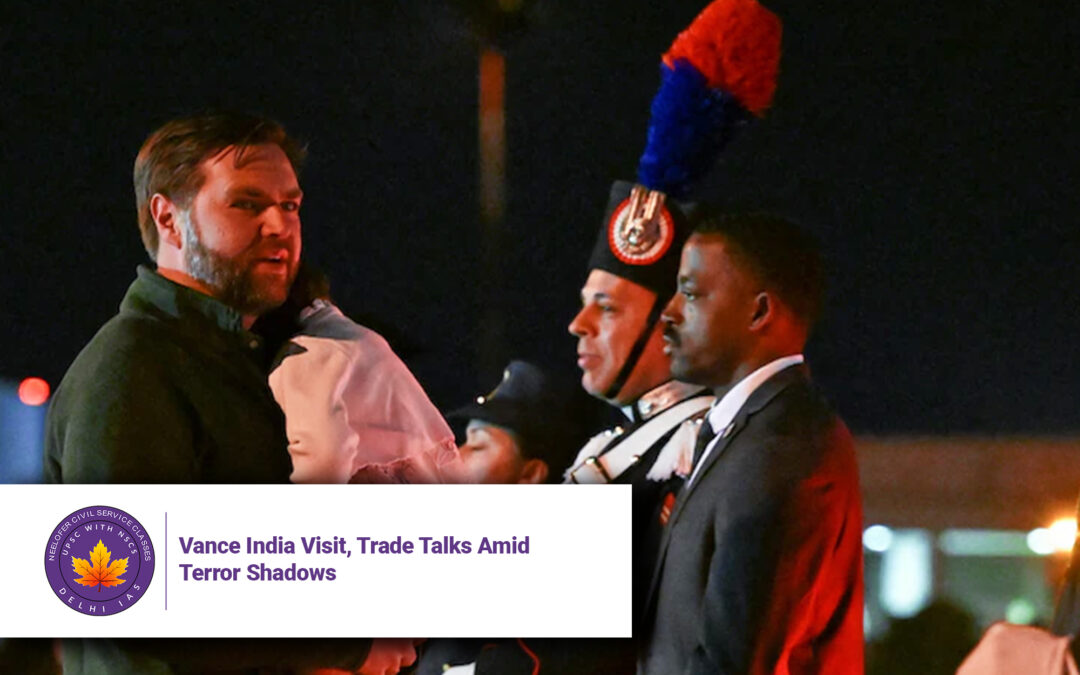
Vance India Visit, Trade Talks Amid Terror Shadows
Context & Overview
U.S. Vice-President J.D. Vance made his first trip to India on April 22–24, 2025, just days after the Pahalgam terror attack. Despite the security cloud, his private‐style visit—focused on trade, defense and energy—was warmly received in Delhi and Jaipur, even as it yielded no immediate breakthrough agreement.
Key Highlights
-
First U.S. Vice-President Visit Since 2013: Vance and his wife, Usha Chulikuri Vance, toured Delhi’s monuments (Red Fort, India Gate), Jaipur’s palaces and the Taj Mahal in Agra—an itinerary more akin to a family vacation than high‐stakes diplomacy.
-
Bilateral Trade Agreement (BTA) Talks: Vance reiterated U.S. interest in a “final deal” to re-balance trade but stopped short of signing. He defended U.S. tariffs as a tool for “fairness,” not a new trade war, and urged India to trim non-tariff barriers—particularly “local content” requirements in solar, agriculture and dairy.
-
Defense & Energy Cooperation: He praised India as a trusted partner for co-development of U.S. military hardware (including an overture on F-35 fighters), and called on Washington to reverse recent U.S. fossil-fuel restrictions—urging sales of drilling rigs and expanded LNG exports to India.
-
Nuclear Liability Law: Vance stressed that U.S. firms need a stable liability regime to invest in India’s civilian nuclear plants, echoing longstanding American concerns.
-
Immigration & Visas: He acknowledged India’s concerns over U.S. visa recisions affecting students—India tops the list of F-1 visa denials—and pledged to raise the issue in Washington.
Why It Matters
-
Trade Tensions: India and the U.S. remain locked in tariff and non-tariff disputes. Vance’s public push for “fair” trade and removal of local-content mandates signals sustained U.S. pressure even as negotiations limp forward.
-
Strategic Partnership: Defense cooperation and energy security underpinned Vance’s message: the U.S. sees India as a linchpin in Indo-Pacific geopolitics, but expects concrete offsets in market access.
-
Domestic Politics: The administration in Washington faces internal debates over trade policy, immigration, and energy transition. Vance’s remarks reflect the Trump-Vance “America First” legacy within the Biden White House.
-
Perception Management: Touring heritage sites showcased cordial ties, but the absence of a signed BTA or major deliverables illustrates the gap between goodwill and agreement.
5 Critical Q&A
Q1. What was the outcome of the BTA discussions?
A1. No deal was finalized. Both sides agreed on the goal—rebalancing market access and “fair play”—but deferred detailed concessions (tariff cuts vs. non-tariff barrier removal) to future rounds.
Q2. Why did Vice-President Vance press India to ease non-tariff barriers?
A2. U.S. officials view measures like local-content quotas in solar manufacturing and stringent agricultural import rules as unfair protections that hinder American exports. Vance urged India to drop these to unlock a trade deal.
Q3. How did Vance address India’s nuclear liability concerns?
A3. He argued that U.S. nuclear‐supplier firms need a predictable Indian liability law—without threat of open-ended legal exposure—to commit financing and equipment for reactors.
Q4. What was said on energy cooperation?
A4. Vance criticized recent U.S. curbs on fossil‐fuel production, calling them counterproductive to India’s energy needs. He proposed that selling U.S. drilling rigs and LNG would both boost American jobs and help Indian industry.
Q5. How did the timing of the terror attack affect the visit?
A5. The Pahalgam massacre heightened security in Delhi and Kashmir, but Vance chose to proceed with a low-profile itinerary. Indian hosts emphasized solidarity, though substantive talks were confined to core ministries in New Delhi.
