
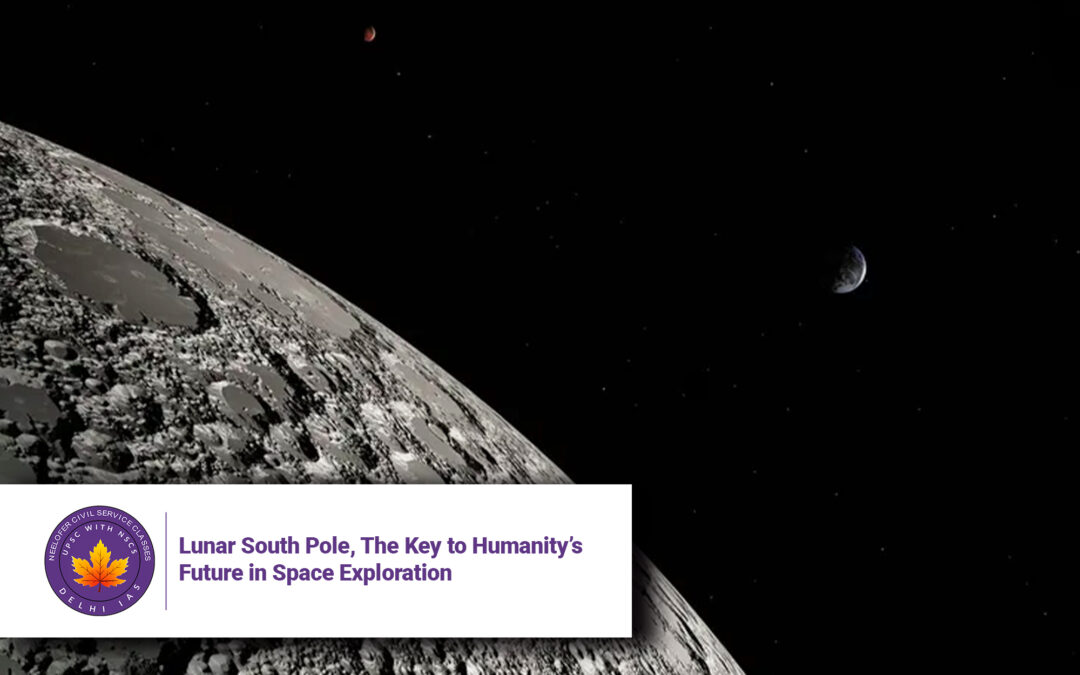
Lunar South Pole, The Key to Humanity’s Future in Space Exploration
Why in News?
NASA’s Artemis Program is targeting the lunar south pole as a primary site for human exploration in the coming years. The region is considered rich in water ice, which could provide vital resources for long-term lunar missions. This area’s potential for sustainable space exploration could pave the way for future missions to Mars and beyond. 
Introduction
The lunar south pole is emerging as one of the most exciting frontiers in space exploration. Unlike the moon’s equator, where temperature extremes and limited sunlight present challenges, the lunar south pole remains a stable and promising region for establishing a long-term presence on the Moon. The recent discovery of water ice in the area is further fueling interest.
Key Issues and Background
Why the Lunar South Pole?
-
The lunar south pole has been targeted for its water ice reserves, which could be used for drinking water, oxygen, and rocket fuel.
-
The Sun’s rays barely reach the region, allowing areas in permanent shadow to maintain temperatures as low as -250°F (-157°C), preserving water ice over millennia.
-
The lack of water on the moon has long been a challenge for long-duration lunar missions, making the discovery of ice at the south pole a game-changer.
NASA’s Artemis Program
-
The Artemis Program aims to land astronauts on the lunar south pole by 2025, making this the first manned mission to the region.
-
The program is part of a broader effort to establish a sustainable presence on the Moon and use it as a stepping stone for Mars exploration.
Scientific and Economic Potential
-
Water ice found on the Moon could be broken down into hydrogen and oxygen, essential for both life support and rocket fuel, reducing the need to transport resources from Earth.
-
The lunar regolith (soil) also contains materials that could be used for building habitats, such as regolith bricks.
The Core of the Concern
-
Sustainability Challenges: The main concern is whether technological advancements can keep pace with the requirements for sustained human presence on the Moon. Extracting and processing resources efficiently will be a critical challenge.
-
International Cooperation vs Competition: As various space agencies (NASA, ESA, Roscosmos, and private players) prepare for the lunar race, there may be tensions over territorial claims and resource rights.
Key Observations
-
NASA and other space agencies see the lunar south pole as a testbed for Mars missions. If resources can be extracted and used sustainably on the Moon, they can be replicated on Mars.
-
Robotic missions are currently exploring the region to map water ice locations and analyze surface conditions, laying the groundwork for future human missions.
Conclusion
The lunar south pole could become the launchpad for humanity’s future in space. With its abundant water ice and potential for resource extraction, this region offers exciting possibilities for sustaining long-term lunar exploration. The success of the Artemis Program could not only revolutionize lunar exploration but also propel humanity closer to settling on other planets, with Mars being the ultimate goal.
Q&A Section
Q1. Why is the lunar south pole considered a crucial area for space exploration?
Ans: The lunar south pole has water ice, which could be used for drinking water, oxygen, and fuel, making it essential for sustained human exploration on the Moon.
Q2. What is NASA’s Artemis Program?
Ans: NASA’s Artemis Program aims to land astronauts on the lunar south pole by 2025 and establish a sustainable presence on the Moon to pave the way for future Mars missions.
Q3. What resources can be extracted from the lunar south pole?
Ans: The lunar south pole contains water ice, which can be converted into hydrogen and oxygen for fuel and life support, and lunar regolith, which can be used to make habitat-building materials.
Q4. What challenges do scientists face in exploiting the lunar south pole’s resources?
Ans: Major challenges include technology development to extract resources efficiently, ensuring sustainability, and overcoming the harsh environmental conditions of the Moon.
Q5. How does the lunar south pole relate to future Mars missions?
Ans: The technology and experience gained from establishing a sustainable presence on the Moon could be applied to future Mars missions, where resources will also need to be extracted and used for long-term habitation.
