
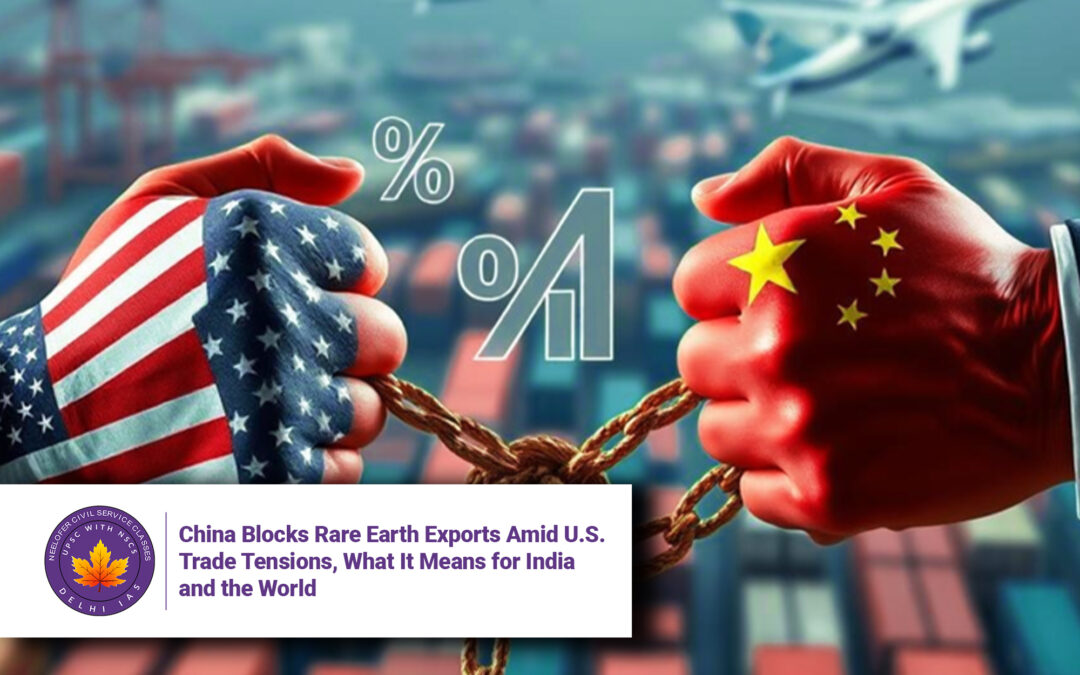
China Blocks Rare Earth Exports Amid U.S. Trade Tensions, What It Means for India and the World
Why in News?
Amid rising tensions in the U.S.-China trade war, China has blocked the export of rare earth elements (REEs) and related magnets that are vital for various manufacturing sectors including defense, electronics, and clean energy. This move has significant global implications, particularly for countries that depend heavily on Chinese REE exports — including India. 
Introduction
Rare earth elements (REEs) are a group of 17 metals crucial for modern industries. From smartphones and electric vehicles to fighter jets, REEs are vital. Despite their name, they’re not scarce in nature but are difficult to mine in usable quantities. China dominates the global REE supply chain, and its latest export restrictions have triggered concerns worldwide.
Key Issues and Background
1. What are Rare Earth Elements?
-
REEs include elements like neodymium, dysprosium, terbium, and others.
-
These are essential for manufacturing semiconductors, LEDs, EV motors, missiles, and more.
-
Dysprosium is especially used in making permanent magnets for high-tech defense and energy applications.
2. China’s Export Restrictions
-
China’s Ministry of Commerce has halted the export of REE-related products, citing national interest and strategic reasons.
-
The move is seen as a response to U.S. trade measures, especially those targeting Chinese technology.
3. Global Impact of the Ban
-
Countries like India, Japan, the U.S., Australia, and EU nations will be severely affected.
-
The restrictions could choke supply chains for critical technologies, causing price hikes and shortages in global markets.
-
The world is now forced to search for alternative suppliers or accelerate domestic exploration.
The Core of the Concern
India’s Vulnerability
-
India imports a limited amount of REEs but lacks sufficient refining and production capability.
-
According to a Lok Sabha reply, India imported over 2,270 tonnes of REEs in 2023–24 alone.
-
India’s only REE producer is IREL (India) Ltd, which is not enough to meet rising domestic demand.
Government Response and Policy Measures
1. Critical Mineral Strategy
-
India has launched the National Mineral Policy (NMP) and Critical Minerals Strategy to reduce dependency.
-
The government aims to diversify sources and has begun auctioning new mineral exploration blocks.
2. National Mineral Exploration Trust (NMET)
-
Under NMET, over 1,200 mineral blocks are being explored.
-
Private entities have been granted exploration licenses to speed up rare earth production.
Conclusion
China’s decision to restrict REE exports highlights its strategic control over the global tech supply chain. For countries like India, this is both a challenge and an opportunity to ramp up local production, diversify imports, and reduce dependency. The urgency to build self-reliance in REEs has never been more evident.
Q&A Section
Q1. Why did China restrict the export of rare earth elements?
Ans: China imposed the ban amid rising U.S.-China trade tensions, using its dominance in REEs as leverage to counter foreign restrictions and assert strategic control.
Q2. What are rare earth elements used for?
Ans: REEs are used in high-tech manufacturing, including smartphones, EVs, military equipment, semiconductors, magnets, and wind turbines.
Q3. How does this export ban affect India?
Ans: India imports a significant portion of its REEs from China. The ban could disrupt industries, cause price hikes, and delay technological projects.
Q4. What steps is the Indian government taking in response?
Ans: India is expanding exploration through the National Mineral Exploration Trust, issuing licenses to private firms, and promoting domestic extraction of critical minerals.
Q5. What is the long-term global impact of China’s REE restrictions?
Ans: The move could trigger global diversification of REE sources, accelerate investment in local mining, and reshape the geopolitical control over tech supply chains.
