
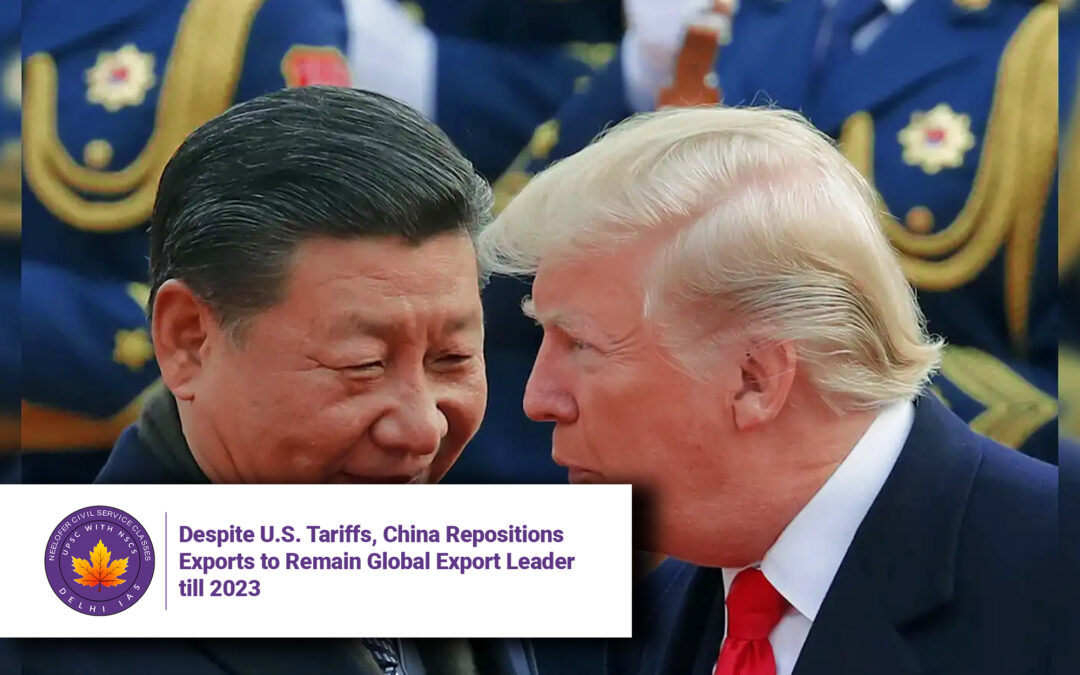
Despite U.S. Tariffs, China Repositions Exports to Remain Global Export Leader till 2023
Why in News?
A detailed data analysis shows that despite aggressive tariff actions by the U.S., China managed to remain the world’s top exporter until the end of 2023. China restructured and rerouted its exports effectively to mitigate the impact of rising U.S. tariffs under both the Trump and Biden administrations. 
Introduction
The trade war that began in 2018 between the U.S. and China saw tariffs imposed on hundreds of billions of dollars’ worth of goods. These tariffs were intended to reduce China’s trade advantage. However, China adapted by shifting its export focus away from the U.S. to other countries, thus maintaining its lead in global trade.
Key Issues and Background
Escalation of Tariffs
-
Tariffs by the U.S. increased drastically starting in January 2018.
-
By 2023, nearly 93% of Chinese exports to the U.S. were under tariffs, while U.S. exports to China under tariffs stood much lower.
-
The trade war witnessed multiple rounds of escalation during the Trump era, with President Biden continuing some of the policies.
China’s Export Adaptation
-
China’s export share to the U.S. dropped significantly, from 9.7% to 8.1% between 2014-2018 and 2019-2023.
-
However, exports to non-U.S. countries increased, compensating for the drop. This helped China maintain its global dominance in exports.
-
Export destinations such as Vietnam and Germany gained share from rerouted Chinese goods.
The Core of the Concern
Impact on Specific Sectors
-
Items like wood, leather, rubber, and organic chemicals saw a decline in exports to the U.S.
-
Meanwhile, China increased its global export share in these very items, despite the drop in U.S.-specific exports.
Data-Driven Insights
-
Chart data confirms that China’s share in global exports rose in many sectors, even as its U.S. market share declined.
-
Exporters adapted by diverting trade flows and relying more on Asian and European markets.
Key Observations
-
China’s resilience in international trade is driven by flexible supply chains and strategic redirection.
-
U.S. tariffs failed to significantly reduce China’s role in global trade, though they did alter bilateral trade patterns.
-
The U.S. share of Chinese exports declined, but China still grew its global trade footprint.
Conclusion
While U.S. tariffs created hurdles for Chinese goods entering American markets, China’s export engine proved robust, with rerouted goods sustaining overall growth. This underlines the adaptability of Chinese trade strategies and highlights a broader trend of shifting global trade networks in response to protectionist policies.
Q&A Section
Q1. What was the impact of U.S. tariffs on Chinese exports to the U.S.?
Ans: Chinese exports to the U.S. reduced from 9.7% to 8.1% between 2014–2018 and 2019–2023 due to tariffs, but China compensated by increasing exports to other countries.
Q2. How did China maintain its top exporter position despite tariffs?
Ans: China rerouted its exports to non-U.S. countries, where demand remained strong, especially in Vietnam, Germany, and South Korea.
Q3. Which Chinese export items were hit hardest in the U.S. market?
Ans: Items like wood, leather, plastic, rubber, and organic chemicals saw notable declines in U.S. imports from China.
Q4. Did China increase its global export share in any sectors?
Ans: Yes, China’s share in global exports increased in many sectors even as exports to the U.S. declined, especially in precious stones and rubber.
Q5. What does this trade shift indicate for global markets?
Ans: It highlights China’s strategic adaptability and signals that global trade flows can shift rapidly to counteract protectionist measures.
