
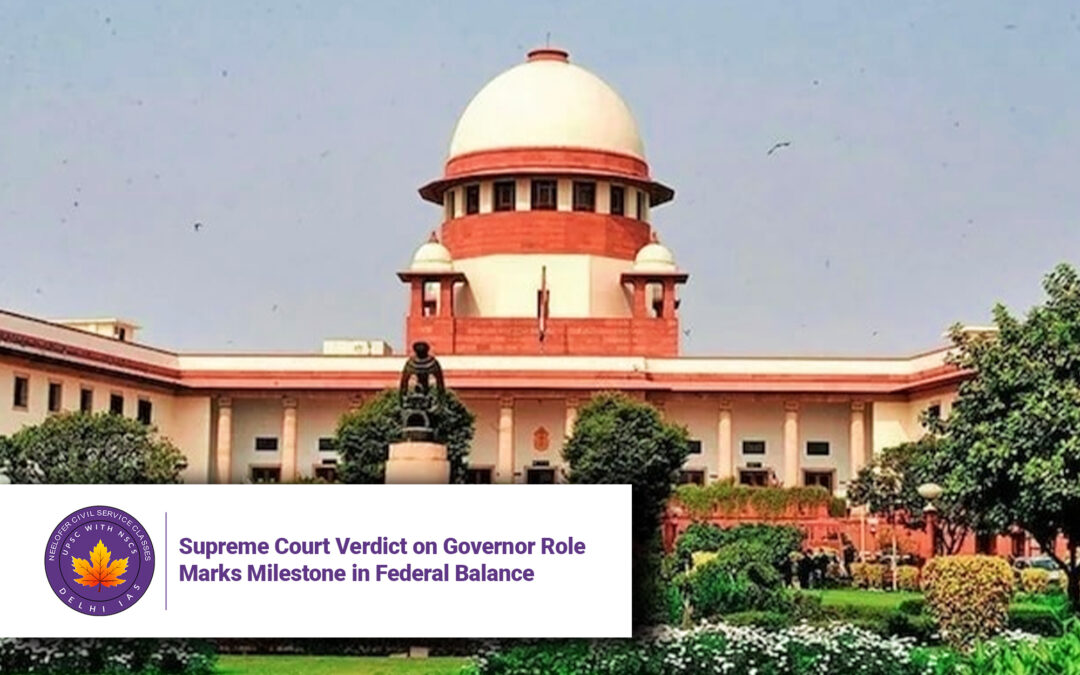
Supreme Court Verdict on Governor Role Marks Milestone in Federal Balance
Why in News?
On April 8, 2025, the Supreme Court of India delivered a historic verdict in a case involving the Tamil Nadu Government and its Governor, resolving a long-standing dispute over delayed assent to Bills passed by the State Legislative Assembly. 
Introduction
The judgment is being hailed as a landmark for cooperative federalism, reaffirming the supremacy of elected State Legislatures and limiting the Governor’s discretionary powers. The verdict not only impacts Tamil Nadu but sets a precedent for other States facing similar issues.
Key Issues and Background
The Dispute
For several years, the Tamil Nadu Governor had withheld or delayed assent to multiple Bills passed by the Legislative Assembly, refusing to return them for reconsideration. Effectively, this allowed the Governor to “pocket veto” these Bills, stalling legislative progress.
Supreme Court’s Findings
-
The court ruled that the Governor had no authority to delay or indefinitely withhold assent to Bills.
-
It emphasized that the Governor must act within a reasonable time, and perform a “constitutional duty” rather than acting as a parallel power center.
-
The court used its power to “complete justice” under Article 142 to direct the immediate enactment of the Bills.
The Core of the Concern
Constitutional Design Flaws
-
India’s Constitution borrowed the colonial-era design, including the British system of Governor-General’s veto, which lacked democratic accountability.
-
The Governor, though meant to act on the aid and advice of the Council of Ministers, has occasionally acted independently, especially in States ruled by opposition parties.
Need for Structural Correction
-
The framers of the Constitution did not anticipate frequent tensions between Governors and elected State governments.
-
The SC judgment is seen as a course correction to align with the spirit of federal democracy and rectify ambiguous constitutional silences that enabled misuse.
Key Observations
Court’s Landmark Role
-
The court prescribed timelines for Governors to act on Bills — something not explicitly detailed in the Constitution.
-
Critics argue this was judicial overreach, but the court defended it as essential to preserve the principle of responsible governance.
Impact Beyond Tamil Nadu
-
The ruling sets a binding precedent for Governors in other States.
-
It ensures that the will of the elected Assembly is not subverted through indefinite delays by unelected officials.
Conclusion
The Supreme Court’s judgment stands as a strong message in favor of democratic accountability, setting new boundaries for gubernatorial conduct. While critics caution against excessive judicial activism, the verdict is seen as necessary to strengthen India’s federal fabric and safeguard legislative autonomy of States.
Q&A Section
Q1. What was the issue between the Tamil Nadu Government and the Governor?
Ans: The Governor delayed or withheld assent to several Bills passed by the Tamil Nadu Legislative Assembly, refusing to return them, effectively stalling legislation.
Q2. What did the Supreme Court rule in this case?
Ans: The Court ruled that the Governor has no authority to withhold or delay assent indefinitely and directed the immediate enactment of the Bills using its powers under Article 142.
Q3. Why is this verdict significant for federalism in India?
Ans: It upholds the authority of elected State governments and restricts arbitrary use of power by Governors, reinforcing the balance in Centre-State relations.
Q4. How does the court address the issue of constitutional silence?
Ans: The court filled the constitutional gap by prescribing reasonable timelines for Governors to act, ensuring smoother legislative functioning.
Q5. What are the broader implications of this judgment?
Ans: It sets a precedent for other States, potentially reducing political conflicts and ensuring Governors act within democratic norms.
