
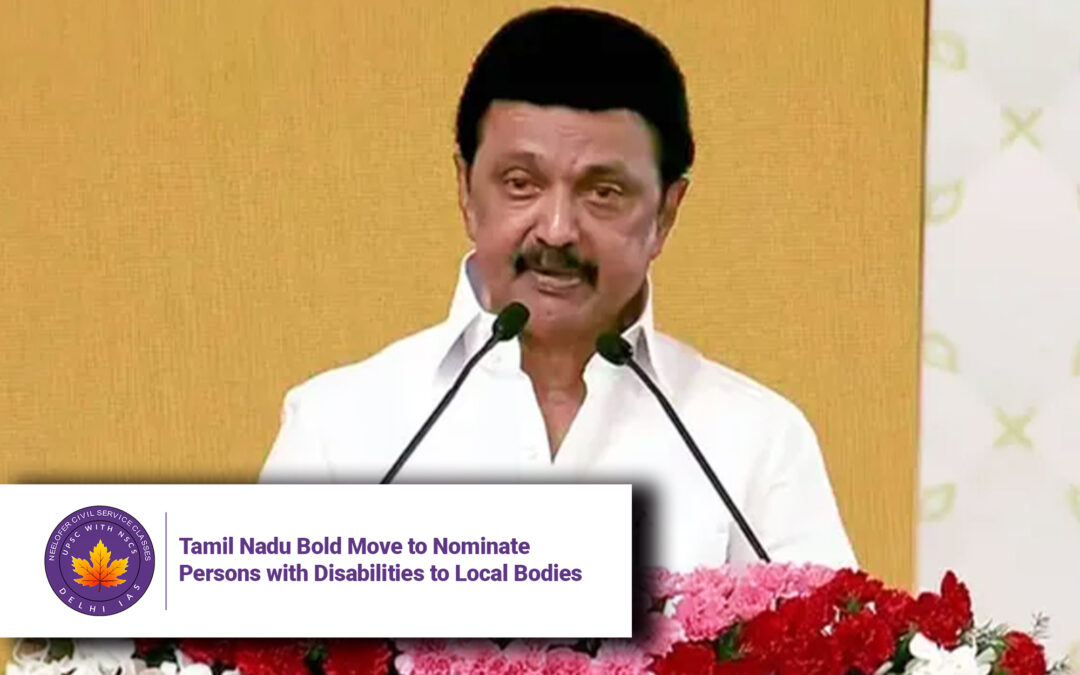
Tamil Nadu Bold Move to Nominate Persons with Disabilities to Local Bodies
Why in News?
Tamil Nadu Chief Minister M.K. Stalin has introduced two Bills in the Assembly aimed at increasing representation of persons with disabilities (PwDs) in all levels of local governance. The move is being hailed as a pioneering step in inclusive governance and a strong example of affirmative action in practice. 
Introduction
Affirmative action continues to be a powerful tool in addressing historical injustices and systemic deprivation. Tamil Nadu’s latest step focuses on empowering persons with disabilities, helping them overcome exclusion by guaranteeing seats in local bodies such as town panchayats, municipal councils, and village panchayats.
Key Features
-
Two Bills Introduced:
-
One Bill amends the Tamil Nadu Urban Local Bodies Act to nominate PwDs to urban bodies (town panchayats, municipal councils, corporations).
-
The second amends the Tamil Nadu Panchayats Act to nominate PwDs to rural bodies (village panchayats, panchayat unions, district panchayats).
-
-
Guaranteed Posts:
-
650 posts in urban local bodies
-
12,913 in village panchayats
-
388 in panchayat unions
-
37 in district panchayats
-
-
Currently, there are only 35 PwDs in urban local bodies in the state.
Specific Impacts or Effects
-
Empowerment & Representation: This move will allow PwDs to participate in decision-making at the grassroots level, promoting dignity, equality, and visibility.
-
Breaking Stigma: Institutional presence of PwDs in governance can erode stereotypes and combat systemic discrimination.
-
Leadership Development: It will bring PwDs not just into the mainstream, but help them emerge as leaders who shape society.
Challenges and the Way Forward
-
Avoiding Proxy Representation: Lessons from women’s reservation in panchayats—where husbands often acted as decision-makers—show the need for ensuring genuine participation by PwDs.
-
Monitoring Implementation: Effective enforcement and tracking mechanisms must be developed to ensure intended benefits reach the actual beneficiaries.
-
Creating Accessible Infrastructure: Physical and digital accessibility in local bodies will be key for enabling full participation by PwDs.
Conclusion
Tamil Nadu’s initiative marks a historic leap in ensuring that inclusivity in governance is not just on paper but practiced on the ground. With proper implementation and safeguards, this reform has the potential to transform not just the lives of persons with disabilities but also India’s democratic fabric.
Q&A Section
Q1. What recent initiative has Tamil Nadu taken for persons with disabilities?
Ans: Tamil Nadu introduced two Bills to nominate persons with disabilities to urban and rural local bodies, ensuring their representation in governance.
Q2. How many guaranteed posts for PwDs are proposed in the Bills?
Ans: The Bills propose 650 posts in urban bodies, 12,913 in village panchayats, 388 in panchayat unions, and 37 in district panchayats.
Q3. What is the main goal of this move?
Ans: The aim is to empower persons with disabilities by including them in decision-making, ensuring dignity, and breaking systemic discrimination.
Q4. What constitutional provisions support this move?
Ans: The initiative aligns with the 73rd and 74th Constitutional Amendments, which mandate reservation in local bodies to ensure inclusive representation.
Q5. What challenge was observed during women’s reservation that Tamil Nadu must avoid now?
Ans: In many cases, women leaders were replaced in practice by their husbands; similar proxy representation must be prevented for PwDs to ensure real empowerment.
