
Can V2G Technology Power India’s Energy Future?
Exploring the promise and challenges of Vehicle-to-Grid integration in India
Why in News? 
The Kerala State Electricity Board (KSEB) and the Indian Institute of Technology Bombay (IIT Bombay) have launched a pilot project to explore the feasibility of implementing Vehicle-to-Grid (V2G) technology in Kerala. This collaboration aims to integrate Electric Vehicles (EVs) with the power grid to manage electricity demand and improve grid stability.
Introduction
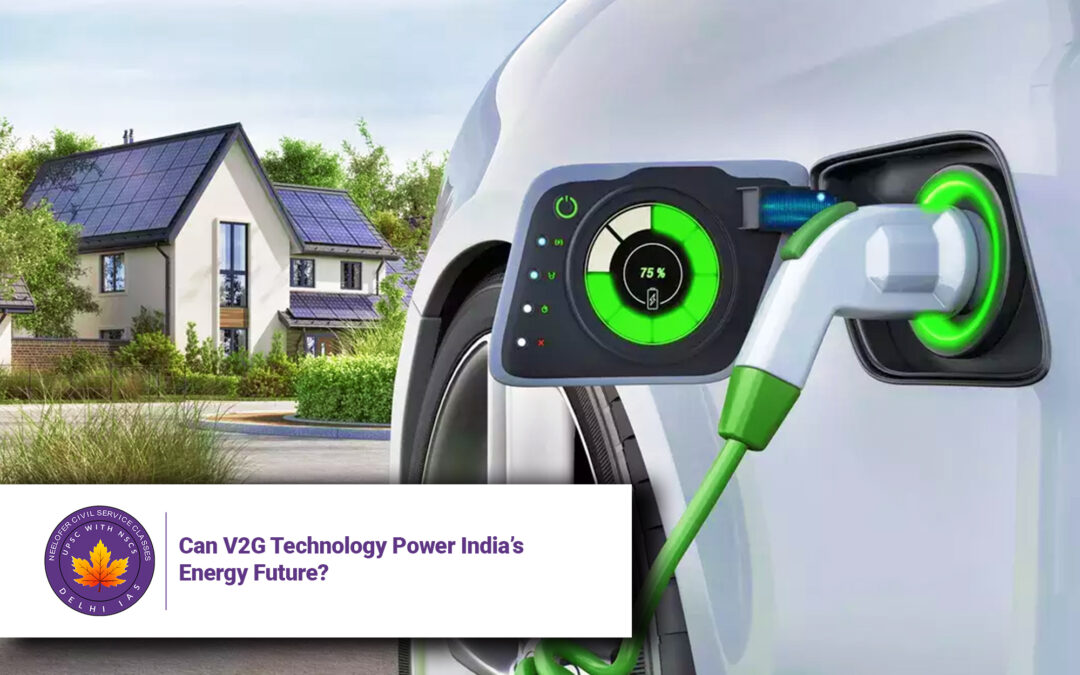
As India sees a rapid rise in EV adoption, concerns have emerged over peak electricity demand, especially during evening hours. V2G offers a unique opportunity to turn EVs into a solution — by enabling their batteries to supply electricity back to the grid when needed, acting as decentralized storage units.
Key Issues
1. What is V2G Technology?
V2G (Vehicle-to-Grid) refers to technologies that enable EVs to send electricity from their batteries back to the power grid. When EVs are idle and connected to a bi-directional charger, they can serve as energy storage devices and help balance the electricity supply and demand. Variants include:
-
G2V (Grid to Vehicle) – power flows from the grid to charge EVs.
-
V2H (Vehicle to Home) – powering homes using EVs.
-
V2V (Vehicle to Vehicle) – energy sharing between EVs.
-
V2G (Vehicle to Grid) – most popular and promising use case.
2. Global Applications of V2G
V2G has gained traction in developed markets like the U.S., U.K., and the Netherlands, where EV owners are compensated for sending energy back to the grid. In California, EVs participate in ancillary services markets to stabilize the grid. These countries have robust regulatory frameworks and incentives encouraging V2G adoption.
3. Challenges in India
India’s power market structure is not yet fully ready for decentralized solutions like V2G:
-
Regulatory and market mechanisms are still evolving.
-
Electricity markets differ from Western models.
-
Lack of incentives and infrastructure for bi-directional charging.
-
Variability in renewable energy makes grid balancing complex.
4. Government and DISCOM Initiatives
Some Distribution Companies (DISCOMs) have launched pilot projects for smart charging and V2G integration. The Central Electricity Authority (CEA) has set up a committee to frame guidelines for reverse charging — transferring power from EV batteries to the grid. But for wide V2G adoption, supportive regulations and market reforms are necessary.
Alternative Approaches
India can focus on smart charging, rooftop solar integration, and better grid planning to manage peak demand, while gradually building infrastructure and incentives for V2G technologies.
Challenges and the Way Forward
-
India must invest in bi-directional charging infrastructure.
-
Policy clarity and financial incentives are essential to encourage EV owners.
-
Coordination between state governments, DISCOMs, and research institutes is needed.
-
Awareness campaigns can help consumers understand the benefits of V2G.
Conclusion
V2G technology holds immense promise to transform EVs into mobile energy assets. While India’s V2G ecosystem is still in its nascent stage, the KSEB-IIT Bombay pilot could serve as a model for future energy solutions. With the right policies and infrastructure, V2G can play a crucial role in India’s energy transition and renewable energy goals.
Q&A Section
Q1: What is the main purpose of the KSEB-IIT Bombay pilot project?
A: To assess the feasibility of integrating EVs into Kerala’s power grid using V2G technology, especially to manage electricity demand during non-solar hours.
Q2: What is the difference between G2V and V2G?
A: G2V refers to charging EVs from the grid, while V2G allows EVs to send stored electricity back to the grid, making them a two-way power source.
Q3: Why is V2G integration challenging in India?
A: India lacks mature electricity markets, has mismatches between renewable energy supply and demand, and limited infrastructure for bi-directional charging.
Q4: How have other countries adopted V2G?
A: In countries like the U.K., U.S., and the Netherlands, EV owners are compensated for supplying energy to the grid during peak times, supported by strong market mechanisms.
Q5: What steps are needed to mainstream V2G in India?
A: Regulatory reforms, pilot projects, bi-directional charging setups, financial incentives, and consumer education are key to mainstreaming V2G technology.
