
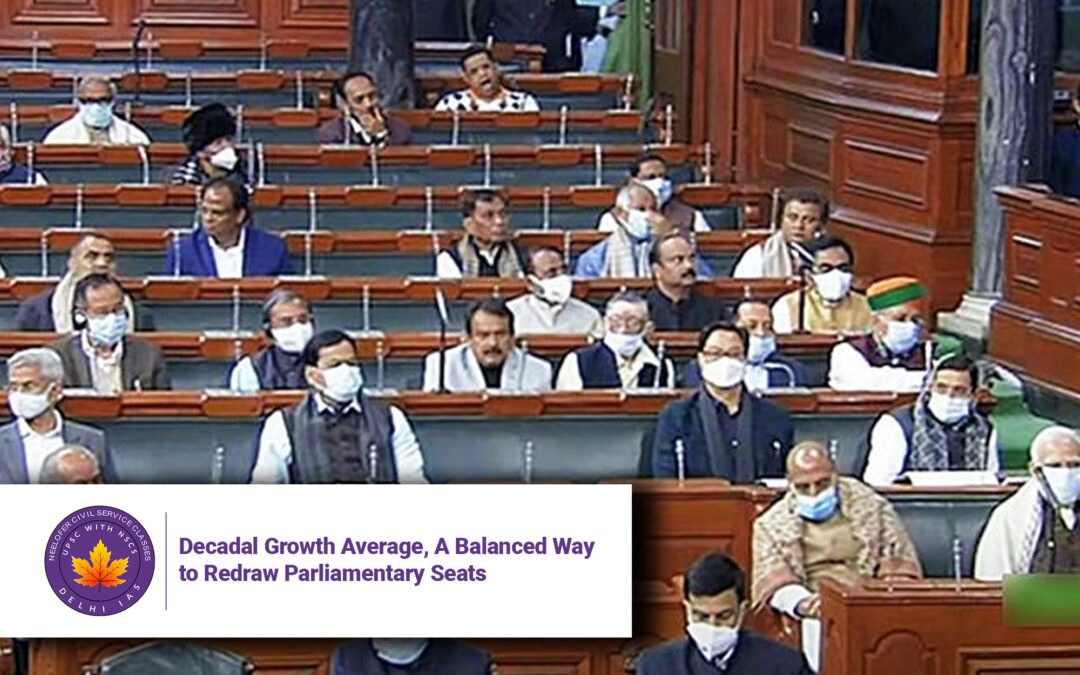
Decadal Growth Average, A Balanced Way to Redraw Parliamentary Seats
Why in News?
With the upcoming delimitation exercise (redrawing of Lok Sabha seats), the debate has intensified between the northern and southern States of India. The southern States are demanding a fair approach that doesn’t punish them for controlling population growth. The proposed Decadal Growth Average (DGA) formula offers a balanced and federal solution. ![8th April 2025] The Hindu Op-ed: A case for a fair seat allocation - Civilsdaily](https://d18x2uyjeekruj.cloudfront.net/wp-content/uploads/2025/04/del.jpg)
Introduction
India’s Joint Action Committee, formed by southern States, wants the next delimitation to consider more than just population growth. These States—like Tamil Nadu, Kerala, Andhra Pradesh, and Telangana—have succeeded in population control and fear being penalized with fewer seats in the Lok Sabha compared to northern States where population has risen rapidly.
Key Issues and Institutional Concerns
1. The Risk with Pure Population Formula
-
As per Article 81(2)(a), the Lok Sabha seat allocation is based on population.
-
If only population is used as the criterion, States like Uttar Pradesh, Bihar, and Madhya Pradesh will gain more seats.
-
Southern States would lose representation despite better governance and lower fertility rates.
2. Political and Federal Imbalance
-
Seat increases: Uttar Pradesh (+20), Madhya Pradesh (+5), Rajasthan (+4).
-
Minimal increase: Tamil Nadu (+1), Andhra Pradesh (+1), Karnataka (+2).
-
Southern States fear reduced voice in national decisions.
3. The DGA Formula: A Middle Path
-
DGA is based on average population growth from 1971 to 2021.
-
This distributes the impact of population growth fairly and avoids penalizing States with controlled growth.
-
Helps maintain political balance while encouraging development.
Benefits of the DGA Formula
-
Encourages federal values by giving equal weight to all States.
-
Maintains the representation balance between fast-growing and slower-growing regions.
-
Prevents disputes and protests by offering a non-biased approach.
-
Helps ensure the principle of one person, one vote is not misused.
Conclusion
The Decadal Growth Average (DGA) formula is a forward-looking method for the upcoming delimitation. It offers a compromise between fairness and federalism, supporting both population-based representation and rewarding responsible governance. By using DGA, India can redraw its parliamentary map without undermining unity or regional balance.
Q&A Section
Q1. What is the purpose of delimitation?
Delimitation is the process of redrawing the boundaries and number of Lok Sabha seats to reflect population changes and ensure fair representation.
Q2. Why are southern States concerned about delimitation?
They have controlled population growth and fear losing seats compared to northern States, where populations have increased.
Q3. What is the DGA formula?
The Decadal Growth Average (DGA) calculates the average population growth from 1971 to 2021 and distributes seats based on this growth to ensure fairness.
Q4. How will DGA impact seat distribution?
Under DGA, Uttar Pradesh will still gain seats, but southern States like Tamil Nadu and Andhra Pradesh will also see modest increases, maintaining balance.
Q5. Why is this important for Indian federalism?
Using DGA respects the efforts of States that managed population growth and prevents regional inequality in political representation.
