
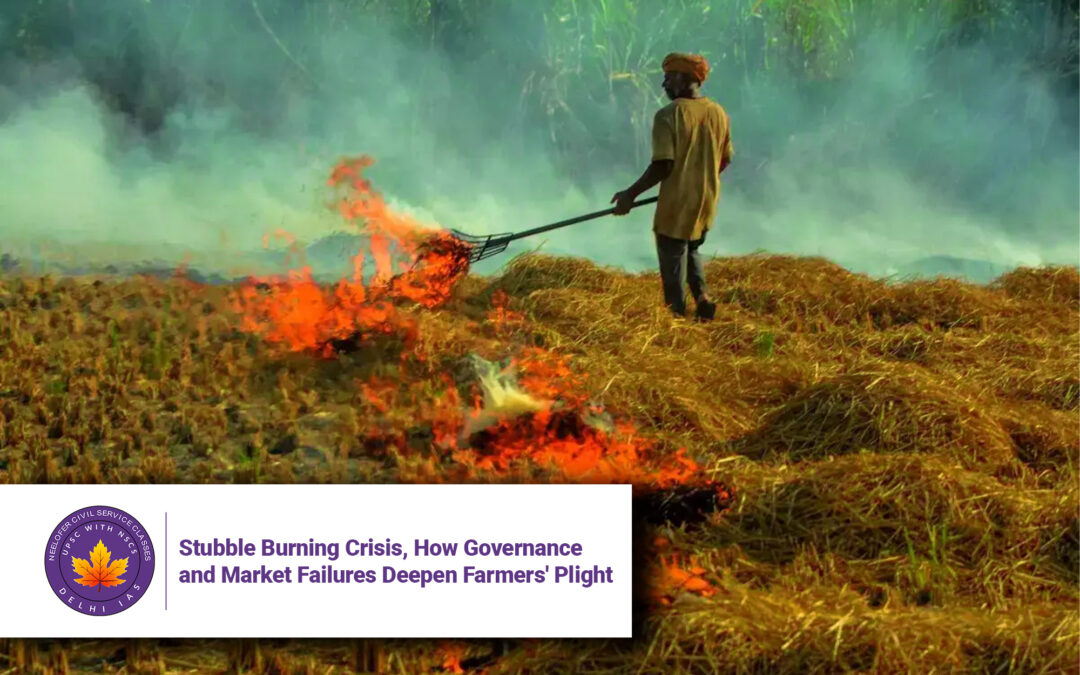
Stubble Burning Crisis, How Governance and Market Failures Deepen Farmers’ Plight
Why in News?
A recent study by Sujit Raghunathrao Jagdale and Javed M. Shaikh from the Indian Institute of Management, Amritsar, has analyzed the persistent problem of stubble burning through the lens of “governmentality” and market failure. The study sheds light on how current policy frameworks and socio-economic neglect are making the problem worse. 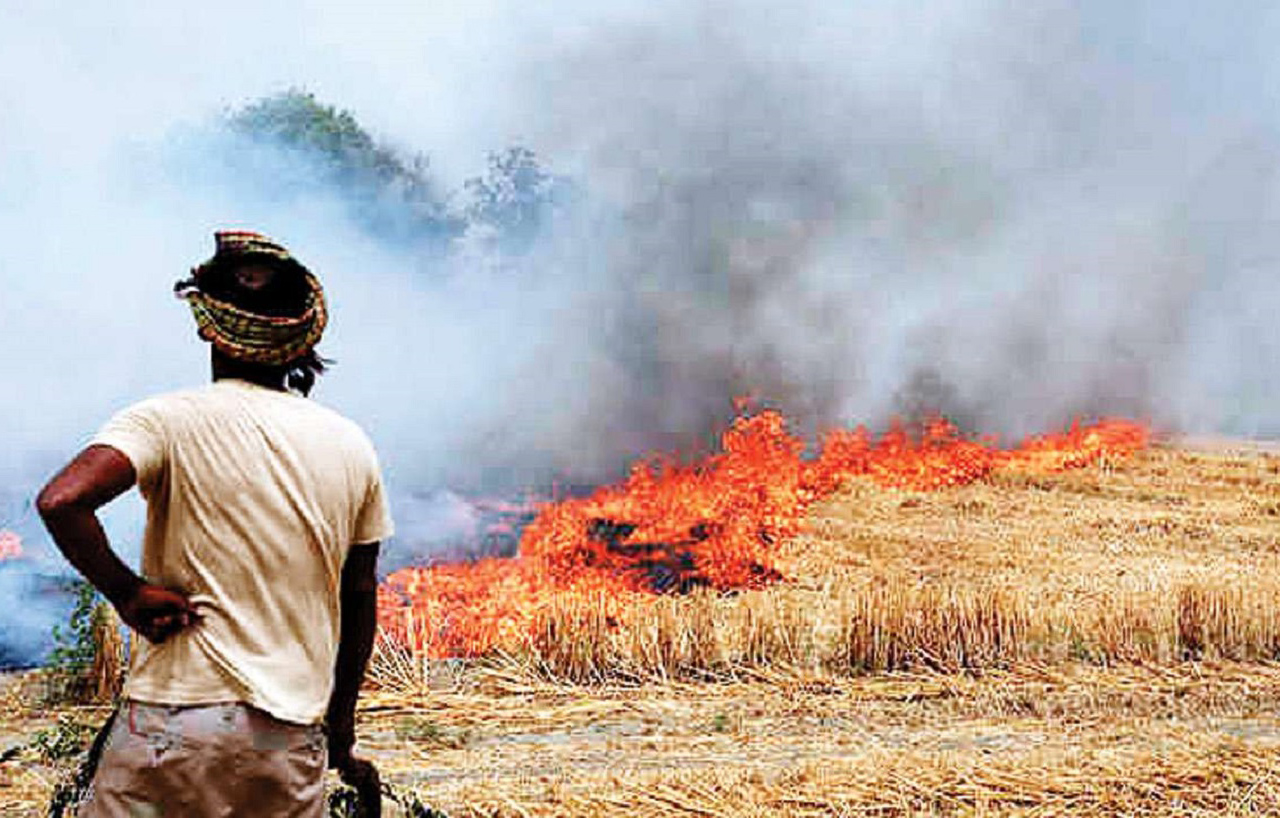
Introduction
Every winter, northern India is choked with air pollution, and a major contributor is stubble burning—the practice of setting fire to paddy crop residues. Despite government bans and awareness campaigns, the problem persists, particularly in Punjab, Haryana, and parts of Uttar Pradesh. This study brings a fresh perspective to the crisis by examining governance practices and the failures of market mechanisms.
Key Issues and Institutional Concerns
1. Alarming Pollution Levels
A 2023 study by IIT Kanpur, IIT Delhi, TERI, and Airshed found that stubble burning from mid-October to end-November contributes around 22% to the worsening of Delhi’s air quality, with peak contributions reaching 33%.
2. Governmentality and Market Failure
The term “governmentality,” introduced by French philosopher Michel Foucault, refers to governance strategies focused on control rather than support. Current policy interventions on stubble burning reflect this, with punitive approaches like fines and criminalisation rather than offering support to farmers.
3. Farmer Marginalisation
The researchers interviewed 85 farmers across three districts—Amritsar, Gurdaspur, and Tarn Taran—highlighting how policies ignore ground realities. Farmers face socio-economic pressure, lack of viable alternatives, and poor access to markets for crop residue-based products.
4. Technology Gaps
Current technological interventions—like Happy Seeders and bio-decomposers—are costly or ineffective at scale. Farmers are not incentivized enough to adopt them, especially when the economic returns are poor.
Challenges and the Way Forward
-
Lack of Economic Incentives: Farmers bear high costs of residue management but receive minimal financial or market-based support.
-
Insufficient Market Development: Products made from stubble (like fodder, biofuels, or packaging material) are not adequately supported by policy or industry.
-
Need for Socially Inclusive Solutions: The study calls for inclusive decision-making involving farmers from different caste and economic backgrounds.
-
Shifting from Punitive to Supportive Policies: Instead of penalizing farmers, the government must reward sustainable practices, support decentralized decision-making, and build resilient markets.
-
Diversification of Agriculture: A long-term solution involves shifting from paddy to less water-intensive and residue-free crops.
Conclusion
The persistent problem of stubble burning is not merely a result of farmer negligence—it reflects deeper structural issues involving governance and market systems. For a sustainable solution, policymakers must address the root causes, empower farmers, and shift from a control-oriented model to one of collaboration and support. Without this, the cycle of pollution and blame will continue each winter.
Q&A Section
Q1. What is stubble burning, and why is it a problem?
Stubble burning is the practice of setting fire to leftover crop residue after harvest. It contributes significantly to air pollution in northern India during the winter season.
Q2. What is ‘governmentality’ in the context of this issue?
‘Governmentality’ refers to state-led governance tactics that focus on controlling farmers rather than helping them. This includes fines and bans without offering practical solutions or support.
Q3. Why are current solutions like Happy Seeders not working?
These technologies are expensive and not scalable. Many farmers cannot afford them and don’t see enough return on investment.
Q4. What alternatives do researchers suggest?
They recommend developing markets for stubble-based products, offering better incentives, promoting inclusive decision-making, and investing in alternative cropping patterns.
Q5. How does market failure play a role in this crisis?
There is no strong market for products made from crop residue. Without buyers, farmers have no economic reason to manage stubble sustainably, so they resort to burning.
